Music


Plus One
The 11 best Wu-Tang Clan songs
Ahead of their farewell tour, Wu-Tang Forever: The Final Chamber, we rank the 11 best songs by the legacy hip hop collective
I am a multitudinous woman with an eclectic music taste, so please grant me the room to make oddball connections and metaphors as I take on the gargantuan task of distilling Wu-Tang Clan’s history-making discography into their 11 best songs. I’ve been listening to the Staten Island hip hop supergroup since I was in primary school – and dare I say that my love for them as a group and individually is rivalled only by my love for Destiny’s Child. Each with their own unique flow, talent and cadence; RZA, GZA, Ghostface Killah, Raekwon, Method Man, U-God, Inspectah Deck, Masta Killa and Ol’ Dirty Bastard came together in 1992 to create a hip hop collective that would blend “Eastern philosophy…from kung fu movies, watered-down Nation of Islam preaching…and comic books.” (The Wu-Tang Manual, 2004) While there are some Nation of Islam teachings across the Black diaspora that are major points of contention, at its core, it is a Pan-African organisation focused on community building, which is what Wu-Tang does with their music.
The cross between these influences, as well as the budding production and lyrical talent within the group, made way for music that was equally cerebral, and explorative of the inner city experiences of Black men in New York. Hip hop culture has always had fringe and punk roots, often going against the grain of what is expected and creating new ways for Black people – particularly working class Black people – to tell their stories and speak truth to power. And with its creation and subsequent regional factions, a lot of counterculture groups formed – Wu-Tang being one of them – to stake their claim and diversify the narratives within hip hop. It’s not just a genre that celebrates accruing massive amounts of wealth or for sampling soul and R&B records for mainstream consumption (Wu-Tang famously lost the Best Rap Album Grammy Award to Bad Boy’s No Way Out in 1998), but a genre that represents all the different aspects of community.

“Wu-Tang is for children” is famously what the late Ol’ Dirty Bastard said when he rushed the stage to protest No Way Out‘s win, a phrase that has since been adopted by the group as part of their ethos. I would argue that this is the essence of Wu-Tang Clan; the positive influence that came with showing how the Black male experience is not monolithic. Prominent member and rapper-producer RZA often takes pride in a myriad of mediums that inspired their work, from chess to Blaxploitation films to his parents to advice from Quincy Jones to Deniece Williams and more. “Knowledge, wisdom and understanding are the first jewels, or riches, that a man should strive for” (Rolling Stone, 2019). That lost verse about being “a sperm cell in a fallopian tube”, which he wrote under the moniker Prince Rakeem, finally got its chance to shine in a 2010 performance with Yoko Ono’s Plastic Ono Band. Not many rap collectives would make sense doing the same.
The collective has also added members along the way, including Cappadonna in 2007, DJ Mathematics in 2017 and Young Dirty Bastard, ODB’s son, who will occasionally perform ODB’s parts alongside the original members and has his own group called 2nd Generation Wu. For the children, indeed.
As a child who grew up loving Björk, reading comics and loving hip hop, Wu-Tang’s music was a safe place for me to land and explore. It was quirky but unashamed of itself, confident and experimental. Each member had something to say; each person’s history, social context and special interests had room to breathe. Each member was a superhero, and as you enter The Final Chamber 2026 farewell tour, you can be a superhero alongside them one last time. Here is our list of the 11 best Wu-Tang Clan songs, ranked.
11. ‘Clan In Da Front’

(Enter The Wu-Tang (36 Chambers), 1993)
On 9 November 1993, Wu-Tang Clan released their debut project, Enter The Wu-Tang, introducing the world to a cast of distinct voices and revolutionising the landscape of East Coast rap. This list could honestly be comprised of songs entirely from the tracklist of the album and it would still do the Staten Island natives justice, but since we have to choose (and choose very carefully!) then kicking this list off with ‘Clan In Da Front’ is a good place to start. Track three on the album, the soulful RZA-produced song samples ‘Ba-Lue Bolivar Ba-Lues-Are‘ by Thelonious Monk, ‘Honeybee’ by 70s funk group The New Birth, and dialogue from the 1983 kung-fu film Shaolin and Wu-Tang. Solely featuring a rap performance by GZA, ‘Clan In Da Front’ came together after GZA was tired of being the closer on every track. In an interview with music journalist Brian Coleman for his 2007 book Check The Technique, GZA described how no one wanted to rap after him and “with eight or nine people on a song, if you go last, you’re gonna get cut on the video or the mix show”. This was GZA’s chance to go first, and show his masterful lyricism, “The outcome is critical/ F*ckin with my style is sort of like a miracle on 34th Street, in the Square of Herald”.
10. ‘Shadowboxin’ (Feat. Method Man)’

(Liquid Swords, 1995)
Coming in at No.10 is another GZA special, ‘Shadowboxin”, which features fellow Wu-Tang member Method Man. From GZA’s sophomore record, Liquid Swords, the track samples dialogue from the 1983 kung-fu film Shaolin vs. Lama, in a scene that explains “the special technique of shadowboxing“, and Ann Peebles’ 1971 track ‘Trouble, Heartaches & Sadness’. When RZA was working on the production of Liquid Swords, he wanted to find samples and motifs that would represent’s GZA’s very calculated and marked lyrical style, and landed on the 1980 Japanese film, Shogun Assassin. The difference in kung-fu and samurai films is how the action is delivered – swift, fluid movement in the kung-fu films but “one-stroke kills” in samurai movies. (Vanity Fair, 2019) GZA’s rap performance on ‘Shadowboxin’, even with its more kung-fu-leaning roots, is a demonstration of his fatal blow lyricism, with Method Man rising to the occasion to match. While the track appears on GZA’s album, ‘Shadowboxin” has two Method Man verses and one GZA verse, with the former describing how the song marked a shift in his rapping style, going from “uptempo sh*t…’Release Yo’ Delf’, ‘Method Man’, ‘Bring The Pain’ to something less “frantic” and more measured. (Complex, 2011).
9. ‘Shimmy Shimmy Ya’
![Ol' Dirty Bastard - Shimmy Shimmy Ya (Official Video) [Explicit]](https://i.ytimg.com/vi/h2zgB93KANE/0.jpg)
(Return to the 36 Chambers: The Dirty Version, 1995)
When RZA first formed the early rap group Force of the Imperial Master in the late 80s, co-founding members included The Genius (now known as GZA) and The Specialist, AKA Ol’ Dirty Bastard. A rapper whose very much woven in the Wu-Tang DNA from day one, this list would be remiss without highlighting his contribution to hip hop. Known as one of the more outrageous and unpredictable members of the collective, his “legacy…is unmatched being that there is no father to his style” (The Source, 2017). ‘Shimmy Shimmy Ya’ is ODB at his best, capturing his playful and unfiltered lyricism – “ooh baby I like it raw” and “Lyrics get hard quick, cement to the ground / For any MC in any fifty-two states/ I get psycho killer, Norman Bates”. The song has since be sampled by a wide range of artists including A$AP Rocky, Aminé, Jason Derulo and even BTS member j-hope.
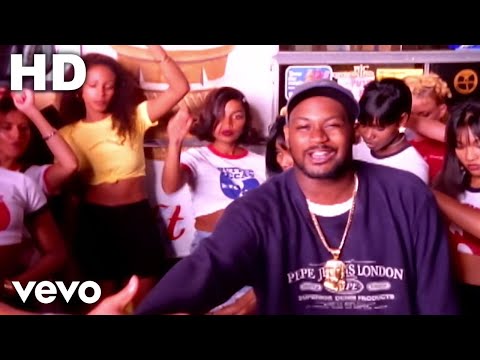
8. ‘Ice Cream (Feat. Ghostface Killah, Method Man & Cappadonna)’
(Only Built 4 Cuban Linx…, 1995)
Led by the one and only Raekwon, our eighth spot goes to ‘Ice Cream’ featuring fellow Wu-Tang members Ghostface Killah, Method Man and Cappadonna, and produced by RZA. From Raekwon’s debut album, Only Built 4 Cuban Linx…, ‘Ice Cream’ is somewhat dedicated to the ladies. (Being a Black woman and a rap fan can be hard to reconcile within oneself, as lyrics can lean quite misogynistic and often feel like one should silence their womanhood to happily partake in hip hop culture along with everyone else.) ‘Ice Cream’ can at first appear as a surface-level comparison, women of all races akin to ice cream of all flavours, but it was Raekwon’s way of making sure “women were incorporated in [the] concept” as “they played a huge part in hip hop culture” (VEVO Footnotes, 2023). It’s a softer Wu-Tang than what we’re used to, but still pairing flirtatious innuendoes with their class kung-fu-laced braggadocio. Plus, the inimitable Lauryn Hill sampled ‘Ice Cream’ on her song ‘I Used To Love Him (Feat. Mary J. Blige)’, and for that alone, it deserves a spot on our list.
7. ‘Wu-Tang Clan Ain’t Nuthing Ta F’ Wit’

(Enter The Wu-Tang (36 Chambers), 1993)
Produced by RZA and Method Man, ‘Wu Tang Clan Ain’t Nuthing Ta F’ Wit’ was inspired by the 1976 movie The Master of the Flying Guillotine. In a 2019 interview with Vanity Fair, RZA explained how “the flying guillotine became what I used as my choice of lyrical weapon”, which explains his sharp opening verse where he says “And the survey said, “You’re dead!”
Fatal Flying Guillotine chops off your f*ckin’ head!”. In a song where Wu-Tang is stating their importance and quite literally telling you that they “ain’t nuthin ta f*ck wit”, the choice of a weapon that trumps even the mightiest of swords as the representative of their lyrical prowess is a bold, measured and considered move that Wu-Tang would come to be known for. The track also features Inspectah Deck and Method Man, who also deliver hard-hitting rap performances. Compellingly, the main loop that serves as the bassline for the track is a sample from the ‘Theme From Underdog’, from the eponymous 1960s cartoon. Plus, the chorus references the album’s opening track ‘Bring Da Ruckus’, “if you want beef, then bring the ruckus”, conveying a cohesive and cinematic world-building throughout the project that draws from the group’s love of film.
6. ‘Hollow Bones’

(The W, 2000)
From their third album, The W, ‘Hollow Bones’ takes the sixth spot on this list, allowing Ghostface Killah, Inspectah Deck and Raekwon to take centre stage. Smooth and unassuming, its soulful swagger comes from sampling Syl Johnson’s ‘Is It Because I’m Black?’ (1969), “that splash against my hollow bones that rocks my soul”. The blues track serves as the perfect backdrop for Wu-Tang’s ‘Hollow Bones’, invoking the spirit of growing up in the segregated south and inner city neighbourhoods in Chicago from Johnson’s upbringing, and layering their own experiences growing up as working class young Black men in Staten Island. It’s slower tempo allows listeners to take in a more pensive Wu-Tang, slightly older and with more reflection on their lives as a few members found themselves embroiled in criminal activity and incarceration.
5. ‘Meth Vs. Chef’

(Tical , 1994)
The infamous (faux) battle between Method Man and Raekwon, ‘Meth Vs. Chef’ from Method Man’s debut album, Tical, kicks off the top five of this list. In an interview with Complex, Method Man described the genesis of this song as “friendly competition” between Raekwon and himself, “that’s what we would do… Rhyme – all f*cking night… We Just loved to do it”. The song even has a dedicated thread on the Wu-Tang subreddit, where die-hard fans have continued to debate the intricacies of both rappers’ verses and declare their own winners. However, although ‘Meth Vs. Chef’ began as a friendly match, it foreshadowed a long period of disagreements and arguments between the two rappers. “It’s crazy, way after ‘Meth Vs. Chef’, [Raekwon] became the one I argued with the most.” (Complex, 2011) For its ongoing lore and some of the rappers’ most poignant performances to date, ‘Meth Vs. Chef’ is our number five.
4. ‘Triumph’

(Wu-Tang Forever, 1997)
The first entry on this list from 1997’s Wu-Tang Forever, the fourth spot goes to its lead single ‘Triumph’. And triumph it is indeed, as the only song in the group’s discography that features performances from all the original members and Cappadonna (before he joined the Wu-Tang). ‘Triumph’ is a demonstration of their lyrical prowess, with no chorus but an introduction and interludes performed by ODB, while the rest of the members each have a verse. Inspectah Deck’s opening verse has been hailed in particular, “I bomb atomically, Socrates’ philosophies and hypotheses / Can’t define how I be dropping these mockeries /Lyrically perform armed robbery”. In a 2021 interview with Wax Poetics, GZA said “when I hear ‘Triumph’, it’s hard not to do Deck’s verse”, and it’s true – while ‘Triumph’ gives every member a chance to shine, Inspectah Deck’s verse sets the tone for one of the greatest and most referenced hip hop songs of the 90s.
3. ‘Gravel Pit’

(The W, 2000)
If Wu-Tang was a K-pop group, it would be very clear that Method Man is my bias and that appreciation came from his verse on ‘Gravel Pit’. “From Park Hill, the house on haunted hill / Every time you walk by your back get a chill / Let’s peel, who want to talk rap skills / I spit like a semi-automatic to the grill.” There’s an ease and confidence on the opening verse of ‘Gravel Pit’ that reminds us that before anything else, Wu-Tang treats rap as an art form and highly coveted skill. Ghostface Killah and U-God also perform some of their best verses, and RZA demonstrates some of his most dense and layered production work to date. Only he could make a beat that samples Cameo (“back, back and forth, and forth”); French composer Antoine Duhamel’s ‘Belgephor’ from the soundtrack of the 1965 thriller TV series Phantom of the Louvre; elements from the 1973 film Enter The Dragon; and dialogue from the 1977 prison drama Short Eyes. Plus, who could forget the music video, with all its Flintstones references and a cameo from Bokeem Woodbine.
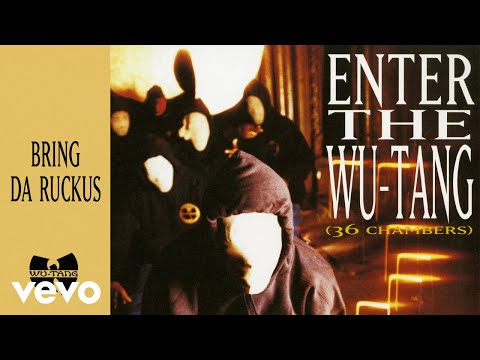
2. ‘Bring Da Ruckus’
(Enter The Wu-Tang (36 Chambers), 1993)
How do you open one of the most pivotal hip hop albums of all time? What song introduces that album to the world? The No.2 spot on this list goes to none other than track one on 36 Chambers, ‘Bring Da Ruckus’. Sampling Ten Tigers of Kwangtung (1980), ‘Bring Da Ruckus’ sets the tone of the album, letting listeners know that Wu-Tang Clan are ready to do exactly as the song title states. What’s special about this track is how they each took something from the kung-fu films they loved – not just the interesting dialogue or sounds – and tried to emulate it in the track. “En Garde, I’ll let you try my Wu-Tang style”, you hear in the beginning of the song, and Raekwon, Ghostface Killah, Inspectah Deck, GZA show you just that. “Ghostface! Catch the blast of a hype verse / My Glock burst, leave in a hearse, I did worse / I come rough, tough like an elephant tusk” introduces us to Ghostface Killah, who got his name from the villain in The Mystery of Chess Boxing (1979). While Raekwon lets us know “And that’s one in the chamber, Wu-Tang banger / 36 styles of danger”. The album is a delicately woven tapestry of references and personalities, and ‘Bring Da Ruckus’ allows us entry into this very intentional world they’ve built.
1. ‘C.R.E.A.M.’

(Enter The Wu-Tang (36 Chambers), 1993)
I think we all knew which song had to reign supreme; we wouldn’t be anywhere without ‘C.R.E.A.M’. The breakout single from 36 Chambers, ‘C.R.E.A.M’ is held together mainly by verses from Raekwon and Inspectah Deck, who describe their experiences and difficulties growing up as working class Black men in New York City. The acronym ‘C.R.E.A.M’ stands for “cash rules everything around me”, which is the hook performed by Method Man, and denotes the class and racial struggles of inner city life, and what people are forced to do to make a living while faced with grave injustice and inequality. The song samples The Charmels’ ‘As Long As I’ve Got You’, almost invoking the idea that as long as you’ve got some sort of access to money, you can find a way to make it – whether it harms you or not. “I grew up on the crime side, the New York Times side / Stayin’ alive was no jive” Raekwon laments, while Deck expresses feeling trapped by his surroundings, “But as the world turned, I learned life is hell / Livin’ in the world no different from a cell”. It was and still is profound to hear the conditions that young Black people have had to endure in a city that boasts some of the most expensive real estate and a high cost of living, all while experiencing police brutality, class inequality and state-sanctioned racism. But it is candid and true, and not to be forgotten.
The UK leg of Wu-Tang Forever: The Final Chamber tour kicks off on 17 March. Find tickets here