Things To Do


Guide
Ramses The Great comes to London
Everything you need to know about Ramses And The Pharaohs' Gold – the blockbuster exhibition 3000 years in the making
When Ramses II died in 1213 BC, the ancient world stopped turning. Leaving behind a legacy as the most successful, longest-reigning, most powerful Pharaoh in history, Ramses left a void that still echoes today – ripples of a power and culture that continue to shape the way we live today.
Three millennia after his lavish burial, the three-mile transportation of his body from one Cairo museum to another in 2021 became a state event, live-streamed to over 200 international TV channels.
While the king’s body will likely never be moved again, the contents of his lavish treasure chambers, including the jaw-dropping wooden coffin he was found in, are on tour. Making its way to London’s Battersea Power Station after stops in San Francisco, Paris, Sydney and Tokyo, Ramses And The Pharaohs’ Gold is a rare chance to see the riches of Cairo’s Egyptian Museum. Here’s everything you need to know…

Who was Ramses II?
Tutank who? While boy-king Tut might still be the most well-known Pharaoh from Egypt’s ancient empire, in his day he was a mere gnat compared to Ramses. Unfairly called “The Donald Trump of ancient Egypt” in one review of the new exhibition, there was a lot more to Ramses than ego, wealth and self-promotion – although he had more than enough of all three to go around.
Ruling for around 66 years (c. 1279–1213 BCE), Ramses II brought stability and prosperity to Egypt during the New Kingdom, allowing the empire to flourish politically, economically, and culturally.
Forging his power with blood, Ramses earned a reputation as one of the greatest military leaders of the ancient world. Early in his reign he led campaigns to reassert Egyptian control over territories in Syria and Canaan – with the Battle of Kadesh against the Hittite Empire around 1274 BCE becoming his crowning glory. Although the battle itself was indecisive, Ramesses portrayed it as a great victory in inscriptions across Egypt – an early example of the power of PR. Eventually, the conflict led to the Egyptian–Hittite Peace Treaty, which is often considered one of the earliest known peace treaties in world history.
When he wasn’t knocking things down, he was building them. Ramses constructed temples, statues, and entire cities across Egypt and Nubia, using architecture to demonstrate his power and divine status. Some of his most famous monuments include the huge rock temples at Abu Simbel, the grand mortuary temple he built for himself (known as “the Ramesseum”), and the expansion of the Karnak Temple Complex.
Building and maintaining Egypt’s strength and prestige for decades, Ramses’ long rule provided political stability, strong administration, and economic prosperity – shaping the ancient Egyptian culture we remember today. By the time of his death, aged around 90, he had become a legendary figure, remembered as a warrior, builder and diplomat.
Known as the Great Ancestor, Ozymandias, King Of Kings, Chosen of Re, Beloved of Amun, Ramesses the Great was never rivalled again in history – making the arrival of his artefacts in London now such a monumental event.
What collections are on display in the exhibition?
Featuring 180 treasures on loan from the Supreme Council of Antiquities in Cairo, Ramses And The Pharaohs’ Gold is rare chance to see some of the greatest archaeological finds of Abu Simbel and the Valley of the Kings.
Highlights of the exhibition include:
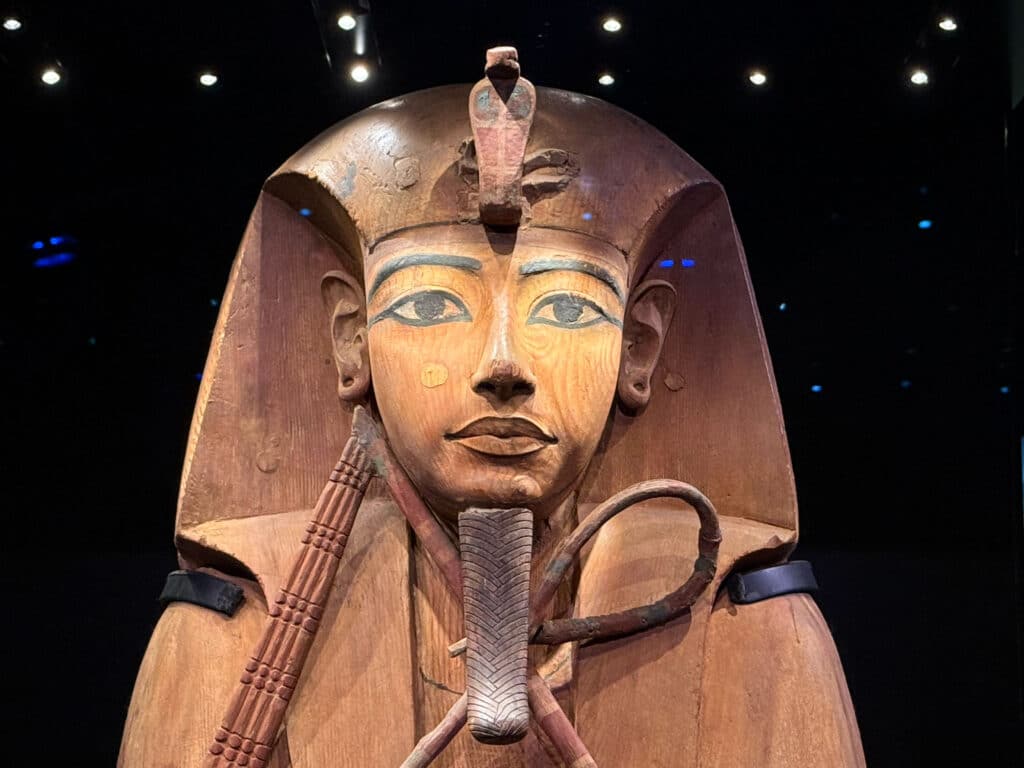
The coffin of Ramesses II. Hewn from cedar and carved with meticulous precision, the coffin that once enclosed the body of Egypt’s most formidable ruler is a work of art. The king is rendered as Osiris, the divine guarantor of rebirth: arms folded across the chest, clutching the crook and flail – the sceptres of sovereignty and shepherdship. The striped nemes headdress crowns the face, its brow guarded by the rearing cobra of kingship, while a braided false beard signals the pharaoh’s transformation from mortal ruler to eternal god.
The Limestone Colossus. Monumental yet intimate in detail, this towering sculpture captures Ramesses II in a posture of poised authority. The king stands erect, the pleated kilt gathered at the waist, a dagger thrust into his belt as if ready for ceremony or campaign. In his hand he clasps a mekes – the cylindrical case used to store papyrus documents – an object that hints at rule not merely by force but by decree and record. The nemes headdress frames the pharaoh’s face, the false beard completing the iconography of absolute kingship.
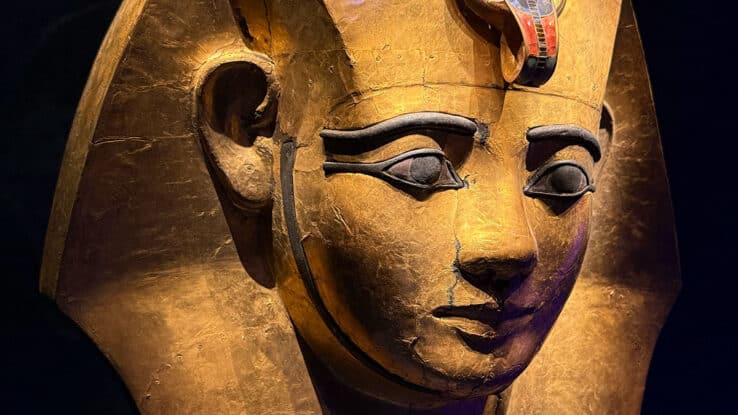
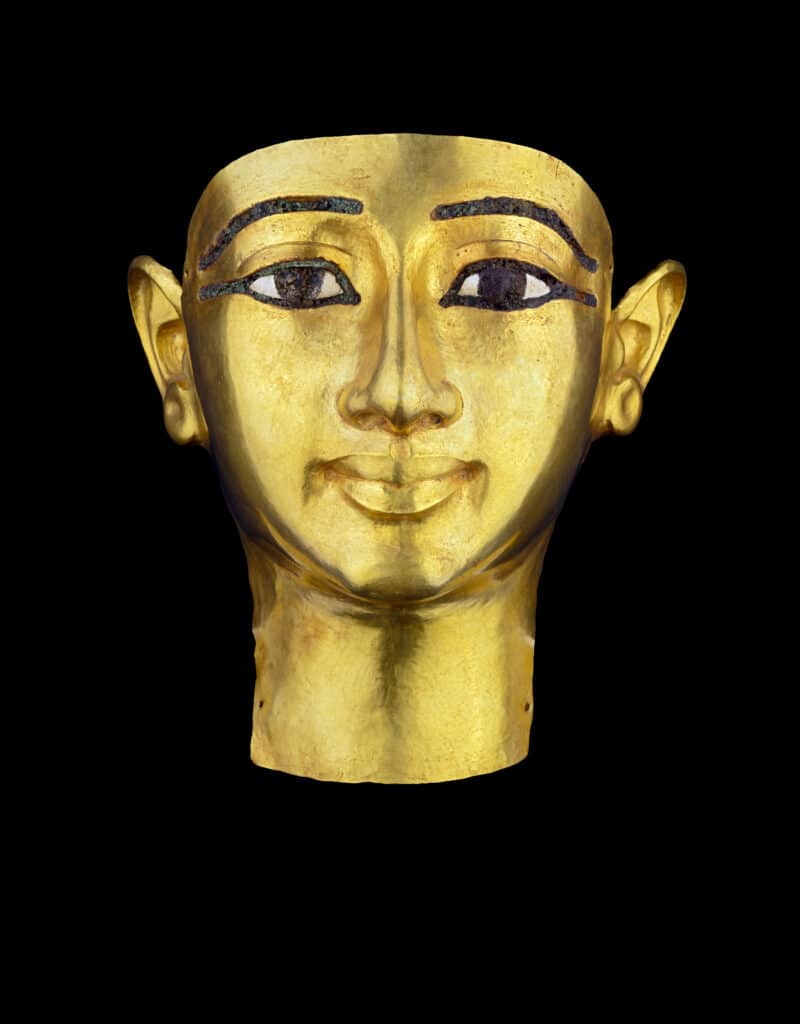
The mask of Amenemope. Fashioned from thick sheets of hammered gold and enriched with wood, bronze, carnelian and lapis lazuli, this funerary mask offers a portrait of regal serenity. The king’s rounded features emerge with striking clarity, while the uraeus – the royal cobra – rises from the forehead in a declaration of divine protection. More than adornment, it is a carefully orchestrated statement of royal identity.
The funerary mask of Wendjebauendjed. Gold, the Egyptians believed, was the flesh of the gods. This mask, created for a powerful military commander of the Ramesside age, lights up the whole exhibition. Its eyes, accentuated with delicate glass inlay, gaze outward with calm intensity. Placed over the general’s mummy, the mask ensured that his idealised likeness would – in Egyptian belief – contemplate the infinite horizons of the afterlife.
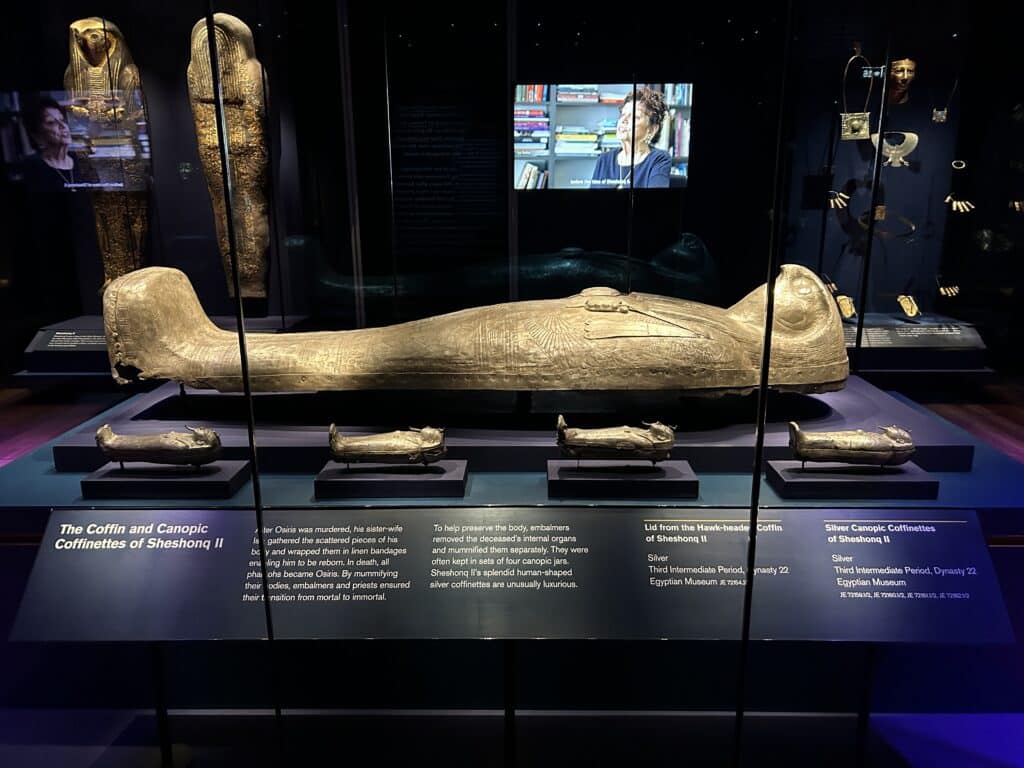
Treasures of Tanis. Few archaeological discoveries rival the riches of the royal burials uncovered at Tanis. Among them are astonishing solid silver coffins – including that of Shoshenq II – especially rare in a civilisation where gold was more plentiful than silver.
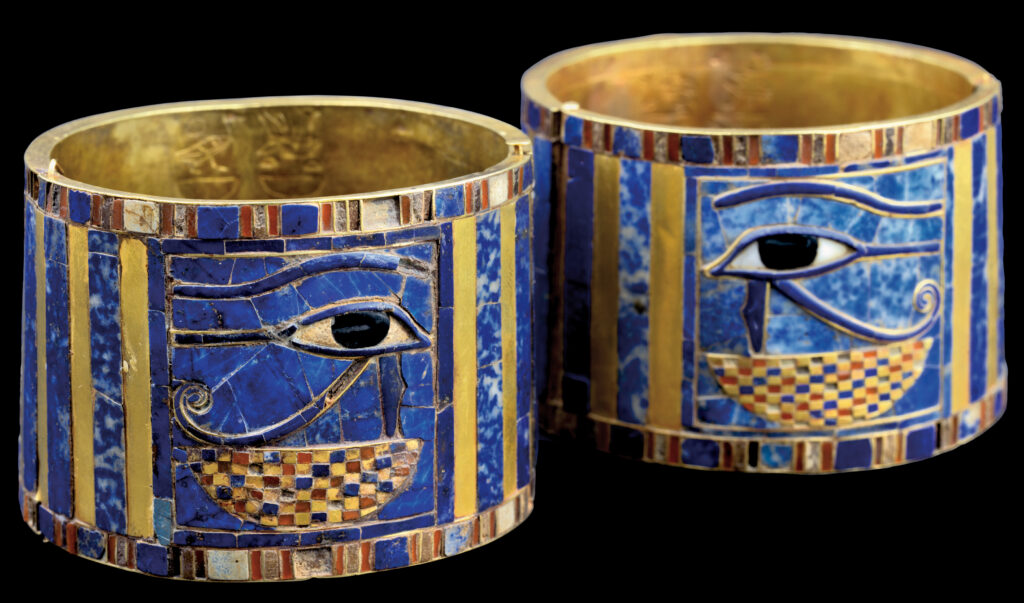
Jewellery and objects of daily life. The exhibition does a great job at revealing how Egyptian artistry also flourished on a smaller scale, with necklaces composed of finely worked gold and semi-precious stones, rings incised with protective symbols, amulets and bracelets of extraordinary delicacy – each piece demonstrating the technical virtuosity of ancient goldsmiths and the Egyptian belief that beauty, protection and status could be worn upon the body.
Animal mummies. Beyond kings and generals, the sacred animal world also has a place in the exhibition. Carefully preserved mummies of cats, a lion cub and even a mongoose evoke a religious landscape in which animals could serve as divine intermediaries or offerings.
Getting even closer to history
If you can’t step into Ramses’ tomb with Indiana Jones, you might as well do it with the next best thing – historian Dan Snow, who narrates the official audio guide for the exhibition that you can buy as an add-on when you arrive. The exhibition does a great job of explaining what you’re looking at, but Snow’s commentary goes a step further to really bring things back to life; essential if you want to get the full experience. Make sure to bring your own headphones if you want to enjoy the audio guide.
And if you want to go step further, you can add on a VR experience (also available as an optional extra when you arrive) that lets you don a headset and headphones on moving chair pods to take a digital tour of Ramses’ tomb with his wife, Queen Nefertari. Essential stuff (especially for fans of The Mummy…).
Planning your visit to the Ramses exhibition
The experience lasts about an hour to 90 minutes, although you’re free to spend as much time as you like wondering around the exhibition (after you’ve watched the opening film and been guided into the main museum space). If you’re planning on adding on the VR experience you might want to allow a bit more time, and there’s also a gift shop and café to enjoy if you want to spend longer. Like all of the best museums in London, it’s a good idea to allow plenty of time if you want to take everything in.
You’ll need to pick a time slot when you book your tickets, and this helps to stagger the crowds and make sure you have plenty of space to enjoy everything. The exhibition is open from 10am to 4pm Sunday to Thursday, from 10am to 6pm on Fridays, and from 9am to 6pm on Saturdays.
Ramses And The Pharaohs’ Gold is currently booking until 31 May 2026, and there’s no guarantee that it’ll extend beyond this time, so make sure you book soon if you don’t want to miss out. Queues build up too, so try and arrive 10 minutes before your booked time slot.
The whole exhibition is indoors (although you might have to queue outside on busy days, so bring an umbrella if it’s raining), right next to Battersea Power Station.
The exhibition has a range of accessibility features, including lift access, portable folding chairs, wheelchairs, large print panel guides and audio description – but check the main exhibition site for full details and contact information.
How to get there
Ramses And The Pharaohs’ Gold has its own bespoke exhibition space, just outside Battersea Power Station. The address is 2 Circus Road East, SW11 8DQ but it’s hard to miss if you walk through the Power Station and exit on the river side, turning to your right to follow the signs to the exhibition.
You can take a tube straight to Battersea Power Station, via the Northern Line, which will bring you right to the front of the shopping area. There are also plenty of buses serving different areas of London, including direct stops on the 156, 211, 344 and 436. Check the TFL website for updated routes and times.
Being right on the river, it’s also really easy to take a boat to visit Ramses And The Pharaohs’ Gold via London’s River Bus, operated by Uber Boat by Thames Clippers.
If you’re driving, the Power Station has charged car parks accessible via Pump House Lane, SW11 8BJ and Circus Road West, SW11 8EZ, both with EV bays.