Music


Interview
Enter Shikari: “The current structure, with its self-maximisation focus, brings out the worst in us”
Rou Reynolds on the surprise release of eighth album LOSE YOUR SELF, the crisis of self-interest in society, and finding hope in human connection
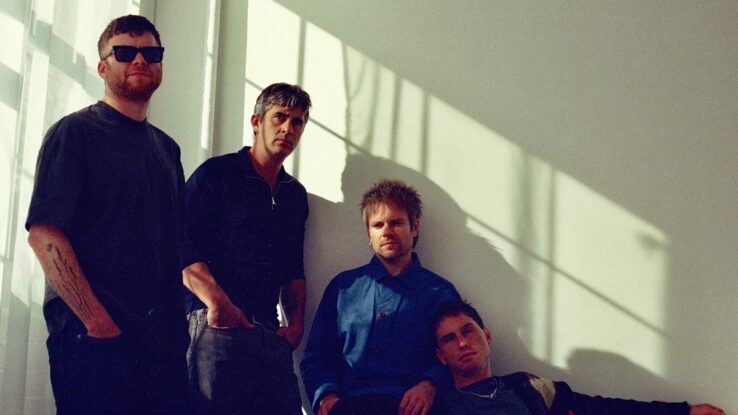
Surprise! With zero teasers or warnings, Enter Shikari dropped their eighth album at midnight, launching it in some style with a return to Manchester’s 400-capacity Satan’s Hollow last night (9 April), almost 20 years to the day since it hosted their first show in the city. It’s called Lose Your Self, with the separation of the second word holding a particular significance.
“It’s a command,” explains bandleader Rou Reynolds, speaking to Ticketmaster on an early morning walk. “The phrase is normally the two words, and it means, ‘Let your hair down, go crazy!’ But what we’re saying is it’s so important to remind ourselves that we’re not these disconnected individuals, and that is actually one of the core reasons why the world is the way it is at the moment. It really is a deep-rooted belief that we’ve gone the wrong way.”
Every Enter Shikari record has always captured the here and now. Lose Your Self is an appeal to the shared ideals of humanity that feel so absent from the modern world, exemplified by second track ‘Find Out The Hard Way…’: “We are all one / And if we don’t realise it now / We’re gonna find out the hard way”. A typically frenetic crash course from rave-punk to pop-rock and light shades of metal, Lose Your Self is Enter Shikari at their potent, thrilling best.
Ahead of their biggest-ever UK arena shows in November, Reynolds spoke to us about the record’s themes, how he tackles his own feelings of helplessness and the story behind the surprise release.
Opening with the title-track and ‘Find Out The Hard Way…’ cuts straight to the point, with a speech about the “knife edge” the human race finds itself on, and the instruction to “lose your self”. Was it important to jump straight into the message?
It’s an immediate bludgeoning with the bigger picture, which is what we’ve attempted to do for our whole career. I see it almost as a responsibility in modern life, where we’ve all [got our] heads down. We have so much to deal with in our personal lives, work, family and the stress of it all that we rarely get a chance to actually think about the bigger picture, our place in the world and the trajectory that our species and planet is on. In typical Shikari fashion, we’re straight in at the deep end.
Unity is a theme you’ve explored before – you think back to songs like your 2009 hit ‘Solidarity’ – but why did it speak to you at this point in your life?
For me, it feels like a core problem. I’m often obsessed with getting to the actual root cause of our issues today, and I think our society has put us in this grip of individualism, where we’re all treated as separate individuals, disconnected from one another. We have to compete at every level of life, we have to be self-interested, and it’s all about self- maximisation.
The most important thing is to remind people that this is just the current structure. It hasn’t been the structure of life for homo sapiens, for, I would say, 99 per cent of our species’ lifespan. It is just the current one, and I think it’s become clearer and clearer that it’s the wrong one, to be so disconnected from each other and the natural world, where we think humanity is above nature, and it’s there to be exploited. We exploit each other for our own gain, and that’s only because the system demands [and] encourages it. It seeps into our psyches from a very young age.
We’re often told to embrace our individuality and encouraged to be our authentic selves. Is it a balancing act between that but also not being entirely self-absorbed, or are they separate conversations?
It’s absolutely about finding the balance. At the moment, structurally, we’ve gone so far the other way. It’s all about atomisation, separation, disconnection and completely concentrating on yourself. That sense of connection to other people, it’s a core physical reality. Often, it’s the spiritual world that has all the language on this sense of oneness that we’ve completely lost. ‘Oneness’ as in our family on this earth, and then also the natural world as a whole, and you can take it even bigger: the universe. Of course, no one wants a world where we’re all carbon-copied and there’s no individuals, imagination and creativity. But at the moment, I would say that’s not the biggest issue. The biggest issue is this idea that has polluted our minds.
‘Shipwrecked!’ references Lord Of The Flies, which explores the idea that humans are inherently violent and will resort to fighting. Is that a scary idea to contend with?
That side of ourselves is brought out much more with our modern world right now than it would be if we were marooned on a desert island. Often, if you look at the actual history of these events, it’s often the disasters that bring people together. Any differences, infighting or cannibalism – metaphorically or literally – doesn’t happen. That is a thing of fiction, like in Lord Of The Flies. But because that story is so pervasive, and it’s everywhere, we’ve come to believe that it’s the case.
One of the real stories that influenced ‘Shipwrecked!’ is [about] six boys from Tonga, who stole a boat in the 1960s and ended up marooned on a small island in the Pacific, and they were there for well over a year. Of course, if it was Lord Of The Flies, they would have all ended up dead, but they made a base camp and worked together. They all had responsibilities, helped each other, and it was this incredible story of human connection and resilience. Eventually they were found, and they all survived.
So often, if you look through the history of catastrophes, that’s what happens. It actually brings out the best in us, whereas the current structure, with its self-maximisation focus, brings out the worst in us. I’m not saying that there isn’t that [selfish] side of us, but we’re so mouldable by our situation, and so it’s about changing the structure and situation to rebalance things.
How do you contend with feeling stranded and helpless – as per the title ‘Shipwrecked! or the lyric “you’re suspended in a light beam” in ‘LOSE YOUR SELF’ – amidst the breakneck pace at which the world appears to be hurtling towards doom?
It would be unnatural if we didn’t all have those periods and moments. What we’re living through is the most stressful, intense, overstimulating, over-emotional period of human history, really, when you think about the crossroads we’re at and the potential futures that we’re heading towards. The pace of it all is so easily overwhelming. It’s acknowledging that it’s a natural and normal reaction to what’s going on, and that can at least take a bit of the sting out of it. I guess we’d be completely desensitised and used to the madness of it all if we didn’t react like that. It’s completely normal.
Where do you personally find hope in the world at the moment?
That core idea of seeking out more human connection and community. That’s happening in lots of aspects of life. On a very local scale, I think people are reprioritising things and realising the madness of the rat-race. All the promise of the internet being this thing that would make us globally closer has been lost under the dredge of everything it does in terms of tribalism, creating tension and pressure. It’s become a very unhelpful thing.
I think people are doing lots of things in the real world, which I find quite encouraging. Whether it’s things that connect you to the natural world – beach clean-ups, forestry work, cleaning rivers – things that reconnect us again. As I say, we’ve looked at nature as this thing to exploit, but there’s lots of areas that provide me with hope.
Do you feel like there will be a wider pushback against the dredge?
As I say, it feels like something that’s starting now, and the momentum will grow. I think it has to. It’s the same thing, I suppose, with how the front cover of the album is so intentionally real. We could have knocked that up with AI in a matter of minutes, but we chose to do the thing that would take about 30 people, and it would be a moment of human connection and community, bringing these people together to create something, to explore an idea. That’s the best aspect of human nature. I think there’s going to be more and more kickback as people realise how unhelpful the direction we’re going in is.
Finally, why did you decide to release this album as a surprise?
I think we wanted to release a Shikari album that would provide a completely new listening experience for the audience. We’ve never done this. It’s always been teasing the work with three or four singles, and if people are anything like me, when an album comes out, I skip the singles, because I want to hear the tracks I haven’t heard. This is dumping a heavy body of work on people, and I think it gently forces them to take in the whole thing as one entity, as one piece.
That’s something that always excites me, because that’s how I think Shikari albums should be taken in. It’s not a novel idea, loads of people have done the shock drop, but for us, it’s new. We also thought of doing the complete opposite, which was to release one song at a time on a monthly basis. But this idea felt like the best thing, especially for an album that is all about the whole, about oneness. It felt apt to provide it in one package.
Enter Shikari will tour the UK from 13 – 21 November. Find tickets here