Interview


Interview
Irvine Welsh: “Musical theatre has dealt with a lot of dark issues – it can deal with this as well.”
With the arrival of Trainspotting: the Musical, creator Irvine Welsh tells us why the story of addiction is more topical than ever
“Choose Life.” In 1996, those two words became a mantra for most young people struggling to meet societal expectations – and choosing the polar opposite path. Which in the case of central characters Renton, Sick Boy, Spud and Tommy, was heroin. The ironic opening monologue to cult phenomenon Trainspotting introduced the hidden underbelly of British youth culture to the global masses, and in an era when Cool Britannia ruled the waves, these fictional characters became the newest anti-establishment poster boys.
Three decades on, that nihilistic sense of youthful abandon is just as pervasive, however.
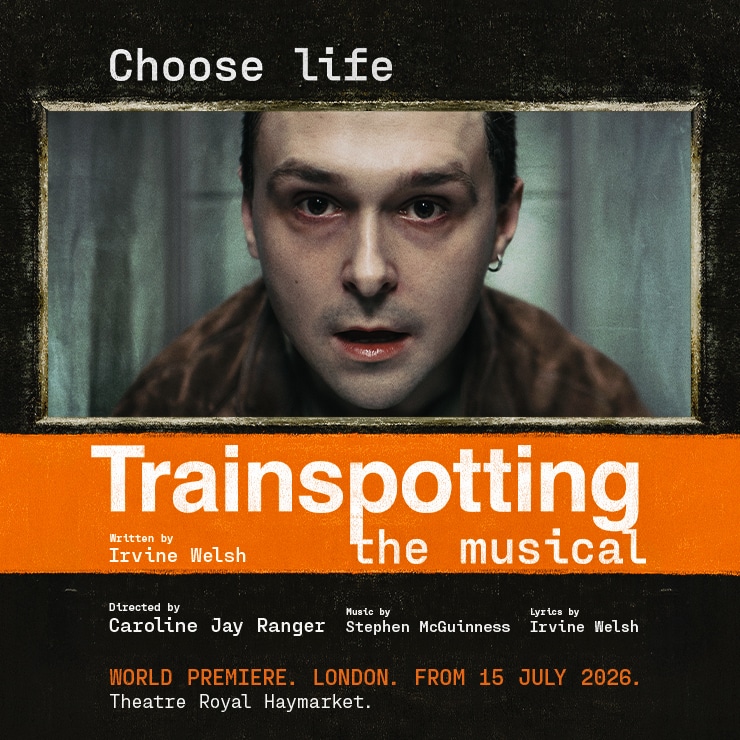
With Trainspotting feeling almost as relevant as it did back in the mid-90s, author Irvine Welsh has conceived the next chapter in the story, with Trainspotting: the Musical. The brand new production is set to open on 15 July at London’s Theatre Royal Haymarket.
The adrenaline-fuelled series – which includes 2017 cinematic sequel T2 alongside sequel novels in Porno, Dead Men’s Trousers, and Men in Love, and prequel Skagboys – was previously a play before being made into a film, starring Ewen Bremner as Renton before he was cast as Spud in the 1996 movie, with Ewan MacGregor taking up the lead role (newcomer Robbie Scott is set to make his West End debut in the musical). So, Trainspotting has history on the stage.
But given its tastemaking soundtrack was intrinsically tied to the film’s cultural footprint, transforming it into a musical feels like a logical step – and an exhilarating one at that. The new musical will feature both songs from the film’s lauded soundtrack, as well as original material written by Welsh and his collaborator Stephen McGuinness.
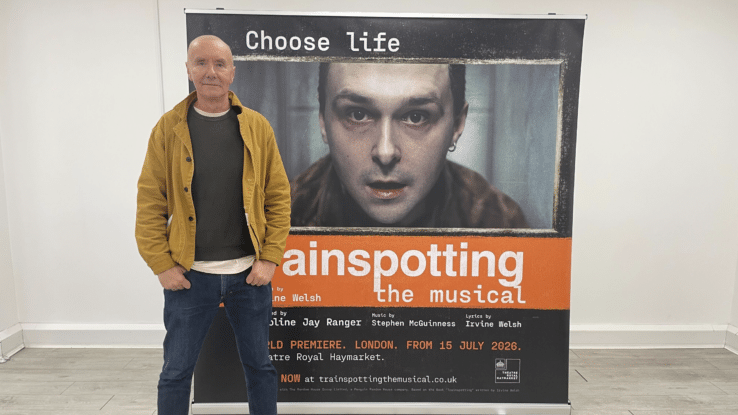
On a crisp, radiant day in central London in the Umbrella Rooms studio – the antithesis to the insides of a putrid bog in a grey, overcast Edinburgh – Irvine Welsh sat down to talk all things Trainspotting: why the new cast are dead certs to become Hollywood stars in the near future, reimagining his book as a musical with modern audiences in mind, and why the story of addiction is more topical than ever.

Why is now the right time for Trainspotting: the Musical?
I think that there’s just so much interest in the 90s. Trainspotting’s never really gone away. People are always talking about it to me and are always interested in it. For me personally, I’ve re-immersed myself in music, and I’ve got a really great music partner in Stephen. It felt like a natural progression.
As a society where addiction is more prevalent than ever – mobile phones, pornography, etc – do you think a wider audience might have more in common with the characters of Trainspotting than they did initially in 1996?
That’s what is resonating now. The Trainspotting characters were the first ones to experience a world without work, or the potential to not work, and the existential crisis that goes along with that. Now with AI and all that, everyone, even the middle-class professionals, is in the same boat basically. When there’s been a big transformation in society it’s always been because of a plague. Now, the plague is addiction. We give our lives meaning with this compulsive obsessive behaviour. We’ve got phones stuck to our face all the time. So, street drugs are really the very smallest part of the addiction paradigm, nowadays.
How long have you thought about transforming Trainspotting into a musical?
20 odd years ago. I worked with Phil McIntyre and Paul Roberts on a play in the West End called You’ll Have Had Your Hole, and we always wanted to do something bigger and a bit more ambitious. A musical. I took a lot of convincing that Trainspotting could be a musical. Maybe I’ve mellowed in my old age. I always thought ‘nah this can’t be a musical’. But eventually I came round. Musical theatre can, and has, dealt with a lot of dark issues – it can deal with this as well.
The music in Trainspotting feels intrinsically linked to the film’s success and legacy. But how important was music to shaping the novel, and fleshing out the characters on the page?
It’s been there all along. Music is the driving force behind Trainspotting. Music is the first art form you experience – it’s just there, you can’t avoid it. That’s your introduction to an artistic life, and an appreciation of the arts. I started doing music before I was writing, so I came to writing Trainspotting with that sense of music. The beats, the rhythms, the effects. I was obsessed with acid-house at the time I wrote Trainspotting. Music is integral.
Was it important for the music in the soundtrack to have a connection to drug use and addiction, or drug culture?
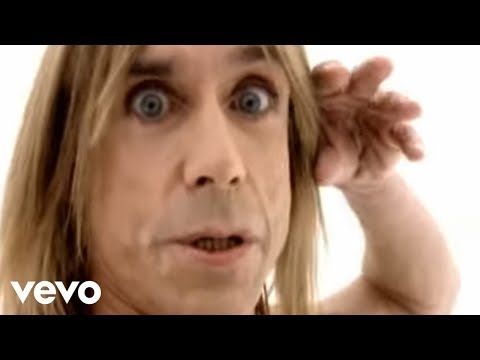
That was the music I was influenced by. Iggy Pop, Lou Reed, The Velvet Underground, The New York Dolls and all that. It just came through as a natural theme. The narrative in my personal life at the time, when I was a younger guy, that and the music world meshed together.
Alongside the music the characters loved themselves, the film used an anachronistic soundtrack centred around Britpop and techno. Did you make any similar bold stylistic choices with contemporary music for the musical?
Yeah. Stephen and I’s orientation is electronic dance music, techno. Underworld, Leftfield, the music that featured in the film. With the musical, we’ve tried to encompass every genre of music that generation – the generations of Trainspotting, though there’s about three of them now – have heard, basically. There’s jazz, there’s blues, country, disco, obviously house and techno. We’ve put the whole lot in. That’s where we’re coming from now.

Did you write new lyrics for the musical, or do the original songs use your words from the novel?
It’s a hodge-podge of things, really. It was basically me and Stephen talking about ideas, getting some harmonies together and putting lyrics to it. Stephen is so quick in the studio with synthesisers, the drum machines. We were just making proper tunes, it was great. I’ve always had these songs in my head, but I’ve not had the musicianship skills to get them out. If I’m messing around with a mouse on a programme, it takes so long. But with Stephen it takes second. He creates great synthesiser beats, and all that, to build the whole track. Our skill sets are so different. But there’s an overlap, an area of really strong communication. We learned from each other all the time.
You made an album alongside the release of sequel Men In Love. Did that collaborative process influence how you wrote new songs for the musical?
It was probably the other way around. We’d already written the tracks for the musical, in their embryonic form. We’ve sat on them for a while, as it’s just taken a while to get the production to this level. We held back a bit to take advantage of the 30 year anniversary of the film. The Men In Love album was afterwards. If anything, that album grew out of the Trainspotting sessions. We just got obsessed with discotheque, so we leaned into that. Some were the tracks we really enjoyed making for the Trainspotting sessions, so just fired on through to Men In Love.

Casting was crucial to bringing the characters to life across the two Trainspotting films. What were you looking for in the new actors to bring to these beloved characters?
You know what, we were blown away with the quality of actors that came through the door. We could’ve cast every part a dozen times over. It’s just margins. You get to the stage where you cast the actors as a group. You know, when this person is brilliant and that person is brilliant, but how did they look when they were all stuck together? We had to take all these things into account, to see if people look like a couple together. It’s a more complicated business than it seems.
The talent was off the scale though. I couldn’t believe how good these actors were. You know, these 21 year olds that were just such polished actors. I’m used to working with people like Ewan MacGregor, James McAvoy, Bobby [Robert] Carlile, Dougray Scott, that calibre. Brilliant actors. But they’d been at it for a while. People just learn so quickly nowadays. I’m not sure if it’s the tech age. But these guys were so good. I know they will be household names. Stars of the future waiting to hatch. You’ve got to see ‘em, just to come and say you’ve seen them.
The film is littered with iconic scenes. Does the musical reference the film visually, or did you and Caroline [Jay Ranger] think about each scene in an entirely new framework?
I suppose I borrowed from myself. Obviously I borrowed from the book. I’ve borrowed from previous stage versions. I’ve borrowed from the film. But I’ve put some original ideas in, some original characters and original material. I think it really has to address now as well as then. Now is basically an intensification of everything that happened then. All the things that happened then are coming to fruition now. It has to be a vital pulse about the times we’re living in now.
Was it a challenge reimagining Trainspotting as a musical with modern attitudes in mind?
It was. There’s a liberation in writing about people from the 90s. There aren’t those shackles of expectation. The characters can say things they probably wouldn’t say now. So, there’s a liberation in going back. But you also have to use that and contextualise in terms of the modern sensibility, and have to enjoy that racy sort of dichotomy, or synthesis. Rather than avoid it or step around it, you have to use the values of then and the values of now clashing together.