Interview


Interview
Good Night, Oscar: “As an audience member, you’re left analysing whether you were complicit”
The cast of the new play at the Barbican talk about how it feels to watch someone break down in the public eye
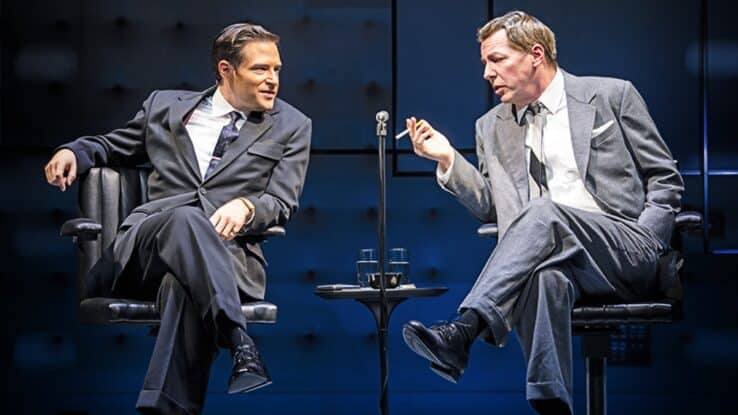
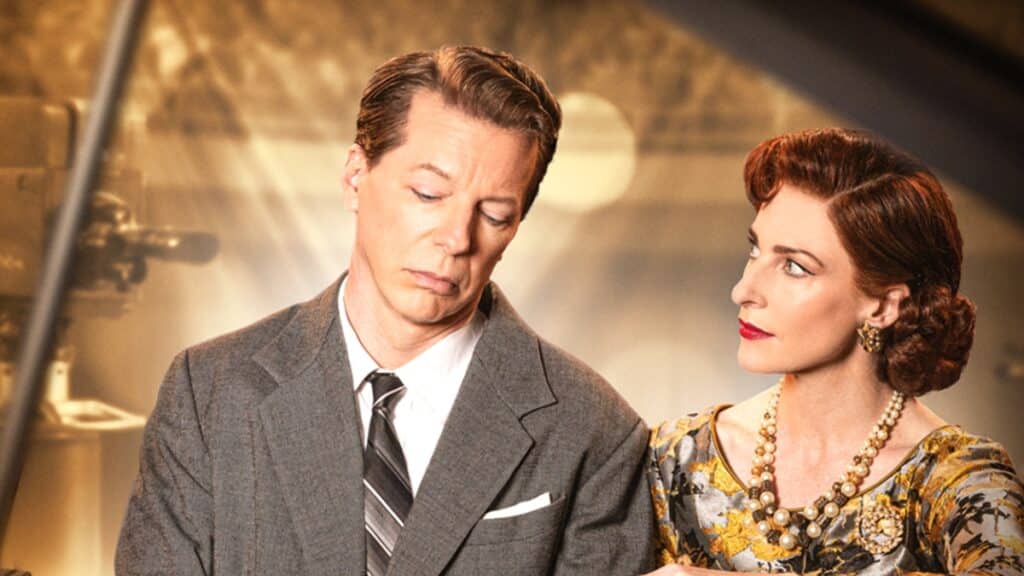
If the names Oscar Levant and Jack Paar ring a bell, it might be because you’re up to date on your 1950s late night television – or it could be because you’ve heard some of the conversation around Good Night, Oscar, the latest arrival at the Barbican. Coming over from Broadway, the comedy-drama tells the story of real-life talk show host Paar and his favourite guest, the talented but unpredictable Oscar Levant, played by Sean Hayes.
Hayes, who reprises his role at the Barbican, received a lot of praise for his depiction of the concert pianist and TV star, even scooping the Tony Award for Best Leading Actor In A Play. But the buzz around Good Night, Oscar extends far beyond Hayes. Performances in Chicago and later on Broadway had audiences rapt.
“It was really cool,” says Ben Rappaport, who is reprising his critically acclaimed role as talk show host Jack Paar. Having played the part since early shows in Chicago, Rappaport has seen the love and admiration for Good Night, Oscar grow and grow – although the sense of something special was there from the beginning.
“Did you know?” asks fellow cast member Rosalie Craig, joining the cast for the show’s Barbican run as June, Oscar’s wife. “Were you like, “This is really good?””
Rappaport describes it as “just a guttural feeling.”
“I mean, in our first few performances in Chicago it became very clear how much it connected,” he says. “It just was kind of undeniable.”
To celebrate the opening of the show, we caught up with Rappaport and Craig to talk about the future of talk shows and how much responsibility we have to the people who perform for our entertainment.
Obviously it’s early days, but how has the UK response compared so far?
BR: Oh, it’s been amazing. Especially because a lot of my stuff in the show is working with the audience as a talk show host. I found the responses here to be really buoyant and full-throated and exciting. It makes it a real pleasure.
This is a story about being in the public eye – what parts of that experience in particular is it exploring?
RC: I guess it’s looking at our relationship to people who have a unique talent, who are possibly being exploited for that talent. Who’s complicit? How far is enough, and when is it too much? When does it meet that exploitative nature? When is it not comfortable for people to watch? It can certainly be dangerous for that person and other people around them.
How do both of your characters fit into that?
BR: Jack Paar is the real life host of The Tonight Show back at this point, 1958, and he was a pioneer in his day of what we know as late-night talk shows today. He was one of the first people to go on live television and sort of wing it and say, “Let’s see what happens.” He really had a penchant for danger and subversiveness. Jack is sort of the Master of Ceremonies, if you will. In a way, he’s puppet mastering this.
It’s complex, isn’t it, because he gets Oscar to do what Oscar does well, but at what cost? I think it challenges the audience to investigate that for themselves. What’s the line? Is there a line? When does that line get crossed? Doug Wright originally described him to me as a Machiavellian clown. I think that’s the best way to put it.
RC: I play June Levant, Oscar’s wife, who acquires this pass for him to go on television. In rehearsals, we were talking about, why does she do it? Is it for Oscar? Is it for her? Is it because she’s a wife in the 1950s and she doesn’t work and they need the money? Or is it essential, in order for her to be Mrs. Levant, that Mr. Levant has to hold that mantle? I think that’s the conversation throughout it, really. Then you find yourself probably engaging in a hilarious moment with Oscar and Jack, and then later on, after various things happen throughout the evening, you’re left analysing whether you were complicit.
Which is a conversation that’s still so relevant, even more so now that celebrities are so accessible. Do you think that talk show hosts or journalists or people in the media have a responsibility to protect the people whose lives or stories they’re platforming?
RC: Well, it would be nice. It would be an ideal world, wouldn’t it, but I suppose everyone has a specific role, and I think a journalist’s role and a person who’s very famous… I mean, they sort of feed each other, but sometimes it can just really go wrong. I don’t know how we solve that. You can’t have the one without the other. As they say, there’s no such thing as bad press, but unfortunately I think we are obsessed with building people up and then breaking them down, because that is just a formula that’s worked since the Victorian era. It’s just so much more immediate now because of social media, and so we’re faced with it several times a day.
Are there any talk shows that you still watch regularly?
BR: I listen to a lot of Conan O’Brien. He has a podcast now, Conan O’Brien Needs A Friend, but I used to watch his talk show all the time. I find him freaking hilarious. I’d say he’s my favourite guy. In research for this role, I watched a lot of different talk shows. I watched Dick Cavett, who was a very prolific talk show host in the States in the 70s and 80s, and he would do these long form interviews that went on forever and everything was fair game. You never know what’s gonna come up. That doesn’t really happen now, other than maybe in podcasts.
RC: I was massively into Parkinson. I used to sit on the edge of my bed and pretend to be interviewed by Parky. He was an absolute legend. He would have on one guest, like Oscar, and then you would have an interrogation, and sometimes it went really wrong. There’s this really famous Helen Mirren interview, which is just cringe and amazing, because she was just such a force, like, “Do not ask me that question.” It was seat of your pants television.
Do you think talk shows are a dying format?
BR: I don’t think they’re dying. I think they’re evolving. I think we’re at this weird kind of midpoint where so much about media has changed, and we’ve changed the way we watch television, the way we’ve watched films, the way we listen to content, and how we’ve shifted so much from the television screen to the phone screen. I think we’re at this really kind of revolutionary place where it’s just shifting, because talk shows are a formula. It would be a Friday night or Saturday night, and you’d sit down and watch that famous person on a talk show because you didn’t have access to them any other way. John Mulaney has been doing some really interesting stuff on Netflix with the talk show format, and it’s sort of bringing a little bit of the classic talk show experience to streaming. We’ll see if that catches on.
Do you think that we should feel guilty as consumers, watching someone like Oscar Levant spiral publicly?
RC: You just do, right? But you can’t look away. It’s sort of a car crash culture, isn’t it? It’s so horrendous that you need to look at it. But whether or not you buy into it or agree with it is a different question. You know, morally, I guess that’s at the kernel of who’s making it, or who’s interviewing them, or who’s complicit in it. I just think there needs to be a lot more support for a person if they are having a terrible moment like that, someone who says, “That’s enough.”
BR: I don’t think there’s anything about our play that’s particularly preachy in that regard, though. I think what it does is open up the conversation and ask the questions, which I think all good pieces of art do. It doesn’t really tell you how you should feel, or moralise, or anything like that. I think it’s just a constant excavation of more questions and more questions. If anything, it actually shows you that Oscar can make that decision for himself in the end.
Good Night, Oscar will play at the Barbican Theatre until 21 September – find tickets here