Comedy



Interview
After 30 years, Jason Byrne still doesn’t know what’s going to happen in his shows
The Dublin-born comedian reflects on three decades of changing venues, audiences and the comedy industry – while discovering that the one thing that hasn’t changed is the chaos
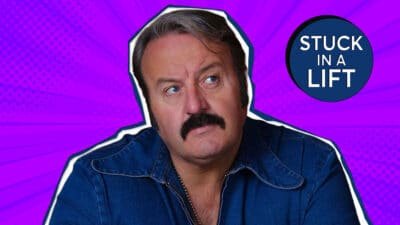
The Jason Byrne sitting in front of me is a very different man to the one who first arrived in Edinburgh for his first Fringe performance in 1996. Late nights and heavy drinking have given way to early mornings and days filled with swimming, golf and Pilates as a way of energising himself for his long-standing fixture at the festival. It’s a far cry from the early years – “I never ran or moved anywhere fast whatsoever,” he laughs.
Byrne is at the Fringe with 30 Years Byrning, a kind of ‘best of’ show looking back on his three decades in comedy, featuring the return of some of his favourite pranks and gaffes and plenty of audience participation, as per. It’s an apt place to debut the show, given how his career kicked off after his festival debut, and as The Sunday Post‘s Murray Scougall pointed out in 2022, “Byrne has been a fixture at the festival for, incredibly, a third of its 75 years.”
As the years have gone by, the venues have got bigger and plusher, his long-standing Assembly Hall residency providing a very different setting to some of the rougher venues of his early career. “It is more or less the best room in Edinburgh,” he says. “It’s not easy to play, but it’s the most comfortable.” That wasn’t always the case. In his younger days, venues were rougher, with audiences arriving already primed and charged. “I remember one place,” he says, “it had benches, and every night there were fights before I even started because there were no seats. There’d be people saying ‘move up, move up!’ That’s all I’d hear before I went on. ‘Move up, move up.’ So I’d go on to an angry crowd every night.”
For all the changes around it, Byrne says the Fringe itself remains remarkably familiar. The dark comedy and “hard bastards and drag acts,” as he puts it, are still there, as are the manifold ambitious shows that have always made the festival what it is. “People go, ‘Oh, you have to be careful what you say now’, and there are several kinds of ‘woke’ acts and all that. But that’s just another element. It hasn’t taken over the festival. It’s still a brilliant festival to show off your show.”
If anything has changed more significantly, Byrne says, it is the industry around comedy, especially television. He remembers a time when broadcasters were more willing to give emerging comedians the space to develop. “When we were younger, Channel 4 were looking to help comics and get them on the telly, give them a 20-minute piece,” he says, pointing to Peter Kay and Phoenix Nights as an example. “That was how they could help the comic, but now it’s how the comic could help them. You know, it’s hard to survive.”
Byrne is currently on a UK tour of 30 Years Byrning, but when we meet in August he is adamant the show’s Fringe preview is not a ‘WIP’. “I never do a work in progress,” he says. “I never say that because it’s I never know what’s going to happen in my f*cking show anyway.” Plenty of comics like to claim that every show is different, but the 54-year-old has built his career on the promise, developing a hybrid-style show that is difficult to put neatly into a category. Where others use crowd work as a set-filler and social media promotion opportunity, Byrne takes it a step further and pulls members of the audience on stage to essentially build the show, participating in what he calls stunts but are more accurately surreal games and routines with unlikely props and rules. 30 Years Byrning recalls some of the weirdest and most popular of these. “I’m coming on the wrecking ball, I’m trying to play people’s balls with xylophone sticks, trying to get people in and do the Queen [‘Bohemian Rhapsody’] thing, the card trick and ‘How Bizarre‘. That’s the hour nearly gone.”
On its UK tour, Byrne promises that amid the chaos he’ll have more space for stand-up, something he actually enjoys the most. “I can just stay in my own little thing. Tell a bloody story and then it’s finished. I don’t need to talk to anyone.” In reality though, the balance will depend on the vibe each night. “All they want is an hour of laughter. And I’ll do whatever. I have to read the room, see what they might like.”
Reading the room is something Byrne has become particularly skilled at after three decades of performing. He’s confident he can identify those who are going to be willing participants simply from their body language. It’s an instinct tested by a bus driver at one of the showings in Edinburgh. “I was quite nervous about it. I was like, shit, is he quiet?” he recalls. “But because he said he was a bus man, that meant no, he can’t be quiet. He has to have a bigger personality. And he did.” The result was a routine Byrne is unlikely to forget, and certainly one he will never be able to repeat. “Not again, ever, ever will I ever be able to have a bus driver singing bus numbers to ‘How Bizarre’.”
Sometimes, of course, the pandemonium creates something neither Byrne nor the audience expected. He remembers once getting a man into a cardboard box and dragging him around the stage making car noises as if recreating a nostalgic childhood game. It was supposed to be another piece of audience participation. But Byrne realised something. “He had a drink on him. I was like, shit.” The routine suddenly took on a different emotional weight. “He got in and I was just dragging him and he start weeping and crying because I was bringing him back to his childhood.”
Does his on-stage persona as an agent of chaos bleed into everyday life at all? As his active and regimented Fringe lifestyle suggests, not one bit. Most comics he knows ‘barely speak’ in real life, and though he’ll still have fun with friends, Byrne admits that “comedy will kind of squash your fun in your life, because you’re trying to laugh at all the time.”
He recalls fellow Irish comedian Sean Hughes, whose comedy often drew on a difficult childhood with an alcoholic father. Byrne remembers hearing a very different version of Hughes’s upbringing from his brother at the comedian’s funeral, and was told their father didn’t even drink. “Sean just wanted to have that childhood in his pocket,” he laughs fondly. “He made up this misery that didn’t exist to try and match his misery.”
Off stage, Byrne may be a different man to the one who arrived at the Fringe 30 years ago, and indeed the one who celebrates mayhem on stage today, but he hasn’t lost that sense of connection with people. Last year, he started writing down what happened at each show, not least because audiences kept returning and expecting him to remember the things they had done together. “Every time I go back to Huddersfield, Stockton, Liverpool: ‘Jason, I’m Paul. Remember, you did the thing,’” he says. “And I have to remember a whole year later!”
Now, he says, he will remember them properly. “It’s the same crowd that come back. I mean, Huddersfield must have up to 40 people I have to remember, in groups and all.” Actually, he suspects the returning audiences may not even care what he does anymore. “They just want me to say hello to them.” For a comedian whose career has been built on elaborate stunts, improvisation and dragging strangers into cardboard boxes, there is something endearingly simple about that. “I should have just called the tour Hello.”