Theatre


Review
Review: The Oresteia
Simon Stone’s reimagining of the definitive Greek tragedy at the Bridge Theatre is phenomenally compelling – and suitably bloody
Don’t be fooled by its quippish, domestic opening – Simon Stone’s modern reimagining of The Oresteia is not a sanitisation. Audiences may be in for a searing examination of upper middle-class family dynamics, but they’re also in for buckets of blood, a light sprinkling of incest (‘light’ because kissing your second cousin is nothing when audiences, knowing they are watching a Greek play, half expect you to sleep with your mother) and a cycle of generational violence that will rip clean through this cast of characters. For now, though, the Middletons are planning a birthday party, and Montie – the stand-in Clytemnestra – is stacking the dishwasher.
The only complete trilogy of plays to survive from Ancient Greece, Aeschylus’ Oresteia was the critical and commercial hit of its day. Following a few chapters in the long and blood-soaked history of the Curse of the House of Atreus, it depicts Clytemnestra’s murderous revenge on her husband, her son Orestes’ murderous revenge on his mother, and Athena’s intervention as she calls for an end to this violent retributive ‘justice’. Things are already bleak when Aeschylus’ play opens – the war in Troy may be won and Agamemnon may be returning home a hero, but he left his young daughter Iphigenia bleeding out on an altar to secure fair weather, and his wife has been stewing in grief and anger ever since.
Simon Stone’s The Oresteia chooses a different beginning. Twins Alice and Isabelle are turning twenty-one, and the family are preparing for a birthday party. Tensions are high – patriarch Chris Middleton is in severe debt, unbeknownst to his family, and Isabelle, having discovered that her father’s company has a pretty heavy involvement in bombing children, is inviting negative media attention with her political activism. Not the problems of a typical London family, but still closer to an episode of Succession than a bloody revenge drama. By the end of Act One, however, a jump forward in time will reveal that Isabelle has been thrown to the wolves by her father, and that youngest son Augie has committed the latest in a chain of intensely violent acts. The Greek tragedy of it all has caught up with the Middletons, and the body count is high.
When it comes to reimagining classic theatre as contemporary, Stone might be the definitive voice. His Yerma set in present-day London with Billie Piper was an enormous success in 2016; subsequent adaptations of Medea and Phaedra were equally well-received. Last year, he staged a reimagining of Ibsen’s The Lady From The Sea at the Bridge Theatre with Alicia Vikander, Andrew Lilcoln and Joe Alwyn. Stone is excellent at pulling out modern themes in historic texts, but in The Oresteia those universal themes of generational trauma and the problem of forgiveness sit very close to the surface. Stone’s production asks: How does modern society view these crimes? How do we make sense of them? How easy is it for that cyclical violence to be reignited even in our civilised age?
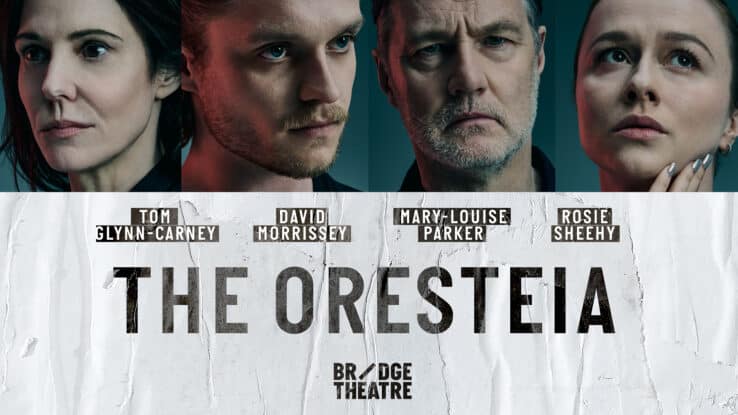
Mary-Louise Parker is the matriarch, Montie, and neither Stone’s script nor Parker’s fantastically controlled performance position her as a misunderstood feminist hero – like Clytemnestra, Montie is easy to empathise with and easy to loathe. Unlike in the original text, however, she isn’t the villain of the piece. Nor is the suitably repressed David Morrissey as Chris; nor is the wildly, excitingly unhinged Tom Glynn-Carney as Augie. In each individual incident there is a clear perpetrator, but where generational trauma is involved, blame is a hard thing to assign. Stone’s production suggests that the Middletons are driven by a force outside of their control, particularly Augie, for whom history bleeds into the present. Revenge is not a choice, but a compulsion, and they are at the complete mercy of the narrative.
Rounding out this group of players is the truly excellent Rosie Sheehy as overlooked twin Alice, not directly implemented in this cycle but victim to it all the same. John Macmillan as Jerome, our stand-in for Aegisthus, is emasculated by Chris’ success, then a cringeworthy brand of gleeful when he usurps him as man of the house. Chris’ insightful second partner Chandra (Rakhee Thakrar) is the all-knowing Cassandra of the piece, driven mad by not being believed. Only Archie Madekwe as cousin Lorenzo might stand a chance of moving on. “I hope Enzo escapes,” Jerome’s blood-soaked spectre tells Augie, tenderly, as he pursues him through his childhood home.
Not just housing this bloody affair but containing it is Lizzie Clachan’s set, an enormous, rotating family home, the majority of which is composed of giant glass windows. Fittingly, the house is both the stage from which this public-facing family convince the world of their nuclear success and the pretty prison in which they are trapped with each other. But Clachan’s design also comments very literally on the way new money often chooses to present itself, in greenhouse-style modern builds, curtains thrown open, inviting an audience.
The set presents a challenge to Peter Rice’s sound design, and most of the dialogue has a slightly artificial quality when it reaches us on the outside. This feels entirely appropriate. Stone’s production presents a self-contained world, a performance conducted for our benefit, a family falling apart for our entertainment. The Middletons have designed their home and their lives to display themselves, and the pressure-cooker they’ve trapped themselves in has been brought to boil as we look on. The smears of blood on the glass are startling, but they will not get on our clothes. Whatever demons we the audience return home to are our own business. We reserve the right to close our curtains.
The Oresteia is playing at the Bridge Theatre until 19 September – find tickets here