Sport


Feature
The legends that built the WSL
Here are the names you need to know if you plan to start following the WSL
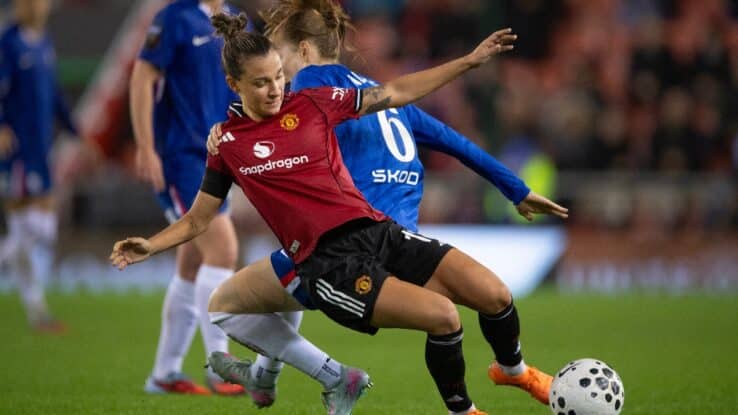
My first experience of a Women’s Super League football match was 10 years ago at the Etihad Academy Campus in Manchester. Our tickets for the match were donated to my high school, given away for free in an effort to get more people down to watch what was meant to be a landmark fixture against local(ish) rivals Liverpool. Unfortunately, it was a pretty miserable day and whether it was the weather, or the fact that women’s football hadn’t really taken off yet, it felt like there were maybe only 100 or so of us scattered soggily around the ground.
As a Manchester United fan (solely in the men’s game, as MU hadn’t got around to founding a women’s team yet), I couldn’t decide which team I wanted to lose more. In the absence of rooting for a team, I quickly found myself backing individual players. Lucy Staniforth, Lucy Bronze, Steph Houghton, Toni Duggan and Katie Zelem had all featured during that season for one of the two northern powerhouses. Whilst of course, Lucy Bronze has got to enjoy the limelight with the success of the Lionesses, when I look back it feels like some of the best players from the day came just at the precipice of the game’s exponential rise, maybe a couple of years too early to get all of the recognition that they deserved.

There are countless talented players who had an enormous impact on the WSL, driving women’s football forwards and playing through challenges to do what they loved – funding their own journey to play each week in front of often non-existent crowds.
That isn’t to say that the WSL is in a perfect spot at the minute, but the people listed below participated in a version of the WSL entirely different to the league as it is today. These players and coaches were there before Nikki Doucet transformed the brand, before multi-million-pound commercial deals and before broadcast slots on Sky.
Here are some of my favourites:
Steph Houghton
Surely you’ve heard of Steph Houghton? Usually followed by “Captain. Leader. Legend”. Or something along those lines. Steph Houghton was one of the players on the pitch back in Manchester in 2016 and she really did command the entire pitch. The best centre-back in the world in her prime, she captained England 72 times, inspiring an entire generation of young girls. Now she’s a frequent face in punditry, and an outspoken advocate for Motor Neurone Disease, a condition suffered by her husband, former professional footballer, Rob Burrows.
Alex Scott
Potentially the most well-known figure on this list, Scott recently featured on our TV screens in this year’s I’m A Celebrity. Winner of a domestic treble in 2012 with her beloved Arsenal during her first season in the recently established WSL following a stint in the US, she stayed with the Gunners until she retired in 2018. On I’m A Celeb, she talked about the importance she places on opening doors for other women, and these aren’t just empty words. She really has done more than most both on and off the pitch to take women with her. (And her Instagram stories with partner Jess Glynne are a highlight of my life.)
Emma Hayes
So far, we’ve only talked about players. But there seems something intrinsically wrong in talking about WSL trailblazers and not mentioning Emma Hayes. Undoubtedly a controversial character who now manages the United States Women’s National Team, she led Chelsea to 7 WSL titles, winning 5 on the trot. A champion at all costs, putting winning before anything else, she made a few enemies along the way. Nevertheless, her influence is undeniable, and she helped to pioneer women’s health in sport, innovating on the really important parts that get brushed under the carpet, and incorporating period awareness and ACL research into her coaching plans.
Jill Scott
We’ve all seen that clip. You know the one. She’s shouting something like “F** off, you f****** pr***!”. It was at the 2023 World Cup that we all learnt not to foul Jill Scott, and that was only one of 4 World Cups she’s represented England at. She made her debut in 2007 in China where she played every single minute of the tournament. Talk about breaking onto the scene. Thankfully for us, Jill Scott has remained on our screens following her immensely illustrious playing career, taking part in some incredible shenanigans on The Overlap with Ian Wright, Gary Neville and Roy Keane.
Fara Williams
Only the most capped England player of all time, men or women, she made a ridiculous 172 appearances for her country. Whilst she wrote her name in the history books, she was also homeless, spending 6 years during her late teens and 20s living out of hostels. The fact that she was able to achieve so much success, whilst battling so much off the pitch, truly is testament to her incredible resilience and determination.
Casey Stoney
Casey Stoney couldn’t not make the list. I’ve managed to stop myself from going on about it too much, but I am a huge Manchester United fan. When my club finally got around to establishing a women’s team in 2018, an embarrassing 7 years after the WSL launched, Casey Stoney was appointed at the helm to manage this new, exciting and long-awaited project. A truly brilliant player and now a brilliant manager. She oversaw MU’s promotion to the WSL and then departed in 2021 to manage in the US. She is now Head Coach of the Canada Women’s National Team.
Rachel Yankey
15 seasons at Arsenal under her belt and 2 WSL titles, including the inaugural WSL title back in 2011 – no one can doubt that commitment. She was the very first professional registered women’s footballer in England and she showed us why. If you’re ever down at the Emirates (and you should be, as AWFC are enjoying an interesting season), you’ll actually be able to spot Yankey on two of the murals outside of the stadium.
Matt Beard
Matt Beard unfortunately passed away earlier this year. The outpouring of grief that came in the wake of his death spoke volumes to the kind of person that he was, and the impact that he had on those he managed. For all of the titles and awards that he earnt, his vast success as a manager can be measured by the relationships he built with those around him and how much he managed to get out of players by always being genuine, passionate and full of humour. We should mention the awards briefly though because leading Liverpool to back-to-back WSL titles in 2012/13 and 2013/14 is no mean feat.
Karen Bardsley
Karen Bardsley was another player on the pitch against Liverpool. The only goalkeeper on the list, she made 81 appearances for England despite being born in the US. With family connections to Stockport, she spent 8 years at Manchester City and quickly became one of the figureheads as the WSL was established. Goalkeepers in women’s football tend to get a lot of stick, but KB was so good between the sticks that she ended up being one of the best counter arguments to anyone who tried to patronisingly suggest that the goalposts in women’s football be made smaller. (Shut up about that already, please.)
Hope Powell
If one day someone happens to gift me a women’s football club, I would like Hope Powell to be involved in any capacity that she chooses. She played on the international stage and then England realised she was a coaching prodigy, made England manager at just 31 and then spent 15 years working with the FA to completely revolutionise women’s football in the UK. That wasn’t enough, though. She then spent over 4 years at Brighton, building one of the most impressive women’s set ups in the UK and developing some of our very best young talents, and now she’s women’s technical director at Birmingham City.
Maria Petri
Maria started supporting Arsenal back in 1950 when she was just 12. As Arsenal began their WSL campaign, dominating from the commencement of the league under Vic Akers, Maria was as passionate a fan as you could hope to find. On first name terms with players, loved by her fellow supporters and respected by rival fans, the club mourned her passing and paid tribute to her relentless support when she passed in 2022. She clearly demonstrated the best thing about women’s football: it is for everyone, regardless of age or background.
When you turn up and support a game, you’ll feel immediately welcome, and you’ll be entertained from start to finish. And you’ll be standing on the shoulders of giants who made it so.

Photos by Visionhaus/Getty Images