Review


Review
Review: Hamlet Hail to the Thief
This eerie meeting of works separated by 400 years is surprisingly slick, immersive and compelling
In my university days, some friends and I recruited a guitarist to play some Radiohead riffs on our production of Dennis Kelly’s Faustian tale The Ritual Slaughter of Gorge Mastromas, which we were taking to a student drama festival. Honestly, we didn’t really overthink why we did it, we just liked Radiohead and it sounded cool and added a sense of drama to the stage before a line was even spoken. There is something inherently eerie, emotionally rich and painfully human to Thom Yorke’s voice and the melodic cadences behind it; it is the crux of their appeal, and happens to work deliciously well in a play that explores morality and existentialism.
Now, I’m certainly not comparing a student production to a collaboration between the Royal Shakespeare Company, Factory International and Yorke himself. But the success of Hamlet Hail to the Thief lies in a similar ethos – one which doesn’t pretend to pander to the purists of either Shakespeare or Radiohead, but partners to immersive and atmospheric effect in this sleek, 1 hour 40 version of the relentlessly adapted tragedy.
The roots of this production go back decades to when Christine Jones, who co-directs the play alongside Steven Hoggett, was listening to the band’s sixth album while working on a production of Hamlet at the time and began to notice some parallels. When Hail To The Thief was released in 2003 it was one of the most anticipated albums of the year, and journalists were quick to read into its political angle in the years following 9/11 and months following the invasion of Iraq. Its title an anti-Bush riff on the U.S. presidential anthem ‘Hail to the Chief’, it’s not a stretch to see the connection to wallowing Prince Hamlet’s own sarcastic salute to his usurping uncle Claudius.
As the years went by, Jones continued to mull on the feelings of powerless gloom and rage shared by the two works in their themes of betrayal and paranoia, and persuaded Yorke to join her in exploring how they could combine them. “We’ve found that the play haunts the album, and the album haunts the play,” said Jones.
Making its debut in Manchester’s Aviva Studios in April 2025 where, as Hoggett told The Sunday Times, “people would come and have four or five pints and then take their seats and go, ‘Oh, f***! It really is Hamlet!’,” it now begins its 12-week run at London’s Barbican Centre.
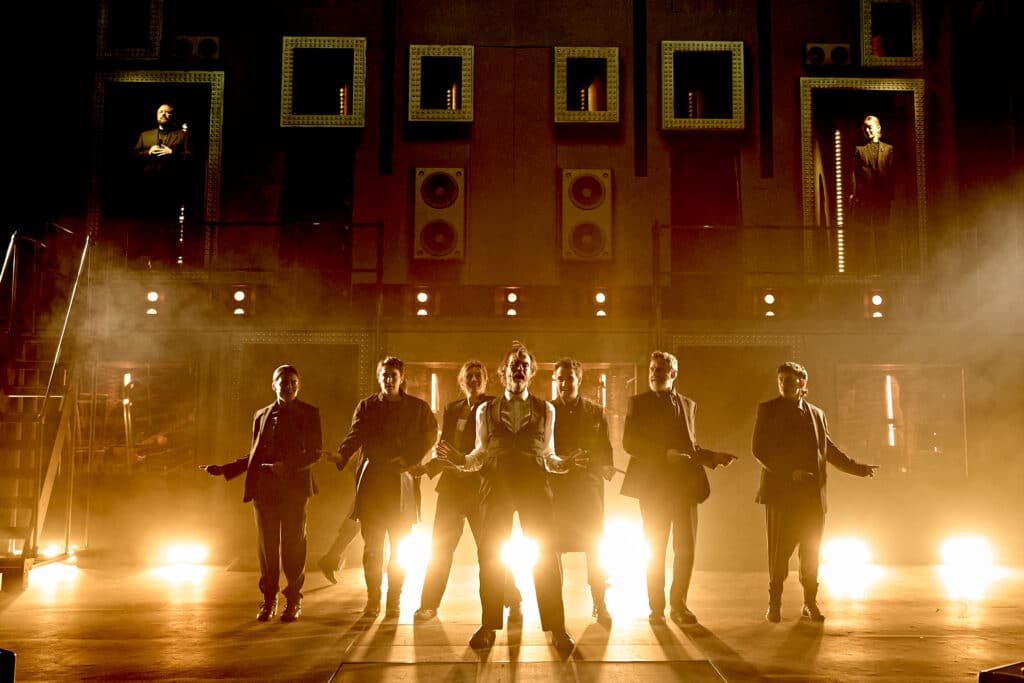
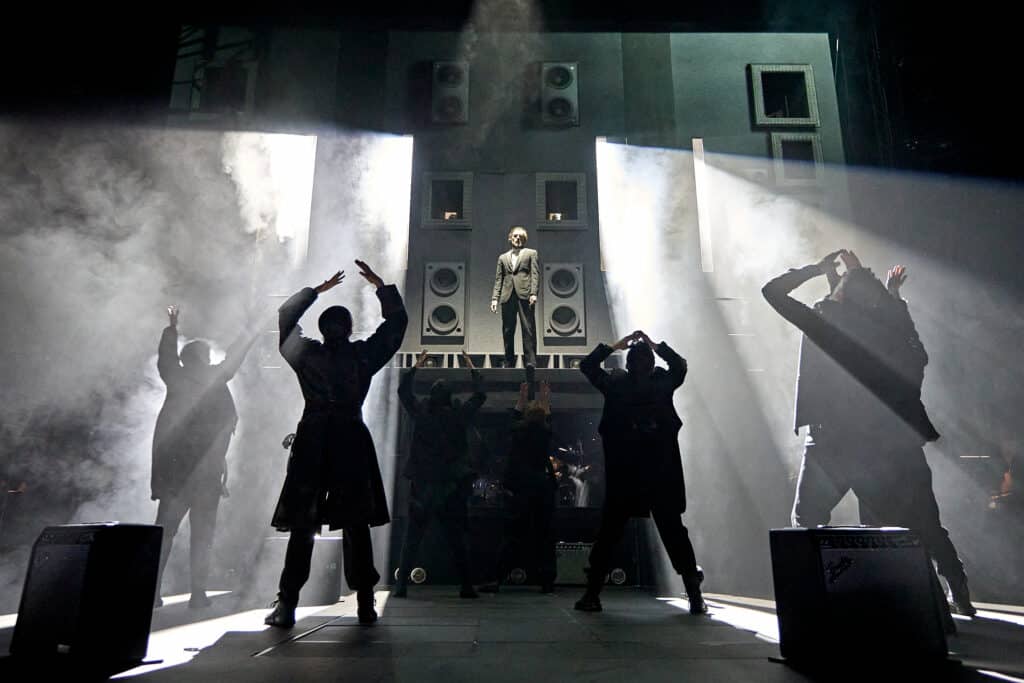
Though I don’t think anyone at the Barbican has sunk multiple pints thinking they’re here for a Radiohead cover show, it’s clear from the off that music is a principal player. The stage looks like a recording studio, with Marshall amps for drama blocks and a five-piece band separated into booths under a platform in which vocalists Ed Begley and Meg Hill periodically appear like apparitions – or the angel and demon of conscience – to offer differing edges of Yorke’s haunting voice.
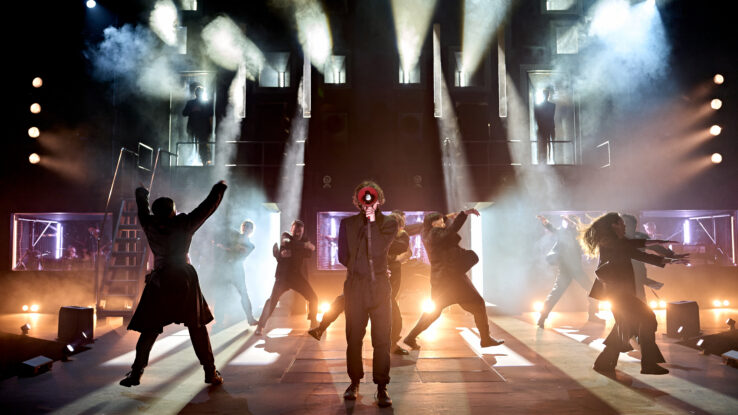
As the black drapes hanging ominously across the stage during the pre-show soar back into the loft, the cast emerge to the album’s Orwellian opener ‘2+2=5’. They attack its explosive climax with a swagger, as though propelled by the same chaotic energy that sets Hamlet‘s tragedy in motion (TL;DR – the king is dead but has appeared to his son as a ghost, while his brother Claudius has married Queen Gertrude and seized the throne). As an angsty but likeable Hamlet, Samuel Blenkin sings Yorke’s refrain “You have not been paying attention” through the distortion of a megaphone, which sets the tone of the spitting intensity with which he plays the prince. If at times this threatens to steal the show, it is neatly counterbalanced by Paul Hilton’s smarmy and slippery Claudius – who, it must be said, looks a lot like Radiohead’s Ed O’Brien from my seat.
But Hamlet Hail to the Thief isn’t a track-by-track listening session. Instead, it draws on what Yorke has described as the album’s “shattered pieces”, weaving lyrical motifs into the action where they occasionally mirror the plot – “Just ’cause you feel it / Doesn’t mean it’s there” – but thankfully without forcing the connections. More often, the character of a song sits alongside a scene, supplementing its emotional intention. The ominous mood but undeniable groove of ‘Go To Sleep’ soundtracks a court party filled with jerky dancing, while the dark pulse of ‘The Gloaming’ captures the anger about to burst during Ophelia’s funeral.
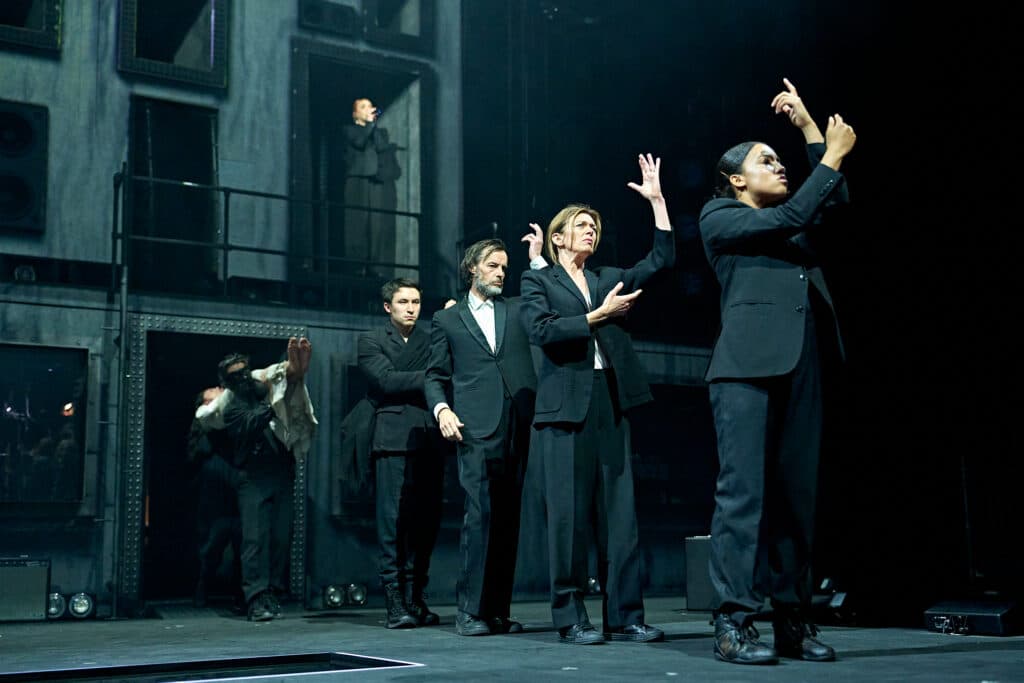
At other times, the characters engage directly with the album. Hilton gives a brief air guitar as Claudius’s plans develop. Ami Tredrea’s Ophelia sings the opening lines of ‘Sail To The Moon’ in the throes of madness, reflecting the song’s gentle drift as she slips delicately to her demise, accompanied by an astounding trick of lighting and staging. So too does the Gravedigger on ‘Scatterbrain’, wearing a weary sadness as she sings “Any fool can easy pick a hole / I only wish I could fall in.”
As someone who listens to Radiohead a lot more than he reads or watches Shakespeare, perhaps Hamlet Hail To The Thief‘s biggest success is that the action is so punchy and accessible that there are several moments I actually forget that another of the album’s songs is on its way. Cutting the usual runtime of Hamlet in half will inevitably leave a few pedants tutting at times – a kind of “York(e) Notes”, as my English teacher father-in-law puts it – but the emotional impact seems worth it. The shortening or omission of certain passages and the brisk pace throughout doesn’t give much time to engage in the usual bigger questions, such as Hamlet’s madness, but it’s hard to deny their emotional resonance deep in the gloomy atmospherics of Radiohead.