New Music


Interview
Basht.: “You can’t just write a song for it to be a single – it can get a bit dishonest”
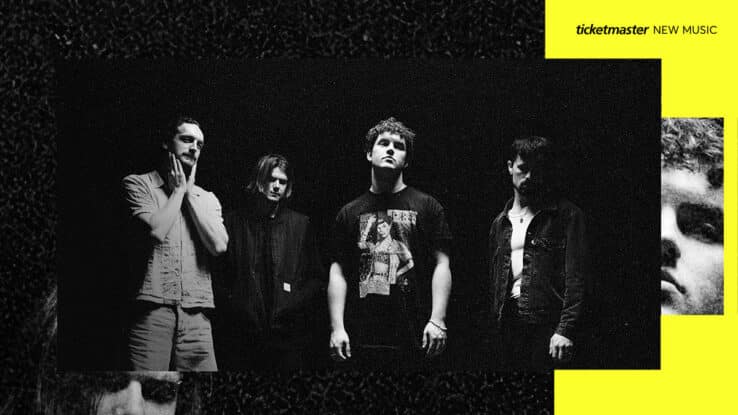
Ahead of their October headline tour, the buzzy Irish alt-rock band discuss their forthcoming debut, Poor Advice
Most stories of freedom start with a flicker and end with fireworks.
The one that unravels over the course of Basht.’s debut album, Poor Advice, is far more gritty-realist than your average blockbuster. The final song, the epic title track, leaves us “in the darkest hour [with] a flicker of a light.” It’s hardly shooting for the stars, but it’s enough to “get you through the night.” This is a band that doesn’t airbrush, their debut album shadowy, raw and pulsing with personal experiences as well as broader critiques of the uncomfortable ways that undemocratic power structures shape society.
Basht. might not go as far as calling Poor Advice a concept album, but that little boy on the cover – crouched in the church pew with a sly smile and a gun pointed at you – is the de facto protagonist. “As he gets older, he’s questioning the authority and the advice that he’s been handed down, and he’s the core thread through it all,” lead vocalist Jack Leavey says. Across 10 titanic songs, the boy extricates himself from the church and its attendant oppression and poor advice – the self-explanatory album title. “It’ll get us there in time” is the conclusion he arrives at, the final line in a timely, timeless story of patience and determination versus oppression.
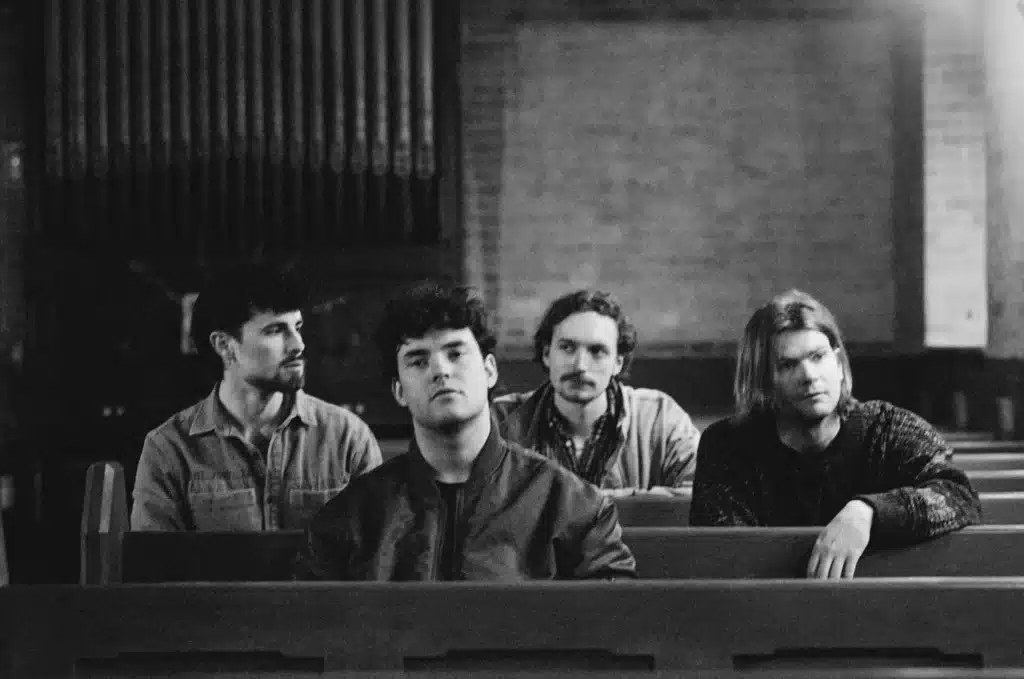
The boy, of course, stands in for the four guys in Basht. – a band of authority-challenging alt-rockers that formed in Dublin five years ago. They clawed up alongside acts like Brooki and Bleech 9:3, a scene whose door was blown out of its hinges by Fontaines D.C. and engendered a renewed focus on Ireland, which, the guys tell me, has been producing great things the whole time – regardless of whether the rest of the world was looking.
A little friendlier than Been Stellar, a lot broodier than Sam Fender, Basht. play really loud and really quiet, often dark and occasionally light. See the whirlwind singalong ‘Terror TV’ for the latter, or notice how a ray of sun fades up on ‘Vermilion Reptilian’ before being usurped by fat, rubbery bass and blues riffs forced through a wood chipper. At their most intense, it sounds like they’re playing in a cathedral as it burns down around them, soaring, liberated, but always with an undercurrent of peril.
In the chat below, the band’s lead vocalist Jack Leavey and lead guitarist Lughaidh Armstrong-Mayock discuss how their songs work in our fly-by-night single culture while also satisfying a broader story arc. You might wonder what a track titled ‘Keira Knightley’ has to do with an oppressive church system, for example, but like the figurative moths, reptilians and Biblical imagery that holds time across the album, a pop culture icon can encapsulate something more.

How do you think Keira Knightley would feel about this song named after her?
Jack Leavey: Maybe a little bit creeped out. Between flattered and creeped out, hopefully. The name Keira Knightley worked more than the actual character. There was that scene from Love Actually where someone was ringing her bell and had that desperate last attempt at love with her, and it just kind of fit. It’s about that desperate point you get to in a relationship sometimes.
Is the band named after the Irish Manx word meaning baptised?
Lughaidh Armstrong-Mayock: I don’t believe so. It kind of came from ‘bashful’ or ‘unabashed’. That was where the root of the word came from.
JL: There’s no real origin story to the name. Years ago, we probably came up with it as an abbreviation of ‘bashful’. ‘Basht’ was another thing we were telling people at the start, but the honest answer is we didn’t know that [meaning beforehand]. Maybe we should just run with that.
The record follows an overarching narrative; how is it writing a song that’s going to work by itself while also making sense in a broader story arc? Lots of people aren’t consuming albums as a whole, but this album is very much an album – with songs that would work by themselves too. Was that a consideration?
LA: Obviously it’s very important for songs to stand alone, that they’re strong compositionally and have their own bookend in terms of narrative and stuff. But we definitely did want to find a way of tying the whole thing into a theme. We worked quite closely with a fella, Polocho, an artist. He was the creative director. He did the music videos, and I suppose the video for ‘Perfume’ helped inform it. We actually released that single while the remainder of the album was still half written. So that helped us find where we wanted to go with the overarching theme of the album. We leaned into certain themes – power structures and the church and stuff like that.
JL: I think contextually you can’t just write a song for it to be a single because then it can get a bit weird and a bit dishonest. Thematically, they all need to feed part of a whole, and I think some songs just naturally lend themselves more to being a single. But the core ideas and the core songwriting has to be sound and part of the overall record first, and then if it feels like a single, then I suppose you can lean more into that. But I wouldn’t be writing songs to be singles. Our next single, ‘Kids Vs Guns’, probably wouldn’t be a single in a lot of people’s opinions, but we think it represents the album really well.
There’s one core protagonist that moves through the story of the album. Is that right?
LA: For me it might not always be directly one protagonist. It’s pretty multifaceted, but I guess you could relate it down to one character. Some of it is more of an observation. There’s some stuff that’s a bit more political and less personal. Then there is some stuff that is more about an intimate relationship, and perhaps that could be more directed at a specific character. But it would maybe be a mixture of things.

I’m curious how much of it is coming from personal experience.
JL: Have you seen the cover art? So that’s an actor called Harley, but I think he represents the child, the boy, in the album, and in each song he’s going through life and experiencing it, and it’s his perspective on things in different ways – whether it be from a church, from a school, a childhood state, or what he sees on his TV and what he’s hearing on the radio. He’s questioning things. As he gets older, he’s questioning the authority and the advice that he’s been handed down, and he’s the core thread through it all.
I think it’s representative of all of us in the band: that personal disdain for authority in our lives, and wanting to make sure that we don’t just take what we hear for granted, and we take everything with a pinch of salt.
Do you have any thoughts on this new wave of Irish bands that are resonating all over, and if there’s anything in particular that’s making people connect with that music?
LA: The scene seems to be booming at the moment. We’re delighted to be part of it. It’s great to see such love and demand for Irish alternative rock music. I guess you could maybe attribute the wave to bands like Fontaines D.C., who are at the head of it, and that maybe opened the gates a bit for up-and-coming bands in Ireland. It’s really put a spotlight on us. I mean, there’s always been amazing stuff happening in Ireland, but maybe we were led to believe you would have to go further afield – maybe move, go to the UK, go to Europe – to really get anywhere with it. So it’s a very inspiring environment. Lots of our peers are doing really well, and everyone’s helping everyone out and teaming up, doing a few gigs together, and just being a real body of support to each other, which is brilliant.
You’re playing your hometown show at the Button Factory in Dublin on this upcoming tour. Is that a venue you’ve played before or been to as punters? Do you have any expectations around that show in particular?
JL: Oh, that’ll be cool. I’m sure we’ve all played the Button Factory at some point but as support acts or as part of different projects. But it’s kind of a full-circle moment for me because my dad used to run it when he was in his 20s as the general manager of the club. So it’s a bit of a full-circle moment for him, I suppose, that his son is playing it now.
Can you tell me about a particularly impactful show you’ve been in the crowd for?
JL: I just went to see Jack White at [3Olympia Theatre, Dublin]. Probably one of the best performances I’ve ever seen. It was incredible. First time seeing him, and we were front row, friends of ours were supporting him. It was nuts. I could see everything, maybe like three metres away from the stage. It’s only like a 1,500-cap venue, so it felt extremely intimate.
LA: Villagers was an amazing show. They’re an Irish band. They’re incredible musicians. I remember in college seeing them live, and I was pretty blown away. Another amazing act I saw for the first time was Just Mustard. Another one was Gilla Band in Vicar Street as well. That was a moment where the whole room, from the very back to the front, was moving from the first song. It was mental. But it’s quite entrancing, especially when the whole room is really there for it.
If you’re having a slightly iffy gig, is there a song in your set that brings the whole thing together? What’s the one that seems to have the power to get everyone locking in or switching the mood up?
JL: I think we really lock in when we play ‘Vermilion Reptilian’.
LA: ‘Wild Horses’ always feels good live. It’s kind of an oldie – it’s from the first EP – but it still hits. It still feels like the closing song, and it’s held that position for so long, even with the new songs. It just has that anthemic feel to it.
The album is paced really nicely in a way that, after a particularly intense or dark moment, something more energetic or light comes in, and it just keeps you really engaged.
JL: I think it’s important to have moments of energy and then calmness and peace, and then you kind of switch it on its head and bring it back so that people go through it with you. It’s also for us; it’s nice to have a slower song every once in a while.
LA: A bit of a break in the mosh pit is always needed. But it’s also reflective of our tastes. As much as we like lively, energetic music and getting crowds going, we also do love more simple songwriting and more down-tempo stuff, and that’s definitely reflected in the tracks on the album. It is quite an eclectic mix; I suppose in a first album you really want to get across your different influences. It feels like the building blocks for the next project – album two. I think for me it was just getting out lots of different facets of our sound.
Ali Chant, who produced the album – his name is such a green flag on any credits list. What did you take away from working with him, or what did he teach you or help you with the most?
JL: He was just brilliant at letting us experiment and push the envelope. He would never say no to an idea. He’d just let you try something out, and then if it worked, it worked. If it didn’t, it didn’t. But we would always have the opportunity to try something out.
LA: Oh, he was fantastic. He would really get into it with us, get on board, get into the nitty-gritty. We would try so many different approaches and tones, and there was no expense spared in terms of creative ideas and throwing stuff at the wall. He was just really clued in the whole time, which is amazing, because sometimes it is a tiring process in the studio, and you’re listening to the same track and idea over and over again, trying to nail it, and sometimes you can lose context. So to have that energy in the room was great for morale and just keeping ideas flowing. And mediating sometimes, when mediating was needed.
Was it his work with other bands that attracted you? Were you already fans of these big, amazing rock records from Dry Cleaning, The Murder Capital…?
JL: …Sorry and PJ Harvey – loads of cool stuff. I had a call with him years ago about doing some work, and we ended up not working together. Then when it came to the album, we were deciding who would be perfect. We all looked at Ali’s credits, and we were like, this would be amazing. We went and had a meeting with him, and then we just knew that he got it and was the right guy for it, and we were delighted that it worked out.
What do you think is the ideal setting/context/time of day to listen to your album?
JL: I tend to listen to it late at night. I think it’s cool when there’s nothing else going on, sitting outside and listening to it.
LA: I’ve been trying to distance myself a bit, taking breaks. I think it’s important sometimes, when you finish a record, to just let it lie, because you can get very close to it in the creative process. So I’ve been on rest from listening to the record. Hopefully then when October comes, it feels fresh and exciting again when it’s coming out.
And will there be enough distance from it to where you’re not thinking, I wish we’d done that slightly differently? By then, is it all locked into shape and you’re not sweating the minutiae?
LA: Potentially. I think there’s always going to be a little element of that in any record you do. A lot of this was done in a very short period of time, where we were recording in between touring dates and writing them in between, so it happened very quickly. Inevitably, in hindsight, you might be like, oh, I could have done this part differently or added this, but I think that’s part of the process – accepting a record for what it is and where you were at the time. It’s very much a moment in time and maybe capturing lightning in a bottle.
So there were benefits to doing it in that bitty way, rather than just going into the studio for two, three weeks and doing it all in one go?
JL: We started recording it – the first two songs – in January, and we didn’t wrap it until May, so we did it over six months, which meant we had a lot of time to sit with the ones we had recorded. If you wanted to add something later on, you could circle back quite easily. But it meant that some of the songs that were written into the later part of it probably had a little less time to develop. But it all worked out.
What was the song that came together super easily, just clicked right away?
JL: I think ‘Keira Knightley’ came pretty quickly. I wrote those lyrics in an afternoon. It was pretty fast.
LA: ‘Perfume’ as well – that was very quick from its conception to its release. It was within a month or two, which I personally feel is one of the strongest songs on the album.
JL: That was a dark horse for me. At the start I was like, ehh, and then now I’m like, Jesus, it’s actually probably my favorite song on the album.
It’s kind of a gooey question to end, but when do you feel most like yourself?
JL: It’s a pretty cliché answer, but I really like being on stage. That’s when everything else goes quiet in my head, and I can just relax a bit, which is kind of weird I suppose. That’s just me.
LA: Mine wouldn’t be miles off. It’s probably not necessarily on stage, but definitely just that meditative process of playing music at home has always been an escape. I would agree – it’s when your mind goes silent. Music has always been amazing for that. So I guess just when I’m home with the guitar.