Music


Feature
Zara Larsson and the pop girl rebrand born from a dolphin meme
What the Swedish singer teaches us about reinventing yourself as a female pop star
‘Just took a shit’ announces the text on the video, over a slideshow of colourful dolphin art with transitions more aggressive than any Year Eight PowerPoint presentation. Zara Larsson is set to play huge sets at Parklife, All Points East and Edinburgh Summer Sessions this summer. Strangely, these two things are linked.
Larsson has been making pop music since she was a teenager. In 2017, her second album So Good broke her out internationally, with hit singles ‘Lush Life’ and ‘Ain’t My Fault’ entering the UK Top 10. She kept a moderate hold on pop stardom in the following years, returning to the Top 10 with ‘Ruin My Life’ in 2018 and the Top 20 with David Guetta collab ‘On My Love’ in 2023. “I feel like people rediscover me every couple of years,” she told Line Of Best Fit in September 2025. What propelled her from occasional hitmaker to pop girl of the moment? A TikTok meme.
After a colourful dolphin and rainbow themed edit of ‘Symphony’ (Larsson’s 2018 collab with Clean Bandit) gained traction on the app, users began overlaying their own text announcements that ranged from the mundane to the depressing, all amusingly discordant with the leaping dolphins and Larsson’s triumphant high notes. Internet literate gen Z that she is, Larsson was quick to get in on the joke. What began as a meme soon became a renaissance.
Pop music has long been about what you see as much as what you hear. From Michael Jackson to Prince to Madonna, the pop overlords of previous generations understood the power of image – and the impact in reinvention. When the Eras tour took over the world in 2023, crowds weren’t just flocking to hear Taylor Swift’s catalogue, but to experience her journey, both audio and visual. Her major rebrands from country to pop and then from America’s sweetheart to the Reputation era are Swift’s most famous do-overs, but each new chapter in her nearly four-hour live show presented proof of a re-re-invention, a reminder of just how many times over she’s done it.

The ‘pop girl rebrand’ isn’t new, but it is zeitgeisty. It gained traction in the days when Disney starlets had to fight tooth and nail to be allowed to grow up, and now it welcomes a new class of initiates. Sabrina Carpenter swapped earnest R&B-tinged confessional pop for winking innuendo and huge platforms, finding her impressively stable feet on the Eras stage and refining her vintage pin-up brand until the ridiculously catchy ‘Espresso’ sent her stratospheric.
Tate McRae went from being a dancer who wrote songs at her piano to the second coming of Britney Spears, head mic and all. Addison Rae graduated from TikTok cringe compilations to performing on the Grammys stage. Even Charli XCX, long a more confident and self-realised artist than the charts gave her credit for, refined her party girl image with Brat. Lime green, white powder and last night’s eyeliner were the recipe for mega mainstream success.
All of this is, in some ways, Western pop catching up to K-pop, an industry where eras and visuals have been essential components of any artist’s career for a long time. For the groups only recently emerging as major crossover acts, rebrands have already been crucial. VCHA were JYP and Republic Records’ global girl group hope, formed via a survival show in 2023. Their first few cutesy pop singles landed them a Teen Vogue cover, but not the international attention that the label had hoped for. After the departure of two members, the group returned in 2025 with a new name – Girlset – and a new, more mature look and sound. Latest single ‘Little Miss’ is already their biggest on streaming by a large stretch.
Then there’s KATSEYE, Hybe and Geffen’s international girl group, who were on a fairly predictable track before their sound took a screeching detour with 2025’s ‘Gnarly’. Experimental to the point of being semi-ridiculous, the track saw the group adopt an edgier image – changes to their respective hair styles were teased almost as much as the track itself. ‘Gnarly’ had a mixed reception on release, and the song itself is still contentious, but it was the music video that got fans onside and won the group an influx of attention – which ultimately led to a Best New Artist nomination at the Grammy’s. As it always is in pop, the image presented alongside the music can change the audience’s opinion of the music itself.
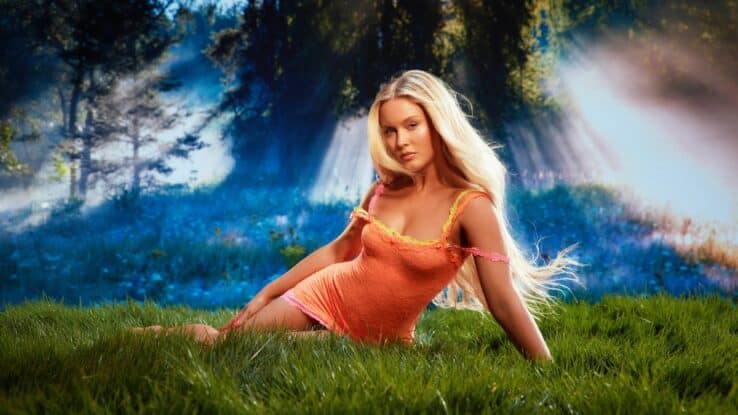
And so, with the cheerful neons and summery ocean tones of the ‘Symphony’ meme to guide her, Larsson and her team got to work. Her rebrand wasn’t a dramatic shift so much as it was a leaning in, a visual aesthetic with which to decorate the Euro summer sound of her fifth album, Midnight Sun. She became Y2K with the saturation turned all the way up, tropical and oceanic. Hothouse flowers, sequins and shells adorned outfits nodding to beachwear and 00s pop. Makeup artist Sophia Sonit created uniquely colourful eye looks for every performance – her role in Larsson’s rise can’t be understated. Pop has to be seen as well as heard, and these days Larsson is hard to miss.

It’s an obvious point to make, but we don’t demand this change from male pop stars, at least not in the same way. True that those who break out of boy groups make strides to differentiate themselves, but that’s often the only the major energy they’ll have to expel in the way of reinvention. It happens occasionally – Ed Sheeran appearing as a sparkly vampire in the ‘Bad Habits’ music video, or Harry Styles dancing cheerfully between genres. Alex Warren is a modern example, going from TikTok content house member to sincere ‘wife guy’ singer-songwriter. But unlike former short-form content colleague Addison Rae, Warren doesn’t have enough of a visual identity to overhaul in the first place, and it’s more than likely that he’ll never be required to try.
Undeniably, the expectation that female pop stars will rebrand stems in some part from our expectation that young female artists – especially those that begin their career as minors – will at some point step into their sexuality and sell it to us. Some have embraced this as early as possible; some have kicked the can down the road, fearing Miley Cyrus-level backlash. Taylor Swift didn’t release a song with even a vague insinuation towards sex until she was 28, and it would take her another three years to swear in the recording booth.
Now, the appetite for ‘sexy pop’ is as high as it’s been since Britney – higher, perhaps – and we’re not quite as liable to point the finger and cry ‘witch’ at those who provide it. But our idea of the rebrand is also shifting. We don’t want a label to create and recreate our pop stars like dolls with swappable heads. We want our female pop artists to achieve an almost fantastical level of body confidence, to be sensually brash, but Britney’s story and others like it are cautionary tales. We need to believe that they are genuine – we need to know it all comes from them.
This in mind, Larsson’s rebrand could easily have failed. After all, the inspiration is clearly traceable and provably did not come from inside Larsson’s own camp. Label intervention and industry plants are loaded ideas and fans are fickle. But the proof is in the performance really, and if Larsson’s comfort in her new aesthetic is all an act, she might deserve an Oscar. Ironically, all we want behind the pomp, excess and sparkly trimmings of pop music is authenticity. If they’re having fun, so are we.
Zara Larsson will play a string of festival dates this summer – find tickets here