Music


WTF is...
WTF is… city pop?
Ahead of Masayoshi Takanaka's return to London this weekend, we take a closer look at the Japanese sub-genre and its recent revival
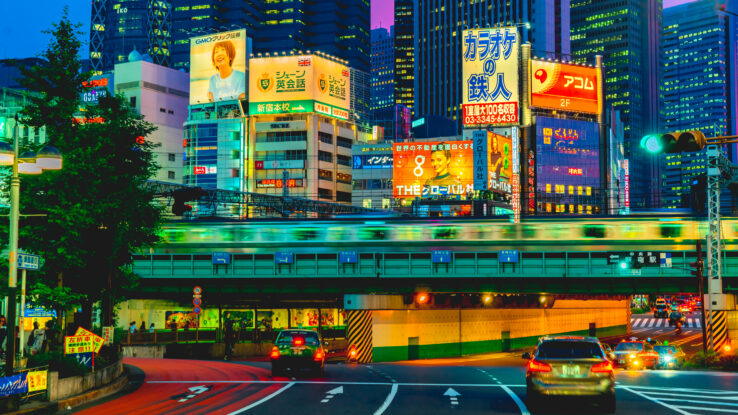
Picture the scene. It’s 1984 in Tokyo. You’re cruising along the expressway in a Honda City Cabriolet, the top down as the breeze cuts through the lingering evening heat. Crisp guitars, peppy flutes and a slapping bass drift from the cassette player, settling into an effortless disco groove. Up above, towering neon signs for Seiko, Hitachi and Asahi glow against a skyline already saturated in impossibly vibrant hues of blue and pink. For this moment at least, the future feels limitless.
This is the feeling that city pop has always chased. More than a genre, it’s a mood – the polished soundtrack to an era of optimism, where disco, funk, jazz fusion and soft rock came together to capture the excitement of a rapidly changing urban Japan. But far more than a postcard from the past, city pop has enjoyed increasing popularity in recent years, with modest hits or forgotten gems from the era finding new life.
With City Pop Waves coming to London’s Crystal Palace Bowl on Friday 7 August – headlined by perhaps the era’s biggest guitar maestro, Masayoshi Takanaka, alongside Junko Yagami, Himiko Kikuchi and a Ginger Root DJ set – what better time to take a closer look this vague but vibey sub-genre.

The boom
In the aftermath of World War Two, Japan underwent one of history’s most remarkable transformations, rebuilding from ruins into the world’s second biggest economy by the 1970s. Household incomes were rising, consumer electronics brands such as Sony, Panasonic, and Nintendo were becoming global names, while cities such as Tokyo and Osaka turned into towering symbols of modernity.
Revolutionary technological upgrades are especially significant here, since they allowed people to enjoy music in higher fidelity and on-the-go as they went about spending their higher disposable income on imported goods, international travel and a general life of relative luxury at home. As Cat Zhang put it for Pitchfork, the advent of the Sony Walkman meant that “casual strolls through the city and weekend joy rides assumed a romantic, movie-like sheen.”
But what to soundtrack this new feeling of freedom, possibility and charm?
The sound
While Japan was booming in the 70s and 80s, so too was the music accompanying middle-class life in the West. Disco had escaped the nightclub to become a chart-conquering force, while the polished sounds of folk rock, jazz fusion and AOR (Adult-Oriented Rock) filled dinner parties, hotel lounges and marina decks. Yacht rock – another vague sub-genre that essentially boiled down to soft rock for West Coast yuppies – is also often associated with city pop. It was music built for leisure: lush, expensive-sounding and impeccably produced, in no small part thanks to all new technology filling recording studios.
Back on home turf, Japanese musicians such as Haruomi Hosono, Ryuichi Sakamoto, Yukihiro Takahashi and their band Yellow Magic Orchestra were already laying the foundations for something distinctly their own. Taking cues from these disco, AOR and jazz fusion sounds coming from the States, they combined cutting-edge synthesisers with meticulous studio craftsmanship and Japanese pop sensibilities into a sound broadly accepted as techno-kayō (techno pop). By the early ’80s, artists including Tatsuro Yamashita, Mariya Takeuchi and Anri had refined those ideas into the cool, melodic sound we now know as city pop.
It’s worth noting at this point that though the term city pop did begin to emerge around this time, for the most part the artists now synonymous with the genre were simply considered part of Japan’s burgeoning Nyū Ongaku (New Music) movement, creating sophisticated, modern pop with a distinct cosmopolitan quality. Only later would city pop emerge as a useful shorthand for the sound that defined the era. As such, there aren’t strict boundaries on what makes a city pop song, but put on some of its best examples and it’ll hit you with a breeze; lightly funky with layers of synth and groovy bass with a jazz-fusion touch, while a dreamy melodic line hints at something yearning or bittersweet in spite of its elegance. Taeko Onuki, take it away…

For all of its associations with the late night metropolis, there was also a strong tropical streak running through city pop, too. Hosono had already dreamed of island life with his Tropical Triology in the mid-70s – “The thing was to take these western ideas of the exotic, but to subvert them,” he told The Guardian in 2008. “I am the target of that western exotica. So what I wanted to make was exotica from an oriental perspective.”
A few years later, City Pop artists’ sun-kissed textures were less conceptual and more escapist. As overseas travel became increasingly attainable and Hawaii emerged as the holiday destination of choice for Japan’s growing middle class, songwriters implemented tropical and Latin flourishes, while album art covers featured palm trees, azure seas and pastel coloured tones. Masayoshi Takanaka left a life of glam rock to make a solo career chasing that beach-ready sound, shredding that guitar over mambo beats and samba grooves on albums such as his 1977 self-titled and its follow up, Brasilian Skies.
The revival
Whether its songs imagined the neon lights of Tokyo’s skyline or the palm tree-lined beaches of Honolulu, city pop excelled at selling a dream. But every dream must fade, and as Japan’s economic bubble burst in 1990 and the country entered a slump known as the Lost Decade, city pop’s spirit of opulence and optimism naturally began to feel out of step. As a new generation embraced the youth-focussed world of J-pop, with its alternative rock stars and pop idols, city pop gradually became a relic of a near yet distant past.
But dreams also have a funny way of resurfacing. Throughout the 2010s, musos and crate diggers began to unveil their discoveries online, sharing their favourite Japanese records on blogs and forums. YouTube became a treasure trove of forgotten vinyl, and in 2017 an upload of ‘Plastic Love’ by Mariya Takeuchi made the city pop resurgence official. Despite peaking at a modest 86 in the charts upon its release in 1985, the fan edit of ‘Plastic Love’ (an original sample looped to make eight minutes) became a viral phenomenon, eventually leading Warner Music Japan to re-release the original and create a new music video for it; other record labels soon followed suit and reissued their own catalogues as fans moved onto other city pop hits. Other internet subcultures such as vaporwave (that’s a WTF is… for another time) took inspiration from city pop’s glossy, 80s production and neon-glow aesthetic, only intensifying the latter’s influence.

It wasn’t a short-lived revival, either. City pop gained even more momentum in the early 2020s, when Miki Matsubara’s ‘Mayonaka no Door (Stay With Me)’ became a global hit on TikTok and streaming platforms. Four decades after the song’s release, city pop was no longer a niche discovery or nostalgic footnote – it was back on dance floors, playlists and festival stages.
And yet, the revival of city pop has led many to examine the feeling of nostalgia itself. “A generation that grew up with smartphones and social media is getting nostalgic for an economic boom they never lived through,” write Dr. Jayson M Chun and Dr. Tokikake Ii, “in a country most have never visited, listening to music in a language they can’t understand.” It’s hardly a coincidence that the two songs that have been most vital to city pop’s resurgence are perhaps the genre’s most wistful. Listeners today aren’t yearning for unrequited love in 1980s Japan. They’re chasing that feeling – of stepping into a world that glows with potential and makes us feel like a million bucks, if only for the length of a song.
Header image photo credit Chunyip Wong.