Music



Feature
The rise of Angine de Poitrine: a rebuke to AI slop
Absurdist math-rock duo Angine de Poitrine crash-landed into the zeitgeist earlier this year. What happened?
Angine de Poitrine. They’re unmistakable. They’re ludicrous. They’re bewildering. They’re brilliant. Some baulk at the sight of them. Others are besotted by their bonkers approach. Just two bandmates, two phallic papier-mâché costumes, a two-pronged guitar, painted feet, jittery math rock, and hella polka-dots. They look as if Roy Lichtenstein painted the mutant offspring of Beaker from The Muppets and The Simpsons’ sinister UFO twins Kron and Kang. Nightmare blunt rotation. Let’s face it, they look mad and they sound mad.
Are they a joke? Are they genius? How on Earth did Angine de Poitrine become the buzziest band of 2026?
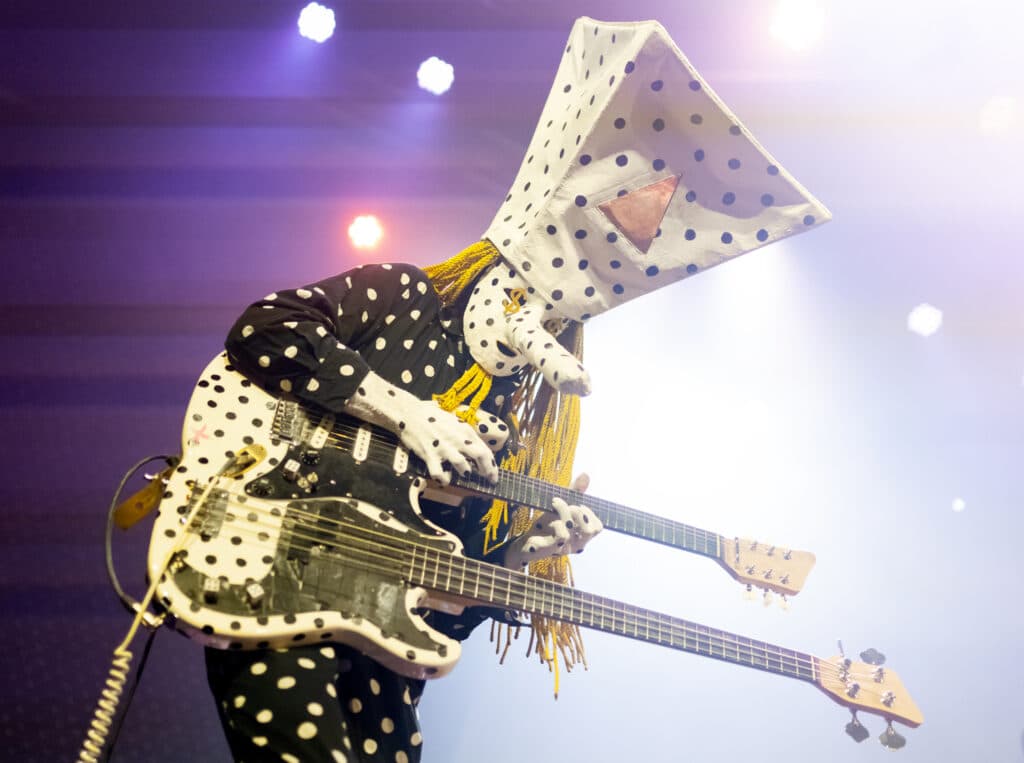
How on Earth indeed, given the absurdist duo’s schtick is that they’re an alien life form. Khn de Poitrine and Klek de Poitrine they call themselves, singing (well, garbling) entirely in extraterrestrial gobble-de-gook. But we know they’re just a couple of anonymous Quebecois musicians with an evident penchant for playfulness, microtonal madness and dressing up. It’s unlikely ‘first contact’ with another galactic species would ever be this fun.
What’s true however, is that they’ve crash-landed slap bang into the zeitgeist – as unlikely as that may seem based on their visual and sonic aesthetic.
By no means is math-rock a new music genre. But it’s often derided as nerdy or painfully uncool (unless you’re a technically proficient musician yourself, that is), and would be a rank outsider if any digitally omnipresent trendsetters bet on it becoming the next viral music genre to enter the mainstream consciousness.
Microtonal isn’t exactly a new phenomenon either. Yes, genre-bending psych-rockers King Gizzard and the Lizard Wizard have dabbled over the past decade. Primus, Ween and the late, great Frank Zappa before them. But microtonal musicianship has been commonplace in Middle Eastern and Indian music for thousands of years.
It’s no surprise that math-rock, particularly of the microtonal distinction, is seldom made for mass consumption. So, why now have Angine de Poitrine blasted into the affections of music fans around the world?

In recent months, anyone mindlessly doomscrolling through social media would’ve had their feeds flooded with snippets of their live set filmed for Seattle radio station KEXP, which went viral soon after it was uploaded to YouTube on 5 February 2026. The performance piqued instant interest in the surreal duo. Comments on the video ranged from bemusement to ridicule to exultation.Their looped grooves, impressive technical prowess and sense of fun made a refreshing change from the more formulaic kinds of music which typically goes viral on this scale.
But their origins date way back. The two musicians have known each other since they were 13 supposedly, playing in numerous projects with one another – ample time to nurture their absurdist senses of humour together. Since forming in 2019 in Saguenay, Quebec, Angine de Poitrine – named after the medical condition Angina Pectoris – have gone through various stages of costume design and technical logistics, with uploaded videos making the rounds of them playing to intimate audiences who had no idea what the f*ck they were witnessing. They released their debut album Vol. 1 in 2024, built a word-of-mouth reputation in their native Quebec and even won Artist of the Year at the 2025 GAMIQ awards which celebrates musicians from the region.
Their KEXP performance changed fortunes almost instantly. It was the math-rock gateway drug for many unsuspecting music fans. Moreover though, their set was a welcome change from the endless stream of AI slop saturating our ears and feeds in ever-increasing levels.

As of April 2026, Deezer revealed that synthetic, AI-generated music represented 44% of new tracks uploaded to the streaming platform every day. 75,000 synthetic tracks every day. 2,000,000 every month. Let’s not even get started on Spotify or any of the other prominent streamers. You can literally make a fully formed song in whatever genre your heart so desires with the simple click of a button. No blood, no sweat, no tears. No sacrifice. No bother. Nothing seems real anymore. Therein lies the appetite for Angine de Poitrine – or at least part of the equation.
Mikey B Rishwain, Artistic Director for Canada’s premiere new music showcase festival M For Montreal and veritable legend of Montreal’s music scene, was one of the first promoters to book Angine de Poitrine. It swiftly dawned on him that they were something special.
“The first time I saw them, it honestly felt like the room lost control in the best way possible. Not in some hype industry sense either. You could just feel people looking at each other like ‘what the f*ck is this?’, but in a beautiful way. I’ve been doing this for over 20 years and very rarely do you feel an entire crowd collectively realise they’re witnessing the beginning of something important while it’s actually happening. Usually that realisation comes years later. With Angine, it was immediate. There’s danger to it, humour, emotion, tension, chaos… but somehow it still feels deeply human underneath all of it.”
Angine de Poitrine’s screwball stylings are resonating globally due to AI exhaustion, Rishwain tells us.

“Everything now is optimised, polished, explained, packaged. Angine feels like the opposite of that. It feels instinctive. Messy in the right ways. Alive. You can’t fake that kind of connection with prompts and algorithms. Even when people don’t fully understand what they’re watching, they feel that it’s real. And honestly, that feeling has become rare. I think audiences around the world are craving surprise again. Something that feels emotionally unpredictable and human. That’s why this band is cutting through.”
A rebuke to AI slop their viral success may be. But Angine de Poitrine’s rocketing reputation also feels like a paean to the sweaty jubilation and unpredictability of live music.
With the hype reaching fever pitch, the duo’s sophomore album Vol.2 was released on 3 April 2026. A slew of live dates followed suit, which sold out in a flash, many of which were upgraded to bigger venues. Could they pull it off where it really counts? Yes, absolutely.
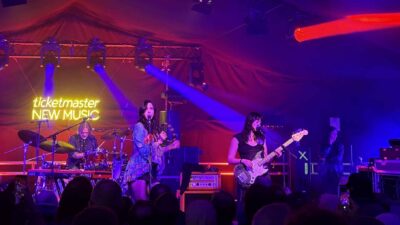
Their debut UK shows at Leeds’ Brudenell Social Club and London’s Electric Ballroom were covered by every national newspaper, earning rave reviews in The Guardian, The Independent, The Times, The Telegraph, etc. Despite playing fairly modest venues, every bugger on social media seemed to squeeze into one of the shows. There’s no official headline act at The Great Escape Festival in Brighton, but a cursory glance at the queues snaking around several blocks outside of The Old Market or cascading outside of the beach stage for the opening party amid an unlikely but torrential May downpour, and you’d guess otherwise.

With frenzied jolts of microtonal guitar virtuosity, looped instrumentation, and time signatures you’d need an abacus to count, they make a greater noise than anticipated and had the crowds in rapture. Even the inter-song ‘banter’ had onlookers chortling away, all yoinky sploinkies and bleepy bloops. The commitment to the bit is commendable, especially since they lack a modicum of the self-seriousness that besets many masked musicians that’ve come before them.
A cult band whose longevity is yet to be seen, the real test of their mettle is when they occupy loftier venues and become bigger drawers on festival line-ups, with new levels of expectation. If you’re wanting a verdict on if they’ll be more than a mere overhyped flash-in-the-pan, Angine de Poitrine need to be seen to be believed.
For this duo of dick-nosed extraterrestrial voyagers, the sky’s the limit. Or maybe outer space.