Music


Interview
Soyuz: “We like to translate the album live, not replicate it”
Alex Chumak on the Minsk-via-Warsaw band's breakthrough album and taking it to the stage as they prepare for their headline show at London's The Jazz Cafe
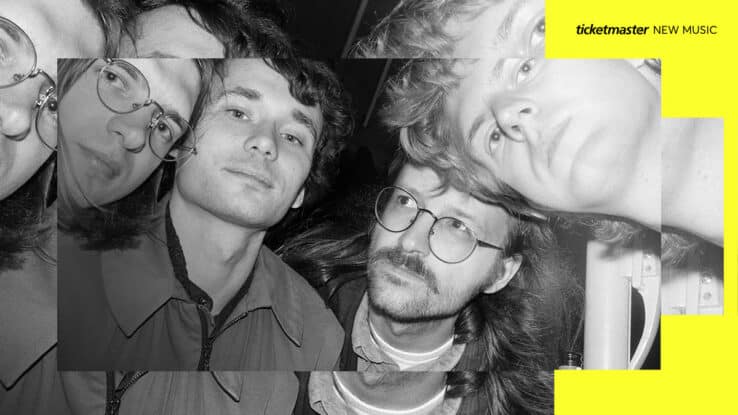
The story of СОЮЗ and their latest album KROK is one that starts in Minsk, comes to life in São Paulo and is bound to take them the world over. But first, a little on the name. Written in Cyrillic, СОЮЗ is pronounced soyuz and translates to ‘union’ back home in Belarus. The latter is certainly easier for the Western tongue, many of which have been wagging since Alex Chumak and his band released their fourth album back in October. For the flow of reading, we’ll go with Soyuz from here on.
Tensions around Belarus’ strict authoritarian regime were already reaching a boiling point in the early 2020s, but with Russia’s invasion of Ukraine in 2022, Soyuz decided to move to Warsaw, Poland. “We were very much happy recording in Minsk,” reflects Chumak, “but people with opposing views were being treated badly. For us, as people who have our own views, if we stayed in Belarus we would be silent and fearing of the future.”
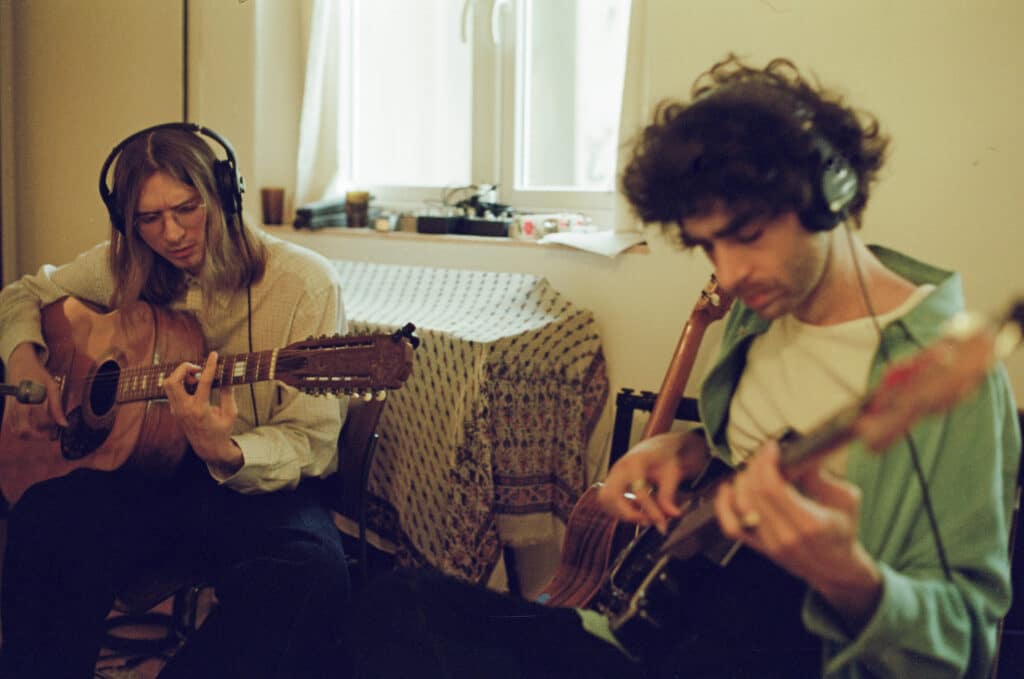
As the band established themselves in the Polish capital, the departure of founding drummer Anton Nemahai and difficulty finding the right studio to call home lead Chumak to think outside the box. He got in touch with the producer and singer-songwriter Sessa, in many ways his Brazilian counterpart and with whom he’d collaborated a few times before, and who was also blessed with access to some of the best of São Paulo’s musicians. After sending over tape-recorded tracks for Sessa and drummer Biel Basile to recover over digitally, to then return and re-record back to tape, they realised this was no way to faithfully produce the dynamism and natural energy this music deserved, so it was time Soyuz finally took a trip to Sampa.
The result was, we’d argue, one of the best albums of 2025. Despite where it was recorded, its Latin American influence is subtle like a breeze, most obvious on the stunning Tim Bernades collab ‘Lingua Do Mundo’ but otherwise adding nuance and depth to a warm, 70s folk-rock album speckled with occasional spirals of cosmic jazz to keep you on your toes.
In February the band play their debut UK headline show at London’s Jazz Café, and with summer festival slots beginning to roll in, now is the time to get acquainted with Soyuz.

I don’t know if it’s my own recency bias or if, actually, you are getting a lot more attention around the project now after the release of KROK , is that fair to say?
I think that’s pretty fair – and of course, we’re very happy with it. I mean, we’re not a new band at all, we formed in 2017 so it’s, it’s been pretty long time, but I would say that the attention to the band was gradual. I think after the second album, which we released in 2019, I started to notice that we have more and more of an international audience, people from from the US, from the UK, are starting to to listen to our songs; people from from Latin America too. And it’s interesting because, of course our music is original it’s made through our own perspective, of but surely we have a lot of inspirations. From the second album, it was maybe more noticeable that we have more and more inspiration from from Brazilian music, from Latin American music, but also from music from Japan and from other parts of the world too, like Ethiopia. So I think it gradually was progressing this experience, these influences and I think on this one it’s just a good moment to to get more attention.
I know you have a huge love for the great Brazilian music like Lô Borges and Milton Nascimento, you felt, you must have felt like you struck gold meeting people like Sessa and Tim Bernades, two contemporaries who capture that halcyon time in Brazilian music so well. At the same time, while there is the Latin aspect to it, as well as this overall mix of folk and jazz, among all of this these elements there are lots of spaces to breathe, for the melodies to breathe. The effect feels almost romantic at times – do you think it’s a romantic album?
It’s an interesting angle. I wasn’t really viewing it as a romantic album. Actually, on the previous records of Soyuz, there are no song about love, you know, like “I love you, you’re beautiful” and this sort of stuff, but these songs are about little other poetic things in our life. It would might pathetic, but you know the love of life. The love of life and its little beautiful details in every day. There is some homesickness in these songs too, which may contribute to in some ways maybe to the sadder sound. I wouldn’t call it a sad record, but it’s maybe a little bit darker than the previous one. I was just thinking of that yesterday, because the previous record was very airy, very dreamy. I think the previous record sounds more romantic to me, like, you know, and this one feels just a bit darker. But still, you know, there’s a lot of emotion in this record I think.
The song and album’s namesake, ‘Krok’, means ’Step’ in Belarusian. Is that a theme that guides the album? Is it a nod to the step away from home that you’ve taken?
I think it can be viewed in a broader sense. I think the song feels to me the most suitable for the record from different angles. First of all, I like how it looks like with the band name when written in Cyrillic, four letters and four other letters; the Soyuz name written in the Cyrillic alphabet is very round, there’s a lot of round shapes. And this one is more vertical and there’s a contrast with the band name, how these two names just look together. But also, of course, I think it’s open to interpretations.
I think I originally discovered Soyuz through the song with Kate NV you did. In fact, on each record you include one or two songs with a collaborator, and of course, there you have other musicians behind the scenes that you work with who tend to be from a lot different parts of the world as well. Is that kind of like a mission statement for so is to be like a worldwide collective?
That’s something I would like us to see. I would leave that for the for the public to judge. Yeah, I think that’s something I’m doing, like, on purpose. I’m not like thinking when I’m like making an album. I’m not like thinking, Okay, I need to have an artist from this and in that country, or, like, just it just happening somehow naturally. Because, yeah, these are all, all these people are those that we will love music, of this, of these musicians, and it feels like very natural thing for us to do something together. So, yeah, when it happens, and if it happens like, if it works well, then it’s a beautiful thing.

It feels like the production of of the album plays a really important part, just as much as the instrumentation or the melodies, in this world building of yours. Do you think you have that sound nailed now, or are you kind of always looking to explore new styles of production?
I think the production is evolving from record to record, we have different angles of production. For instance, on the on the first records, up until Force of the Wind, maybe even that too, the snare drum would always be with a with a muffle, with some kind of clothes on it, so we would be very quiet. And on this newer record, there is also, there are some songs for which it felt the most suitable way of recording drums. But there are also some more open sounding drums there, unmuffled snare drums with all these resonances and stuff. So even from this perspective, it’s like already something is changing. And also previously on the records, the bass was mostly plucked with a pick, you know? Palm muted, this kind of playing. And on the the new record there is none of that actually. There is just an electric bass played with nails, which is an interesting sound, something I’ve been I’ve been really up to lately and adopted that way of playing from this Brazilian player who played on our album, Marcelo Cabral. So I started to to do it myself too. I found it a really nice sounding thing. So I think that it’s evolving from record to record. I always hear music that we’ve done and okay, it’s nice, but it can be done differently next time. So something can be changed, I like to to experiment.
Your music is also reminiscent of old Italian library music classics like Stefano Torossi’s Feelings in its lush and heady richness. is your music exploration always backwards and crate digging as it were, or are you also trying to keep up to date with with the modern music scene as well?
What I’m listening to is mostly from finding some old music. But I’m also very open to finding new artists. I wouldn’t say that I’m not keeping an eye on what’s happening right now, but also I’m not interested in really replicating the old sound, or making a retro thing. I’m just trying to shape my thing out of what I’m hearing and for some reason, on older records there is actually maybe more experimentation and more openness to different things. I’m not saying that there is no experimentation in nowadays music, there are quite a lot of amazing artists who also shape their their own music in a very creative and very unique way. It’s just that maybe in some earlier recording, music from the last century, maybe from some centuries ago, there were some different angles, different ways of viewing the music. I’m trying to find more to learn something from different angles, and just naturally adopting some of this.
On the subject of crate-digging, you signed with the UK label Mr. Bongo a couple of albums ago, who are really famous over here for their credentials in this area, with very popular compilations and reissues. How has signing to them helped move the project forward?
I think it really helped us a lot. Mr. Bongo have been very supportive of us. I think they’ve always been genuinely sharing our music with with people, just because they were very excited and interested in it. For us, of course, it’s also amazing because they have a lot of contacts that we don’t have, so they they know how to approach people. They’ve been very supportive of us.
We’ve talked about how beautifully orchestrated KROK is as a result of your time in Brazil, but how do you find that will translate into a live setting when there’s just a few view on stage? How is it getting that balance right?
We won’t be trying to replicate the songs from the recordings, because of course it’s impossible, on some songs there are 10, 12 and maybe even more musicians playing at the same time. But I would say we’re pretty imaginative, so we like to translate things, not replicate things. We would rethink these songs into a live quartet, because there’s more freedom, I would say, there’s more improvisation on stage. We’re still working on the band arrangements and we’re thinking out all these things, but also there are more possibilities to to go into free improvisation, for instance, or some controlled improvisation. But also in the live setting we are more of an electric band. We have Igor Wiśniewski, who is our latest addition to the band, he plays electric guitar, and he adds a lot of these very interesting details, he reshapes the arrangements for strings and and flutes. We’re finding the most important things in these arrangements and where we’re trying to find the best way to present them. But it’s important at some points in these songs that we’re fine to go in some different direction with them in the live setting. I think it’s like a different experience but it’s definitely worth it. We love to play these live shows and, yeah, there is something very special about about these live performances.
Restaurant tickets are still available for Soyuz at The Jazz Cafe on Monday 16 February