Music


Interview
Northlane: “When I listen to other bands that don’t have electronic music glueing all the bits together, I feel like something’s missing”
The Australian electronic-metal pioneers on their ambitious new album Anemoia, parallels with whodunit thrillers and finding confidence in their vision
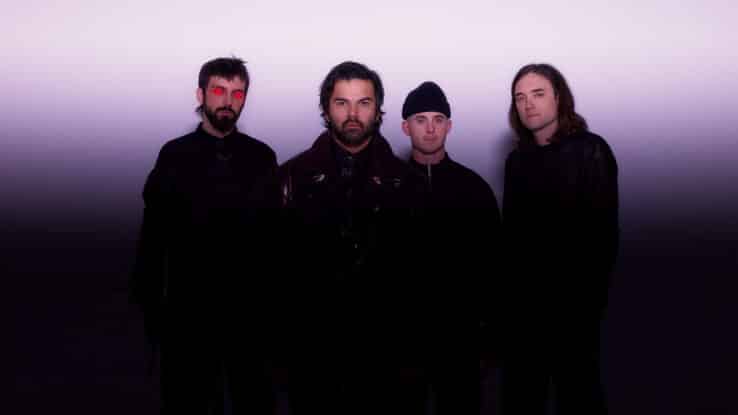
When Northlane introduced their latest chapter with ‘Evian’, a sprawling collision of throbbing trance, grinding metal riffs and futuristic synth-rock, they made their ambitions for this album cycle clear. Since the Sydneysiders’ fifth album Alien (2019), their furious metalcore has rubbed shoulders with electronic music, and arguably with more courage than many of the pop-infused metalcore acts coming in the wake of Bring Me The Horizon’s 2010s success.
“With Alien, we were only just stepping into that world, marrying the electronic and ‘band’ stuff together,” reflects guitarist Jonathon Deiley, who is also Northlane’s primary songwriter. “Whereas now, I feel like people expect this thing from us, so there wasn’t really any caution. I know the parameters I’m able to work within, and then I push it a little bit further. My ability to imagine a thing and actually bring it to life is something that I feel more confident in.”
Indeed, the promise of ‘Evian’ is fulfilled on Northlane’s seventh LP Anemoia, honouring Deiley’s vision as the metalcore quartet unlock boundary-pushing soundscapes that typically shouldn’t exist together. Executive produced by Jordan Fish (ex-Bring Me The Horizon), it’s an utter bombardment of intensity and colour, from the pulsating ‘NEED2FEEL’ through to the drum‘n’bass-coded ‘Deathwish’ and frenetic stadium-sized highlight ‘Start Again’.
The album title nods to false or flawed notions of nostalgia, made all the more pertinent by the way Northlane’s progressive production sits alongside throwback 2000s synth sounds. After its release on 27 November, the band will celebrate with UK shows as main support to Californian outfit Dayseeker. Deiley and fellow guitarist Josh Smith unpacked the album’s shift in sound, the pivotal role of Fish, and why they want their gigs to flow like a DJ set.

You were forced to delay the album from 30 October and cancel an Australian tour because of chronic health issues you’ve been dealing with, Josh. How are you getting on right now, and how difficult was that information to share with the public?
JS: Honestly, I hated having to share that, but it made me reflect on what I’ve been dealing with. For probably eight years now, I’ve been having problems with my spine, but I’m at a point now where I have a plan of what the next steps are. For the last two or three years, I’ve not been having much luck with treatment. It also looks like I have a connective tissue disorder, [which] means my spine is degenerating really fast.
When I travel, it brings out the worst of it, which is a really big problem, because touring is how we make money as a band. If I get on a long haul flight, I can’t sit down for more than half an hour. A neurosurgeon has given me this intradiscal injection, and that’s going to get me through to next June – when I’m going to get a fusion done to two joints in my lower back, which will probably get me through the next 10 years. I’m pretty gung-ho about my health, [but] it’s what my body is, I guess, and I have to deal with that. Unfortunately, Jon has to deal with that, and that’s why he’s sitting at home right now. He’s meant to be on tour!
Does it feel strange to launch a new album cycle with a little uncertainty?
JD: It’s probably the weirdest it’s ever felt going into an album release, but it’s probably some of the best music that we’ve made, so there’s a lot to look forward to.
JS: There was some good with it. It gave ‘Deathwish’ its own moment [as a single], and that song was incredibly experimental and out-there.
‘Evian’ was the first track you shared, which was named after the impact of a DJ set you saw from British producer Evian Christ. Jon, what was so impactful about that moment, to the point where you needed to immortalise it in a song?
JD: It was part of a [month-long event] in Melbourne called RISING. I’d heard of Evian Christ, my partner had seen him before. It was in a medium-sized room, almost awkwardly half-full. It was almost like an ambient set; trance, but it didn’t have a kick drum. Trance is [considered] a bit geeky, nerdy and taboo. I don’t really listen to trance, but because I love synths, I love all the sounds that you can find in that subgenre of electronic music.
When you take the drums out of it and marry it with his style of production… hearing it in that really aggressive way, I was like, ‘There’s so much to unpack here. If you put a band behind this with low-tuned guitars, I feel like it could be something really cool to get stuck into.’ Those times don’t happen very often, where something happens and I walk away so inspired that every studio [session afterwards] is underpinned by that experience.
It’s incredibly impressive how the ‘classic’ Northlane guitar tones coexist alongside out-and-out electronic sounds, such as in songs like ‘Evian’ and ‘NEED2FEEL’. As guitarists, were you determined to carry that element of the band forward with you?
JD: Up until this point, it was probably the challenge, marrying the worlds together. ‘What do the guitars do?’ As I’ve been learning how this all works and fits together, I feel like that was the missing piece: if the guitars can sound like synths, or if we mangle them.
JS: People have made assumptions about some songs, saying, ‘There isn’t any guitar,’ because they’ve never heard a guitar do that. Being able to play it live is gonna be quite shocking.
Jordan Fish is often credited with being a big part of Bring Me The Horizon’s similar breakthrough with electronics around their 2013 album Sempiternal. Was there somewhat of a shared ethos between you, or is that too simplistic to suggest?
JD: He wasn’t anything like what I was expecting. He’s super lovely and to the point, but not rude. He never put anything in my hands. He’s got a great musical mind and he’s like me, in that he loves the puzzle of making music. He loves getting deep into the weeds.
Jon, you’ve said how Fish’s open-minded attitude to ideas helped you cope with some of the perfectionism that bleeds into your production, which could maybe also be interpreted through some lyrics in ‘Start Again’: “Lost in a maze of my old mistakes / Clarity’s a mirror standing in my way / Perfection is a myth I don’t need to chase”. How and when did these moments of clarity come during the process?
JD: When Jordan, myself, and Marcus [Bridge, vocalist] were all cooking, my partner came home from work one day and said, ‘I’ve never seen you guys look so calm and happy while making music.’ Usually, it’s a very stressful thing that we undertake. Having that person [who is] removed from the band [means] anything that comes out onto the table doesn’t come across as personal. Everything feels more flow-y.
JS: I stepped back because they had such a good flow going, and I’m a really big fan of letting people do their thing and not involving myself for the sake of it. I’ve never seen Jon work with someone like that before. For the first time, I could see him being understood by a producer. That’s not to take away from anyone else we’ve worked with, but no one has really understood his vision like Jordan has.
Jon was getting all this confidence in what he was doing, and you could hear that confidence in the music. The three records where I’ve seen him like that were [2013’s] Singularity, Alien and this one. You can hear when a band finds that place in their songwriting, and I knew straight away that this would be a landmark album for us – and I still feel that way about it. I think it’s definitely Jon’s best work, and Jordan was the person to bring that out of him.
Beyond the inner constraints of your own band, do you ever think about changing the wider fabric and potential of what metal can be? Like how The Prodigy, Pendulum and Nine Inch Nails pioneered intersections between electronic and heavy music…
JD: I don’t really think about it. When you’re the first person to do something, it’s like, ‘This is cool,’ but it’s also met with confusion. If more people are doing this style of music, then what I do doesn’t become as weird anymore to fans of [traditional] metal or rock bands.
Now, when I listen to other bands that don’t have electronic music glueing all the bits together, I feel like something’s missing. It doesn’t sound as aggressive or heavy to me, because you’re not using the full spectrum of sound to push air into people’s ears. If you’ve got a sub[-bass] that’s been manufactured and processed that mimics what a guitar is doing, and you stick it underneath, that guitar is going to sound infinitely heavier than a guitar on its own. These are all things I want to do, obviously. [But] if [other] bands want to keep staying heavy and sounding intense, then I feel like people will probably just start doing them.
There are so many layers to the intensity of this album – even the artwork looks overstimulating. How do you channel all the elements without overdoing anything?
JD: I’ve had ADHD my whole life, so that probably adds up! I want people to feel what I feel. I know it’s layered, but to me, it doesn’t actually feel overstimulating. You’re thinking about the mix of all of the pieces, not having three basses at the same time. In ‘Deathwish’, there’s no bass guitar at all, because it would smear the phase of the synth bass. While it sounds crazy, there are actually a lot of rules that I put on top of it, to rein it in and make sure things don’t get out of control.

How did Anemoia and the connotations of that word present itself as a throughline?
JD: I was talking to our photographer Rob [McCoy], saying the album sounds nostalgic, but it’s actually not really nostalgia as you know it. It’s nostalgia for sounds. For ‘Evian’, it’s not that I’m trying to make trance, but for some reason, some of those sounds remind me of when I was young, hearing breakbeat and trance. There were trance songs on the radio here in Australia, but they were commercial, and you don’t really hear [that] anymore. In the late ’90s and early 2000s, music was a little bit more edgy, without actually trying to be edgy.
I’m borrowing these sounds from a time. He was like, ‘Oh, that actually reminds me of this word, ‘Anemoia’.’ I looked into it, and it fucking clicked, almost like one of those ‘whodunit’ thrillers. When they write it, they work backwards from the crime, and they mangle the story to make it far removed from how it actually happened. It’s always a twist at the end. It was like I came up with the name already, wrote the album for it, but forgot that I named it that!
Especially since Alien, Northlane have been generally viewed as a very forward-facing band. But as people, do you need to hit the nostalgia button every now and then too?
JS: I’m nostalgic for when my back didn’t hurt…
JD: Making music gives my life purpose, and that helps me figure out my place in the world, and so, naturally, I’m always distracted with the next thing. The only thing I would be nostalgic for was life pre-internet. It was a simpler time, maybe the world was a little less confused and divided, and the music also happened to sound better – to my ears, anyway.
How are you preparing to convey the essence of Anemoia through the live show?
JD: I treat it like a DJ set, because a DJ set doesn’t have gaps. It’s not like, ‘Here’s this song.’ I want you to watch it, listen – and then the show’s done. You can walk away like, ‘Whoa, I just ate fucking 60 minutes of sound.’ I want to bring that experience that I get when I go to shows like that, which is [about] bringing the club to the metal world. It’s very tribal. Once you’re connected, if you’re locked in and the music keeps you pinned, you forget about the world outside the room. If I can do that, then I think I’ve done my job.
Northlane tour the UK from 28 November – 6 December. Find tickets here