Music


Interview
DMA’S: “Some people really focus a lot on the genre, but for us it’s about the melodies”
Guitarist Matt Mason unpacks the new LP, reconnecting with the “magic” of their debut & how his love of hardcore helped shaped their Britpop roots
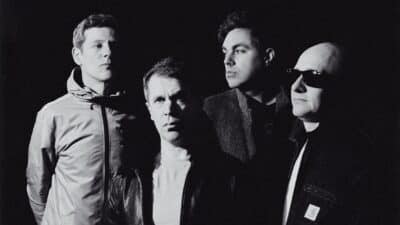
“If you’re singing a melody and you like it, I guess that’s enough,” responds Matt Mason, who’s a little stumped when we probe him for the DMA’S secret sauce. Melody, be it through his lead guitar, Tommy O’Dell’s heartfelt vocals or Johnny Took’s saturated acoustic, is an intrinsic gift of the Sydney trio. When you look back on their rise over the past decade, the consistency of their ever-evolving songwriting is one of the principal driving forces.
Coupled with FIFA sync placements, regular support slots with Courteeners and an internet-shaking cover of Cher’s ‘Believe’ for radio station triple J – comfortably their most-streamed song – the endurance of DMA’S now becomes an unavoidable talking point. On 2020’s The Glow and 2023’s How Many Dreams?, their Britpop-meets-indie headed towards rave-rock, yielding fully-fledged electronic cuts like ‘De Carle’ while also finding middle ground with their roots in songs such as ‘How Many Dreams?’ and ‘Cobracaine’.
“Even though, sonically, the last couple of albums were a bit different, to me it didn’t feel very different, because the way that we were writing the songs was the same,” reflects Mason. Guided by that strength, the band’s self-titled fifth album (due 21 August) almost ditches the synths entirely, honouring its name by revisiting the band’s guitar-centric heritage. The guitarist sat down with Ticketmaster to discuss the road to album five.

This is the fifth time you’re releasing a record. How are you all feeling in the build-up, compared to the previous? Especially as yourself and Johnny have recently had kids.
It’s a lot, but it’s okay. It’s a crazy time to have a kid, because we’ve got so much going on. We self-produced it at our studio, so we were way more hands-on with this record. Our first one [2016’s Hills End] was self-produced, and then the three in between, we were working with producers. This one feels most like the first album because of how involved we were.
What drew you towards bringing things in-house once again?
We went to San Francisco to work with a producer, and we really didn’t like the songs. We were looking at each other going, ‘Oh my gosh, this doesn’t sound like us at all,’ and they were pretty stubborn. We were pretty stubborn as well, because it’s our fifth album, so we knew what we wanted. We decided to come home and do it ourselves.
It’s interesting you thought ‘this doesn’t like us.’ Why is it important to you to stay in touch with that ‘DMA’S sound’, and how aware of it are you as you write new music?
Sounds and genres aren’t as important to me as the songs themselves. When I’m listening to music, I’m listening to the melody. That’s the most important thing, to me. I know that some people really focus a lot on the genre, but for us, it’s [about] the melodies, and I think Tommy’s voice hasn’t really changed that much.
You’re coming back to the UK in February, a place you’ve shared so much history with since DMA’S began. Is there anything you’ve noticed shift within that relationship?
When we first started touring there in our early to mid-twenties, we were quite different people. I suppose we’ve changed a lot ourselves. Instead of going out and finding fans that wanted to party all night, the fan interactions are a lot less turbulent these days. Before COVID, gigs were a bit crazier, it was more dangerous looking out into the crowd, but I feel like people are more respectful of other people around them after social distancing. After that got into the public consciousness, it showed up at gigs as well.
A lot of our fans have gotten older as well. We had fans that had 10-year-old kids that they would listen to their music with, and now those kids are 20, they’re coming to shows, and so it’s almost like there’s another generation of people coming in. We play different venues now, and the bigger the venue, there’s a bit more of a disconnect with the crowd. There’s still a connection, but it’s different to playing in a 100-capacity venue.
You’ve played Manchester’s Heaton Park twice. Is the song ‘Heatin Park’ connected?
We wrote that song in LA with these two songwriters from Norway [Milo Orchis, Benjamin Schandy], and they were like, ‘It sounds like a Linkin Park song!’ In the chorus, I can kind of hear it. It was the influence of these Norwegian guys, because they listen to a lot of that stuff, and we were loving it, and as I was putting the song together, you come up with working titles. I called it ‘Heaton Park’, like the venue, but then spelled it with an ‘i’ as a joke. Sometimes when you actually need to release it, by that time, that name has actually stuck. The song is about someone falling out of a relationship with someone else.
Assumedly ‘Emailz’ and ‘Hurracane’ follow that principle, but self-titling the album can’t have been a working title. That feels like more of a conscious decision?
Album titles are pretty hard to come up with and hard for everyone to agree on. Returning back to only guitars on an album, and making it ourselves, there’s just a few sonic nods to our first album and origins. Calling it DMA’S is a return-to-home moment.
You toured your first album in full earlier this year. How much of an impact did revisiting those songs have on the way album five turned out?
Trying to get yourself in that headspace was fun, because there’s things on that album that we wouldn’t do now. There’s mistakes that would sound off, and after a decade, you’ve learned so much, so you think, ‘Oh that sounds out of tune. I wouldn’t do this like that.’ Back then, you’re kind of stabbing in the dark. There is a magic to that, and I think that’s one of the reasons that people so often like [an artist’s] earlier stuff, because later down the line you’ll have learnt things that might actually be to the detriment of the music you’re making. That has something to do with why we decided to try that again, to see if we could still do it.
It seems somewhat unexpected, after The Glow and How Many Dreams? saw your sound gradually become more electronic. Why did you strip away the synths?
That last record, that push for that sound was led by Johnny. I spearheaded a lot of the sonics on this album, and I wasn’t really that involved in the electronic side of the other albums. We’ve had different members taking different roles at different times, so the fact that I was more involved on this record, and I’m less of a synth guy, I think that’s probably why.
Tonally, the guitar tones on ‘Killing Time’ sound like a throwback to early DMA’S. Did the emphasis on the guitars feel celebratory and nostalgic from your side?
We pushed all the electronic effect-y stuff on the last couple of albums, so it’s actually got the least amount of guitar effects on any record. It’s pretty much raw-sounding instruments. We spent 12 months on it, because we were doing it ourselves, we kept chipping away until the label was like, ‘You need to hand it in.’ If they didn’t, we’d probably still be working on it.
You had a lot of Oasis comparisons when DMA’S started. Alongside their reunion, we’ve seen newer artists like High Vis, Militarie Gun and Yungblud lauded for infusing Britpop influences into their sound, but it’s a sound you’ve proudly leant into since before it was arguably ‘cool’ again. What resonated with you about it back in 2016?
It’s funny that you mention High Vis and Militarie Gun, because I love hardcore. I grew up on it and was listening to that genre before I met the guys in DMA’S. There’s a really clear connection between Britpop and hardcore, and I’ve been trying to figure it out for ages. You get a lot of guys in hardcore bands wearing Stone Island and CP Company, and I think that had something to do with [the influence]. I love that crossover, and I’m still trying to figure out exactly why, and there’s also a crossover between country music and Britpop; we also played a lot of country music a while ago. A lot of the chord progressions and tempos are really similar to country. There’s a big country-hardcore-Britpop thing going on!
It feels like the image of Britpop’s golden age also goes hand in hand with the hedonism of the ’90s. Do you feel like that’s shifted, especially in the context of lairy, pint-throwing crowds that you’ve seen at your own gigs?
There’s only so much you can see from the stage, but there’s definitely less fighting. Early on, you’d see fights happening, security guards dragging people out and us looking at each other like, ‘Oh fuck, what do we do?’ I also feel like young people are drinking less, and it’s definitely a good thing. But I don’t really know why. Millennials have just grown up, and the next generation’s a bit more sensible, maybe.
Lines like “My head louder than the speakers” in ‘Killing Time’ and “Crashing through my mind like a hurricane” in ‘Hurracane’ are quite harsh metaphors for feelings that are clouding your mind. Is there a common thread between those lyrics?
Tommy has such a sweet voice. The way he sings has this real bittersweet melancholy sound to it. So for this record, we were intentionally trying to write more abrasive lyrics to make the songs sound a bit more gritty, more angsty. You do need to counteract Tommy’s sweet vocal with that lyrical angst to give it a bit of edge.

What do you hope that people will take away from this album?
The fact that we did it ourselves. We went to San Fran, it failed, we’d lost a bunch of money and the label was kind of freaking out. It took that happening for us to realise that we were supposed to do it ourselves the whole time. You’re in a shit situation, but it’s meant to be, and I suppose there’s probably something in that.
DMA’S will tour the UK throughout February 2027 – find tickets here