Music



Daisy Veacock: “Artists yearn to know that the thing that they’re making is important and good”
We talk situationships, big bands and bad gigs ahead of the London singer-songwriter’s headline UK tour coming up this November
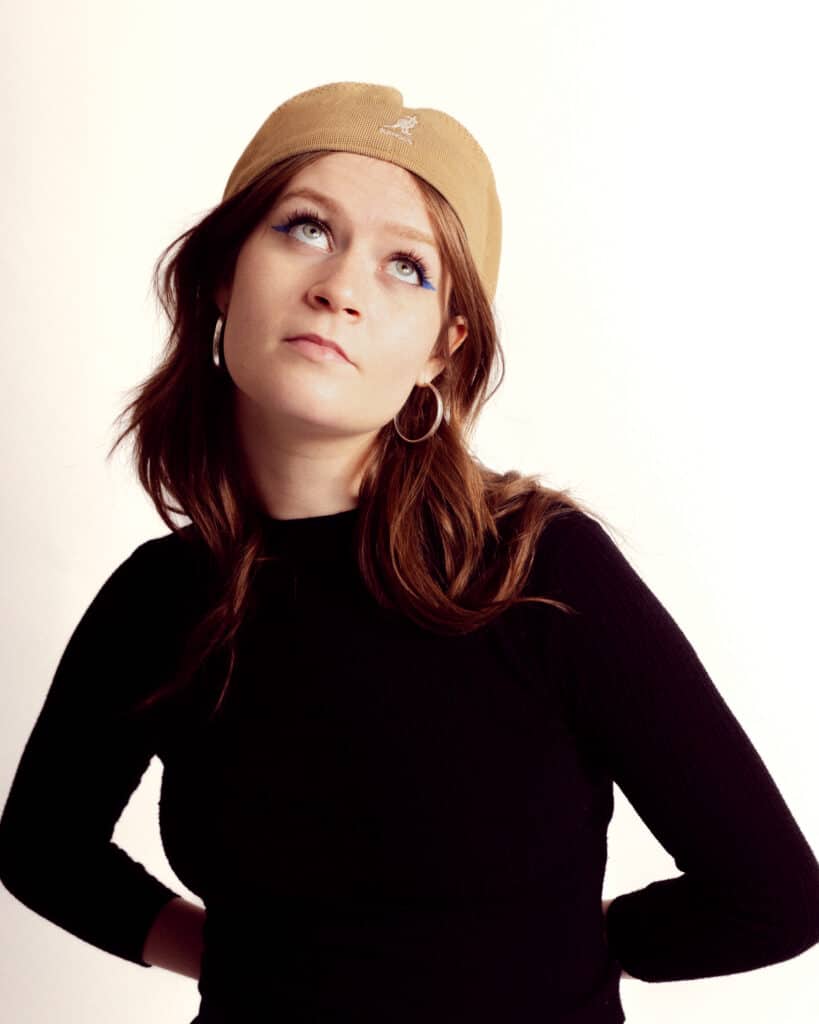
There’s not much inspiration to be had in a nondescript corner of Clapham. But then, with an eager jazz-pop observer like Daisy Veacock, a night of binge-drinking turns into a deliciously ear-catching, horn-fuelled chorus (‘cool, confused, clapham’). Slipping out of a London high-rise is soundtracked, literally out of nowhere, by a balmy bossa nova breeze (‘Highrise’). a drunk thought from a night bus in november sparks an EP chronicle of playful lyricism and intimate heartache. TikTok took notice in 2022 thanks to ‘Pickle Juice’, a floaty ballad that channels both her Lily Allen and late-night jazz influences (“…baby you don’t get to pick or choose”).
A BRIT alum who loved spending school days learning about Elvis and Beethoven before giving songwriting a go, even during one-and-a-half-hour commutes in the directionless times of COVID (“I don’t think I’ve ever been more tired or carried more things in my life!”), Daisy brushes off a precarious future for artists with hard graft, dedication to giving audiences a memorable experience, with or without a full band, and big dreams to one day headline the Royal Albert Hall with a live orchestra. She’s already experienced the venue as a support act, about a week after RAYE dropped that first album (“Oh my god, how am I supposed to stand on that stage and do something as groundbreaking as this?!”).
From Tottenham to New Cross via Shoreditch, young London life is as much on display in her songbook as are her nods to the city’s great music heroes like Amy Winehouse, her supple vocals turning from blissful to wistful as her verses clock everyday moments of laughter and pain. We caught up with Daisy over Zoom ahead of her aptly titled The “Isn’t this just London, Manchester & Glasgow? Tour, kicking off up north in early November. You already have the cities down. Now, let’s get behind the scenes.
Music, for one, runs in the family. Then, many of your influences come from the 2000s — Norah Jones, Lily Allen, Amy Winehouse. Where does your love affair with these and older jazz sounds come from?
Μy dad is obviously a musician; he’s a saxophone player in Jools Holland’s band. It’s my one little nepotism thing, I guess! I grew up around big-band music, him arranging in the room over from me. I’ve also been at those gigs and experienced that as a live experience and there is nothing that moves people and creates a feeling in music like a big band and orchestration, you know? Smaller stuff is great, but this amazing thing of all these musicians playing together is just so groundbreaking! And I think that Amy Winehouse did a really good job of that.
There are a lot of artists from the 2000s that I loved that element with them, that they brought those kinds of live instruments in. Lily Allen, for example, she was known for doing the horns and having a reggae influence. I remember hearing Come Away With Me by Norah Jones at my grandparents’ house when I was a kid — because there was always music on at my grandparents’ house — and it just stuck with me. Her songs sound a little bit like the Toy Story soundtrack, that’s probably where I kind of initially went, “I love Toy Story!” It’s got similar chord structures to what Randy Newman uses in that film.
Are there any new sounds, or new “old” sounds, you’re excited to explore right now?
I think I’m very intrigued by the strings at the moment. That’s what’s great about my project. I know all these musicians I can bring in and they do things just so beautifully. That’s been something I’ve not been using tο my full advantage. So I’m doing a lot more string-based stuff because the next music I’ve written, it’s slowed a little bit. It’s just because I was a bit sad last year, I guess! But I’m also back on the bossa nova, and it’s got more jazz. It just felt like the natural progression, and it felt silly to push against that if my brain was taking it that way, you know?
Even in older songs like ‘big lonely house’, I sometimes feel like there’s an old soul trapped in that young person’s body. Do you feel like an outlier sometimes?
I think every artist feels like an outlier. That’s the nature of it. I think everyone is like, ‘I should be more successful than I am’. Artists yearn for recognition, and they yearn for knowing that the thing that they’re making is important and good.
When I wrote ‘big lonely house’ specifically, it was a really tough year in my family. We had a lot of deaths; my dad was dealing with a cancer diagnosis. And it felt really odd to write about this relationship that was completely separate to all of that. Maybe it comes through as more mature because it was the first year in my life where big, mature things were happening to me. I think everyone has that year in their late teens-early 20s where something quite serious happens to you as a human being, and you’re suddenly, like, ‘Waaaait, life is crazy!”
But I think that’s also the beauty of it, there is still that kind of innocence in the song, and that kind of observational-ness of it. And then there’s songs like ‘BOO!’, which are about the same relationship, which are like, ‘Oh, this is just me being silly!’
Going back to what you said there about recognition… Often even artists themselves say that in order to be an artist you need to be a bit vain. But I don’t necessarily agree with that. I think being on stage and sharing your art is such an emotional thing to do. When you open your heart to the world, of course you want it to be well-received.
I like that because I think the emotionalness of it, that’s a real big thing as well because you’re not just putting a bit of art out in the world; you’re putting a bit of yourself into the ether and that can feel really scary sometimes. I’ve definitely had songs I’ve put out and been like, “I don’t know about this, I’m a bit nervous!” But that’s part of the power of it.
You’ve posted videos online about your musical friends coming to the rescue. What’s it like, having that support system?
For an artist of my level to have a band as big as I do, it’s rare. Everyone’s going, ‘How are you funding this?’ And I’m like, ‘I don’t know! I cook them dinner?!” I try to be really nice to them. They’re the most talented, incredible group of people. Even yesterday, I did my first rehearsal for this show that we’ve got coming up, and just being in the room with the horn section… There is so much you take away from just one person playing your music. It’s a really rewarding thing. I’m just sad I can’t take them round the rest of the country with me — cost-effectiveness-wise, it’s not gonna work. But I’ve managed to work it out, so everyone is gonna get as good a show. It’s just gonna be slightly different.
Obviously, your lyrics come from lived experience. There are such vivid snapshots of London in your songwriting, it’s like another character in your stories. I call it, “Situanionships and the city.” What’s your songwriting process, have you developed a ritual around it?
I don’t know why I do it, I always write the second verse first. Αlways! I speak to songwriters about this, like, ‘Do you guys do this?’ They’re like, ‘No, that’s the hardest bit!’ I think because it’s the hardest bit of the song, it almost feels like, by writing the second verse, you know imagery-wise where you need to get to. And then once you’ve got the chorus, you can link it with the second verse. Then you’re like, ‘Oh, this is where the song starts.’ That’s how it makes sense to me.
London is as relevant to me as the person that I’m writing the song about. This has been my stomping ground since I was a kid, but properly since I was about 16, 17, 18. I’ve had all these experiences in all these different places, and all these pubs, and all these street corners, and bus stops. That feels like a very important thing to include, because my writing can get really personal.
You have a UK tour coming up in November, The “Isn’t this just London, Manchester & Glasgow? Tour. That’s funny!
It’s really funny that I feel like every small artist does the same first tour. Our scene in London is heaps bigger than our scene elsewhere in the country, so we’re doing a really big London show and everything else is intimate and small, which is actually really nice. I feel like I can work myself up to it. I just thought it was hilarious to call it The isn’t this just London, Manchester and Glasgow? Tour because it’s like, calling it a tour, but it’s three places!
You often adjust your set list according to the crowd’s response. It must be hard, thinking on your toes like that. Do you still plan on doing that on this tour?
I have so much vision, and not that much time to execute all of the vision that I want. London, once it’s decided, that can’t change. I can’t just turn to the band and be like, ‘We’re gonna do this song really randomly! It just gets too complex. But Manchester and Glasgow, because it’s gonna be me and Owen on keys and backing vocals, it’ll be a little bit freer, and we have a little bit more space to go, ‘We want to do this one. Fuck it!’
It’s really sweet because I think that the audience reacts differently to stuff. It’s a good skill to have as a performer, but with the tour, it will be a lot more set in stone. I don’t want to go to different places and do a really different set. I always feel like that when I go and see an artist on tour, when they’ve done a certain surprise song in one venue. And I’m like, ‘But I wanted that surprise song!’
I heard you talk about stagecraft and how you’ve got something out of even the worst of gigs. What was your absolute worst nightmare coming to life on stage?
I’m not going to name what it was. I was doing a support and I got there; I travelled for about six hours, didn’t have a dressing room, couldn’t find any water. Didn’t have anywhere to get changed or, like, put my stuff down, and it was freezing cold. I went on stage, and I just thought, ‘This is just completely wrong!’ Cause it was a pretty big audience. But I was like, ‘They don’t get me, and I don’t get them. And that’s okay’.
I would get to the end of every song, and I was like, ‘Are they going to clap?’ But what was quite odd is, even when I watched the main act, whose gig it was, it was kind of the same energy. So I was like, ‘OK, it’s not just me. You’ve literally paid to come see this person, and you’re being this weird with them.’ But I went out for a really nice curry afterwards. A win’s a win!