Music


Interview
Alexisonfire: “There were a lot of emo bands that we perceived to be insincere”
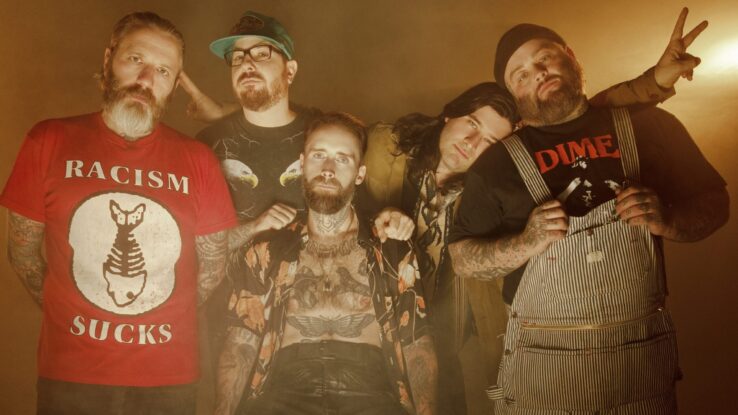
Ahead of a London arena show with Billy Talent in June, AOF's George Pettit looks back on their landmark third album Crisis 20 years on
Alexisonfire don’t normally glance backwards. During the St. Catharines rabble-rousers’ original stint from 2001 to 2011, they were in constant motion, touring the world incessantly while each new album made their take on post-hardcore more melodic and crowd-popping. It’s even been a similar story since their reunion in 2015: they may not spend 10 months a year on the road anymore, but 2022 comeback Otherness contains some of the most vast and accessible songs of their career so far.
As lead singer George Pettit joins me on a video call, though, he has to take an uncharacteristic look in the rear-view mirror. 2026 marks 20 years of the quintet’s landmark third album, Crisis, which thrust them to the top of the Canadian charts for the first time and boasts a lot of their most-loved anthems. The band are about to celebrate its platinum anniversary with a series of summer shows, including a Wembley Arena co-headliner with countrymen Billy Talent in June, where they’ll play it in full and bring out the rest of their greatest hits to boot. So, George and I talk about the story of Crisis, as well as how much Alexis disliked some of their “insincere” contemporaries, the ridiculous touring schedule the band had, and when they’ll release some long-awaited new music.

It seems like Alexis were weathering mixed fortunes in the lead-up to Crisis. Your debut album [2002’s Alexisonfire] was just certified Gold in Canada, but you also had to very quickly replace drummer Jesse Ingelevics with Jordan Hastings. In between that, you were touring pretty much nonstop. What was the mood in the band as you started writing Crisis?
Everything was moving very quickly. We were touring all the time, and then we’d come back home for a month and a half and make a record, and then go back out on the road. We had to kind of throw Jordan in at the deep end of the pool. He came out with us on tour, and immediately he took to the songs in a way we had never heard before. There was this air of excitement. When we got into our rehearsal space and started making songs, we knew what worked from our previous songs. We had stuff on [2004 album] Watch Out! that really resonated with a live audience, things that people could sing along to, and that informed the way we wrote Crisis.
The very first lyric on the album, on ‘Drunks, Lovers, Sinners and Saints’, is “This is from our hearts. Sincerity over simple chords.” It sounds like a punk-ish manifesto. Is that what it was?
Yeah. Crisis was us bucking against a lot of what was going on within the genre that we were grouped in, emo and screamo. There were a lot of bands that we perceived to be insincere in their approach. I felt like people weren’t holding artists to a higher standard at that period. That was us drawing our line in the sand with the first song.
What felt insincere about those bands?
We weren’t going to make a record with a bunch of obvious breakdowns or toe the line of what were the trends in emo so we could appeal to a wider audience. We were just like, “No. We’re going to do what we want to do!” We’d also just come off a tour with Hot Water Music and Planes Mistaken for Stars: there was a bravado to what they were doing, and it resonated with us.
Looking at the lyrics more generally, the album’s themed around different types of crisis. The title track is about the Great Lakes blizzard of 1977. ‘This Could Be Anywhere in the World’ is about not recognising your hometown anymore and ‘Boiled Frogs’ is about employers gradually taking away their workers’ benefits.
It’s a dissent record. And that was, again, us bucking against the times. There were lots of bands that were just party animals. We were still very much like, “We’re gonna dance,” but there was anger in what we were doing. There was this sensation that maybe everything wasn’t alright, and that was OK to write about. ‘This Could Be Anywhere in the World’, arguably our biggest song, is about seeing your hometown get worse instead of better, and I think that’s why it was successful. Everyone’s had that feeling at one point or another.
Were you an angry person in general back then?
I’m still quite angry. I think that the world is a beautiful place at times, and I think that, on the whole, people bend towards civility, but there are moments when I look at the world in contempt. At that time, that’s what was inside me. When it came time to write lyrics, I was quite contemptuous.
The Great Lakes blizzard is also all over the album imagery. The cover is a person with frostbite after that blizzard, but then you open the album and, in the liner notes, it’s children having fun in the same blizzard. I don’t know how involved you were in the visuals…
Very much.
Why did you put those juxtaposing pictures together?
“There was a book in my childhood home called White Death: The Blizzard of ’77 [by Erno Rossi] and it had these incredible, terrifying images. My aunts and uncles would tell me stories about a spot in Fort Erie where they had to dig to find the telephone poles. It was something that happened close to us, so these images of kids standing on top of a school bus and snow coming through a window into your living room, it all felt very ominous and kind of brutal. It went with the theme of Crisis. We went to great lengths to acquire the rights to the photographs. We went through the archives of local newspapers to find the original prints, so we could get the rights to use them.

And you went to those lengths just because they fit the album so well?
Well, I’ve always really liked the book. White Death was this almost scary book at my house growing up. I was always really moved by the photographs in it, so I think, in the back of my mind, I’ve always wanted to use that in some way.
Did Crisis debuting at No.1 in Canada feel like a big deal?
Already, we’d broken through a lot of ceilings with regards to what we thought we were capable of. Things kept going up and up, and Crisis was one of those moments where [we thought], “Holy shit! We’re a bunch of weird kids from Southern Ontario, who’ve been living in a van for a couple years, and now our record is outperforming major-label pop records!”
How did you celebrate?
I think we were on the road. [Laughs]
When the band broke up in 2011, you’d basically toured yourselves into the ground. So, during the 10 months you spent on the road after Crisis, how much of that was enjoyable, and how much of it was, “I’m beginning to feel the grind”?
It was enjoyable in that we were all enjoying the freedoms that come with playing in a touring band: travelling the world and drinking a lot. But, yeah, 10 months of summer vacation and being in a different city every day, I don’t think it was making us better musicians or better at being in a band.
It must make you a bit stir-crazy…
I remember, I think this was on the Crisis tour, being in the back lounge of a tour bus with my wife. We were watching a movie and somebody knocked on the door, and they were like, “You’ve got 15 minutes before you play.” I paused the DVD, went out of the bus and played this hour-and-a-half-long, raucous concert. And then I came back, we laid back down and I unpaused the DVD. My wife immediately looked at me and she was like, ‘I think there’s something wrong with you.’ [Laughs] I played this big, crazy concert and it was just, like, nothing.

When was the last time you listened to Crisis?
This year. We remastered it to do a vinyl pressing and I had to listen to it, start to finish.
Do you cringe when you listen to your old stuff?
Yes and no. There’s stuff that I would do differently now than I did then, and it’s mostly lyrically.
What Crisis lyrics would you fiddle with, given the chance?
I would fiddle with ‘Rough Hands’. I think it might have been a bit too earnest, and I could have done it a bit more artistically. I had an English teacher in high school that, one time, was picking apart something I’d written, and he was like, “Look at these cliches! These are things that people have said before. Someone has said this before, so don’t say it again.” That’s always been in the back of my mind every time I do anything.
As well as doing the Crisis anniversary shows, Alexis are working on a new album. Can you talk about your progress with it and what it sounds like?
A few months ago, we went to Sonic Ranch in Tornillo, Texas and we recorded a lot of songs, and then the boys went to L.A. and filled out the rest of it for a couple weeks. We’re currently mixing it. It’s in keeping with Alexisonfire, in that it’s a progression from our last record [2022’s Otherness] but still undoubtedly Alexisonfire. There are some moments where we take some liberties and draw from a lot of different influences that people might be shocked by.
What kind of influences?
There’s electronic elements to it. I think, equally, there are some of the heaviest songs we’ve ever written and some of the most beautiful songs we’ve ever written. A lot of thought and energy went into it. We’re at a place, writing-wise, where we’re all so open to each other’s ideas, but also, nobody’s too precious about their own stuff.