Interview


Stage Times
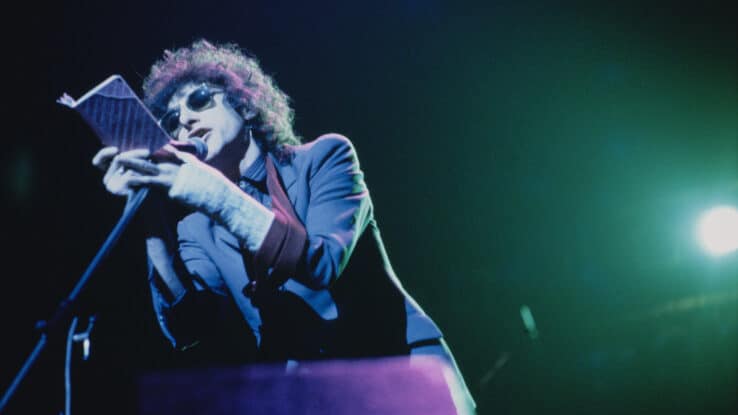
Dr John Cooper Clarke once took so much abuse he lasted just four minutes on stage
Ahead of Dr John Cooper Clarke's upcoming UK tour, the 'Poet Laureate of Punk' talks through his life and career in gigs
“It’s all apocalyptic in my eyes, to be fair,” is Dr John Cooper Clarke’s blunt assessment of modern life when asked for a figurative temperature check. Speaking to the venerated punk poet over the phone from his home in Essex, you can understand why said temperature check might’ve been taken literally given the umpteenth heatwave we found ourselves in on that day. Known for his sartorial standards, Clarke was very likely sat on the other side of the blower dressed head-to-toe in full dress. Come rain or shine – or in this case doomsday-nearing heat.
But modern life’s many failings acts as a continuous source of inspiration for Clarke, inspiration for his latest batch of poems which feature in his new book Have It which will be available on book shelves from Thursday 1 October. He’s set to take said words from his “the hermetically sealed incubator” of his own mind – via the page – to venues around the country soon after.
As his monikers in the ‘Bard of Salford’ or the ‘Poet Laureate of Punk’ would suggest, Dr John Cooper Clarke believes that poetry is the people’s form of expression, and it’s much more readily accessible and accepted than a myriad of other artistic disciplines.
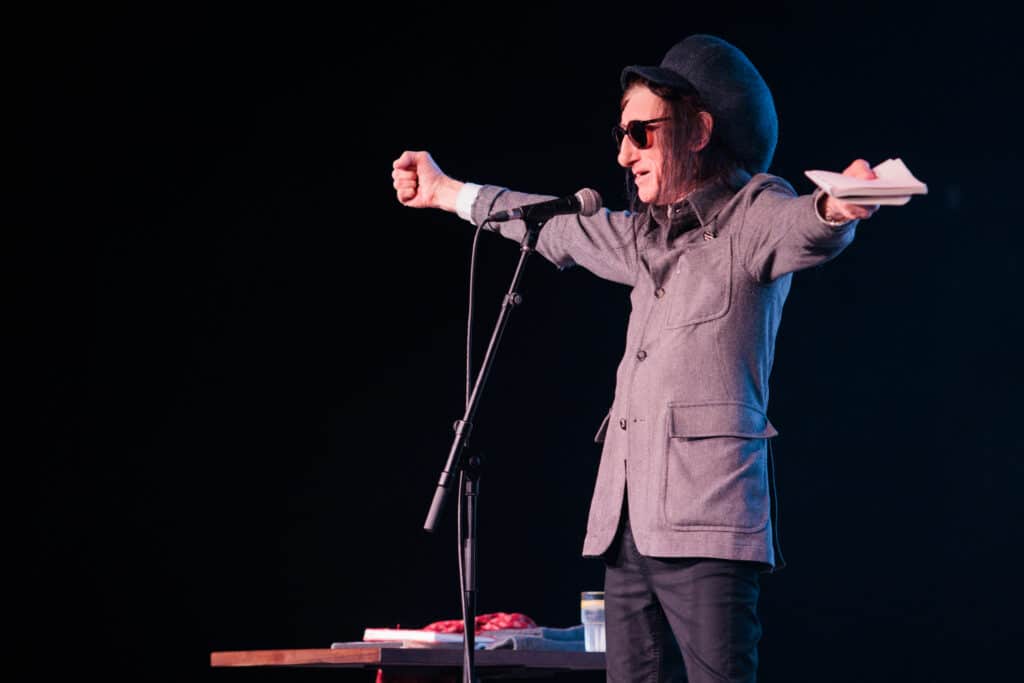
“I think the argument that people don’t like poetry is an urban myth,” Clarke insists. “It’s available to all. People might not paint a picture or play the guitar, but everybody gives it a go with poetry. On loved one’s birthdays or weddings, you know. Roses are red, violets are blue. I’ve always worked on the assumption that people only say they don’t like poetry. But not all poetry is as good as mine!”
Truesay, Dr John Cooper Clarke, truesay. The proof is in the proverbial pudding, given the Mancunian poet’s long and (mostly) illustrious career on stage.
Which is why we sat down with the ever-cordial Clarke ahead of his forthcoming UK tour to chat through his life and career in gigs: from his Beatnik beginnings to being spat at during the punk explosion, and from his four-minute catastrophe in Glasgow to his Arctic Monkeys-related resurgence that saw America embrace him as one of their own.
The gig that made you want to become a performer
I got the bug for being a one-man-one-microphone act from seeing Bob Hope, in 1958 at The Palace in Manchester. That’s where I lived then. There was only one guy in that building that wasn’t in hysterical laughter. That was Bob Hope. What a position to be in. I was nine years old then. All of his jokes were about divorce, alimony. The adult world. The American adult world. But I was a willing recipient of American cultural hegemony as a child. As was anybody else with any sense – and a television set.
I was a big fan of Bob Hope because of the Road movies. When I say Road movies, I don’t mean Easy Rider. I mean Road to Morocco, Road to Bali, those kinds of Road movies. Then I found out he was actually English. He said “I left England early on, when I realised I was never going to be king.” We didn’t use the term ‘cool’ in that regard back then, but if we did I would’ve said that Bob Hope is a real cool guy. All I knew of him before was his slapstick movies. But to see him live was a real treat. He was terrific. It was the best thing I’d ever seen. I guess that fed into my desire to become a performer, and for the use of comedy in my act, to make sure people are listening. As Confucius said a thousand years ago – or more – that excellence cannot be recognised outside of a tradition. I think I am part of that tradition.

The first
It was a benefit for a Beatnik comic. I did it for nothing. My dad was never encouraging about being a poet for a living. He’d never heard of anybody making a living out of poetry. He didn’t know much about that world. I mentioned a few names to him, like ‘have you never heard of Philip Larkin, poet laureate? He must’ve looked it up and made a few enquiries because he came back a day later saying ‘that Philip Larkin is a librarian. Making a living out of poetry? Forget about it kid!’ I was determined then though. I’ve spent my lifetime proving my dad wrong. One of my first gigs was doing a public recital in the Castle Hotel, which is now in the Northern Quarter in Manchester. He goes ‘how much you getting paid son?’ I said it’s a benefit for a bunch of Beatniks. There were some good acts on the bill. He wasn’t impressed though. ‘Anybody will employ you for free’ he goes.
How did Buzzcocks’ Howard Devoto convince you to start playing punk clubs?
Well, I kind of looked the part for the punk thing. There were only two sartorial rules in punk, emphasised by Johnny Rotten. ‘I’m a lazy sod. We don’t care about long hair. We don’t care about flares.’ I didn’t have long hair, or wore flares, so fit right in. Howard Devoto, who along with Pete Shelley, actually organised the Sex Pistols’ first show at the Lesser Free Trade Hall.
Was the punk crowd a little reticent towards your poetic stylings initially?
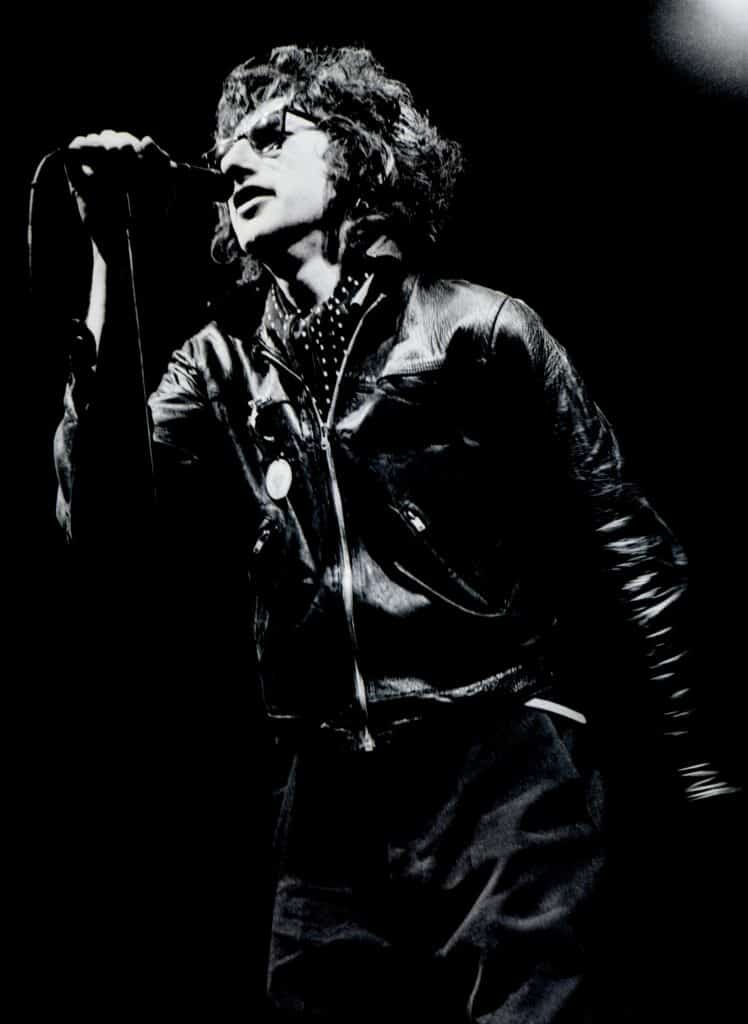
There was a lot of agg’ with everybody, I wasn’t the only one who suffered that. Everybody got a dose of it. Especially the gobbing situation. That was the worst. I used to dodge all the flying bottles. I wouldn’t have cared to have been hit by an airborne bottle. I was equally concerned about the gobbing part of punk shows. Thanks very much to the music journalist who posited that spitting at a performer was a mark of success. The bizarre, reverse world of punk rock where everything that was ugly was considered beautiful. Don’t forget, I was wearing sodding suits – which I hadn’t even finished paying for, and were getting covered in phlegm. My dry cleaning bills were prohibited. At one point I stopped wearing suits and started wearing a leather jacket. The spit was easier to wipe off, with a bit of Dettol.

The worst
That was obviously my four minute appearance at the Glasgow Apollo. I was kind of prepared for that one. It was my first tour of large halls, actual sit down theatres. That was a big gig then. If you think that Bruce Springsteen’s first UK gig was at the Hammersmith Odeon, you didn’t really get any bigger than those sort of places. The magnitude wasn’t what it is today. You were doing well if you were playing Hammersmith Odeon. But this gig wasn’t even with a punk group. I was a guest for a group called Be-Bop Deluxe. They were kind of proggy, with a bit of David Bowie. Glammy, sort of esoteric lyrics and musical proficiency. Punk rock didn’t sweep away all before it.
What made you leave the stage? Survival?
It was late on in the tour. Throughout the road crew would wind me up like ‘you’re not going to do Glasgow are ya?’ Of course I was. I was contractually obliged. ‘They’re going to fuckin’ kill ya’. I hoped it’d be a small venue I could forget about. But Glasgow Apollo was one of the largest venues there was, shadowed only by Brixton Academy. There were two balconies, it was huge. It had a lot of history. So, I came out, and it was just like they said it would be. I gave it four minutes. When the hatred subsided, I left. I was seen as the enemy of everything that audience held precious. I was a representative of punk rock. I remember a barrage of incomprehensible insults in my direction. But no spit! Sticks ‘n’ stones etc. At least I wasn’t injured permanently. I did four minutes, called it a draw, then fucked off.
The best
Getting on with the story, I thought I couldn’t leave it like that. Glasgow is a very important place. They should be introduced to my work. I wouldn’t let it lie. If I’ve ever done one brave thing in my life – which I haven’t – I got back on that bike. I thought within the year I’d do a successful Glasgow show. That was made possible by Elvis Costello and his people, when I went on tour with them and Richard Hell and the Voidoids. It was a punk rock, new wave night. Guess what? It was at Glasgow Apollo.
At least you got to exorcise those demons.
It was a big difference. I went back, and victory was mine. It went from the worst gig, to within a year, being the best. In terms of personal triumph. I never felt it as strong before. Now Glasgow is my favourite place in the UK. Or at least top three. It’s wild up there.
The weirdest
Somewhere English wasn’t the first language. Finland or Estonia. My show in Estonia, for instance, was in the afternoon. It was an outdoor thing, 2,000 capacity. I’m a night-time guy. Most of my career I’ve been a club entertainer, so haven’t started work till 23:30. Doing gigs in the daylight is still very strange to me. However, I have to get used to it doing the theatres that I am. In Estonia, I could see the entire audience – and nobody left in the hour I was on. They sat perfectly still. They were very appreciative. It was weird, in a good way.
Were they even laughing?
Oh yeah. They seemed to get it. That struck me as weird. However, not so weird when the entire world wishes to speak English. It is the lingua franca. It’s the language of international business, let’s face it. Victory is ours. If you’re going to be a poet, you need two things: the English language, and idleness. They’re prerequisites for a professional poet. You need those two components.

The biggest
Probably the Co-op Live arena [in Manchester]. That’s big enough. The more the merrier.
Did it feel like a homecoming of sorts?
I had that on my side. It’s almost a patriotic act in Manchester to be a John Cooper Clarke aficionado. I do feel cherished in that part of the world, even though I haven’t lived there for the past 35 years. I actually travel up to Manchester more than I used to. Well, Salford actually, because of Media City.
You are the ‘Bard of Salford’ after all. I know this technically wasn’t your gig, but you joined Arctic Monkeys on stage a few times.
I did. There was Earls Court in London. I also did a show with them in Queens, at Forest Hills Stadium. That was amazing because that wasn’t my audience. You can’t guarantee that everyone who loves the Arctic Monkeys has even heard of me outside of this country, even though my lyrics supplied ‘I Wanna Be Yours’. I can’t thank them enough. They improved my life no end those lads. I didn’t expect anybody to know who I was. I just MC’d for them, but they insisted I did the number. It was a real treat. I can’t remember whether I did the number or not. But they did know who I was, it was incredible. Every time my name came up it drew a unanimous cheer. To hear that in the States, from so many people, it was validation beyond belief. I’ve always loved performing in America. To have some kind of profile of America, I’ve always been desirous of that. There’s a lot of America about me and my stuff. Me and America belong together. Anybody else at my age with a television set was a willing recipient of American cultural hegemony. When it was at its height, anything that was worth anything was from America.
Before you stepped on stage with Arctic Monkeys, were you intimidated?
I was mainly worried about the crowd not knowing who I was. I didn’t think I’d get a bad time off of them or anything. It could’ve been ‘who is this guy? What’s he doing here?’ I’d hate that. But what a surprise. I never expected that level of appreciation from a crowd at Forest Hills Stadium.