Interview
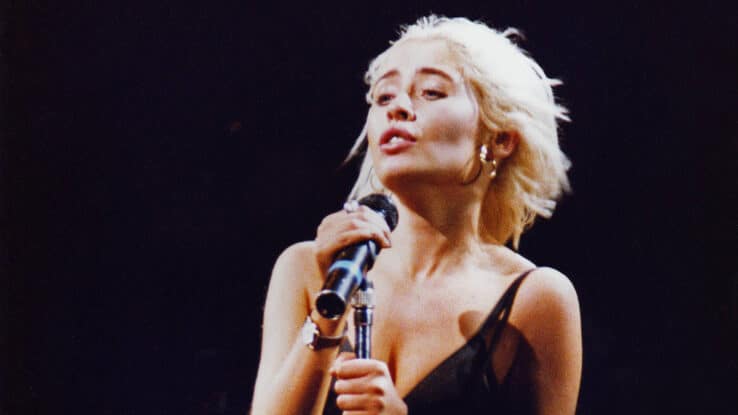


Interview
My Greatest Hits: Wendy James of Transvision Vamp
The Transvision Vamp icon talks us through her career highlights, from sneaking in to see The Clash to playing sold-out reunion shows
Long before Transvision Vamp became one of British pop’s most distinctive success stories, Wendy James was a teenage punk fan squeezing her way to the barrier of shows to catch a glimpse of her idols. Transfixed by the freedom, possibility, and self-invention that the scene represented, the frontwoman has spent the last fourty years building a career on that fascination.
Formed in London, Transvision Vamp exploded into the late ’80s with a sound that fused glam-pop immediacy and rebellious cool, turning Jams into one of British music’s most striking frontwomen in the process. Balancing glamour and grit, the band’s 1988 debut album Pop Art and its follow-up Velveteen introduced the world to chart-rising hits such as ‘I Want Your Love’, ‘Baby I Don’t Care’ and ‘Revolution Baby’, their rapid ascent spurred on by snarling attitude and irresistible hooks.

After the band’s 1992 split, James started over in New York, embarking on a solo career that led her to collaborate with countless of her musical heroes. In 2026 though, Transvision Vamp are finally hitting the road together again, reuniting for a run of shows across the UK this October.
Ahead of their return, we sat down with Wendy James to revisit the moments that brought her to this point – from formative teenage revelations and mind-boggling collaborations to sold-out shows on the other side of the world and the full-circle thrill of seeing fans still singing every word to these songs.
Seeing The Clash as a teenager
“I was underage, but I bunked in and managed to find my way right to the front of the stage. I didn’t manage to survive there for very long, maybe half an hour, because the crowd was such a heaving mass that I wasn’t able to breathe. I got hauled over the crash barrier by the people that were roadie-ing for The Clash.
“It was during the Combat Rock tour, and Joe [Strummer, frontman] had his mohawk. I came from quite a straight background, so seeing Joe with that haircut and so much passion signified freedom to me. Freedom to be what you want to be, how you want to be, and where you want to be. That was a watershed moment in my young teenage life.”
Moving to London and signing to EMI
“Everyone else in the band had been in punk bands before. They’d played at The Roxy, and they were all between eight and ten years older than me. When we got to London, we lived in Ladbroke Grove, just off Portobello Road. Our local pub was The Warwick Castle, and that was a very famous pub in those days. It was where a mixture of artists, writers, authors, actors, musicians, and all other high lives and low lives all mushed in together. It was a very inspirational kind of place, and there was a lot of cross-pollination.
“We signed our record deal with Dave Ambrose, who was the person who signed the Pistols at EMI Records. Nick [Sayer, founding guitarist] and I walked into EMI and demanded that the receptionist let us see Dave Ambrose, telling her that we were going to be the biggest band in the world. For some unlikely reason – and I doubt it would happen now – she ushered us up to Dave’s office. He listened to our little four-track demo tape that we’d made on a Portastudio and said, ‘Well, I think there’s something there.’
“He told us to go into the studio in the basement of EMI Records in Manchester Square, London. We fleshed out two or three songs down there and took them back to Dave a couple of weeks later. He said, ‘Yeah, I’m going to sign you.’”
Watching Top Of The Pops with The Clash

“We broke out with our third single from Pop Art, which was ‘I Want Your Love’, which charted at number five. As we gradually climbed up the Top 40, we did a few appearances on Top Of The Pops. I remember our first ever Top Of The Pops appearance. You would record it at about 4pm in the afternoon at BBC Television Centre, and there would be a crowd watching whoever was on the show that day.
“By the time it went out on air at 7pm, I was back in The Warwick Castle. I was very ebullient, saying, ‘We’ve just done Top Of The Pops, isn’t it amazing?’ And I was with Joe Strummer and Paul Simonon from The Clash. Joe, who knew a bit more about world travel than me at that time, slammed his hand down on the bar and said, ‘Barkeep, get this woman a whiskey, three fingers. American style.’ He said American style because there you measure your shots with your fingers up against the glass. That night, as Top Of The Pops went out, I was drinking whiskey with Joe. That’s how quickly the whole thing came around for us.”
Launching Pop Art in America
“I was flown to New York for the American launch, and I was given a banquet dinner with every surviving member of Andy Warhol’s Factory at the time. Sylvia Miles, the fabulous actress, was there, the film director Paul Morrissey, and Danny Fields – who managed The Stooges and is an icon of great American rock and roll.
“All the living members of the Factory threw me a party, and that’s how Pop Art launched across America. We became a successful college alternative indie band in the States. We would always have number ones in the college charts over there. We didn’t get as far as getting into the Top 40 Billboard charts – that was happening when we split up, funnily enough – but for those first two albums, Pop Art and Velveteen, we were one of those British bands they just couldn’t get enough of. Especially on the coasts, and weirdly in Texas. I always remember being in Amarillo and getting swamped by people. You just think, ‘This is bananas.’”
Causing chaos in Australia
“We’ve just got back from the latest Transvision Vamp tour of Australia, which was sold out. I love those Australians. The first time that we went there though, it was mayhem. We had to have police on horses for crowd control. There weren’t riots, and no one was violent, but it was a large crowd. We did some in-store signings in Melbourne, and there was like a football crowd on the streets, disrupting traffic and trying to get into the store.
“There’s a particular video clip that has gone viral again since we did the last Australian tour. In it, there’s one girl who just screams at the TV cameras, ‘They’re bigger than The Beatles!’ In her life, that’s what we were. I put it out on social media saying, ‘Wherever you are, please come to these shows again. I’d love to see you’.”
Playing Brixton Academy in 1991
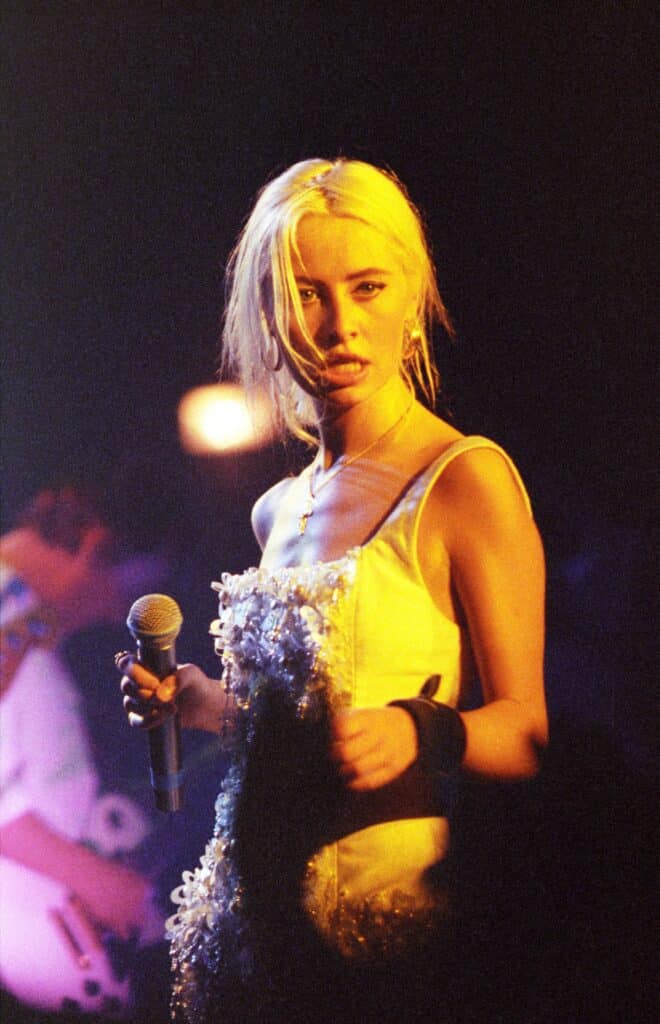
Photo by Pete Still/Redferns
“We reached a point where we could have played a couple of Wembley Arena shows, but instead I think we did three Brixton shows and three Hammersmith Apollo shows. Brixton Academy is one of the best venues in the world. It’s got a slanted floor, it’s built for the acoustics, and it has a brilliant wide stage so you can move around. It’s an iconic venue. Playing Brixton is one of the highlights of my life, for sure.”
Working with Elvis Costello
“Transvision Vamp were on our 1991 world tour, which took us around the globe twice that year. The third album was having more success in America than the previous two, but Nick and I were working like dogs. We were basically crawling into the venues because we were so tired. I don’t know where we were, but we sat down in a cafe somewhere and said, ‘We’ve got to call time on this.’ We didn’t have any management or an agent to say, ‘Listen, you guys are burnt out. Take a year off and just have a nice time. You’ve earned some money, take care of yourselves and see how you feel in a year.’ No one gave us that kind of talking-to, and we certainly didn’t give ourselves that kind of a talking-to.
“Consequently, we arrived in Hollywood, where we were staying at the Sunset Marquis Hotel whilst we did a residency there. I was in the bar and Pete Thomas, the drummer from Elvis Costello’s band, walked in. I knew who he was because we’d been on the same bill with Elvis earlier on that year. I just said, kind of conspiratorially, ‘I think Transvision Vamp is going to finish at the end of this tour in San Diego. Do you think Elvis would do anything?’ Pete said to me, ‘Well, why don’t you write him a letter?’
“So that very night, I wrote him a letter on Sunset Marquis notepaper. It said something to the effect of, ‘Hey, Elvis, would you write a song for me? Transvision Vamp is going to end, and I’m going to become a solo artist, but I’m not quite ready to do the whole move in one go. Maybe you could help me bridge this gap.’ I didn’t hear anything for a while, but then I started hearing murmurs from his publishers saying, ‘Oh, he quite likes the idea.’
“The band had split up in San Diego. When I got home to London and opened my front door, there on the floor was a cassette from Elvis Costello. Not only had he written one song, he’d written a whole album for me. I repacked my bags, flew to Los Angeles, and ended up recording that album [1993’s Now Ain’t The Time For Your Tears] with him.
“That was a really important moment in my life, but not so much for the album itself. What it did was mark out a clear crossroad in my life. From there on in, I decided that I would only write my own songs, my own lyrics, sing my own feelings, and sing my own thoughts. That album drew a line under that first chapter of my life.”
Moving to New York
“Even though I grew up surrounded by British punk, it’s actually the mid-’70s downtown New York new wave that I feel most connected to. Early New York Dolls, Patti Smith, what turned into the CBGB scene, what was Max’s Kansas City – that more spiky, angular, jagged new wave music – that is still my favourite touchstone. It’s where I go to start an idea.
“Just like anyone that travels to New York, when I first got there and walked along the avenues, looking at the skyscrapers and listening to the police sirens, everything looked like a Martin Scorsese movie. You really do feel like you can do anything.
“After I did that album with Elvis, when I had that little demo tape together, that’s when I sold my house, sold all of my belongings, and bought a one-way ticket to New York. I crashed on Transvision Vamp keyboard player Tex [Axile]’s sofa in the Meatpacking District for one month of November. He gave me one month to kip on his sofa while I pounded the sidewalks to look for an apartment to rent, and I found one.
“By the 21 of December, I’d moved into my own apartment, I’d ordered a mattress to be delivered, I’d had a big TV delivered, I’d got the cable hooked up, and on Christmas Day I was in bed flipping through US TV channels. It was the beginning of the best time in my life. It was freedom again. I wasn’t concentrating on the past; I had stepped into the future. I could make that future whatever I wanted it to be. It was one of the best decisions I’ve ever made.”
Recording The Price Of The Ticket with punk heroes
“On that album I got to work with James Williamson [guitarist, The Stooges]. When he had to go back to his band to do the Raw Power tour though, the guitarist that took over from him was Lenny Kaye from the Patti Smith Group. Lenny is like the soothsayer for all musicians. If you hosted a pop quiz on ‘name the B-side of that one-hit wonder from 1973,’ he’d know that.
“Jim Sclavunos, Transvision Vamp’s drummer, also plays on that album. As well as my old buddy from the very early days, Glen Matlock, the Sex Pistols’ bass player. Glen is just so impressive. You think of him as The Pistols, but he’s actually the most melodic Motown-esque bass player when he’s doing parts in the studio. His favourite bass player is James Jamerson, the session player for Motown.
“Making that album was just incredible. It was like, ‘Bloody hell, these are the guys I used to listen to, and here I am living in New York, recording with the very same people.’ I don’t believe in destiny or any of that stuff, but I was certainly in the right place at the right time with the right attitude and the right songs.”
Bringing Transvision Vamp back

“There was no plan. I think if I had put thought into it – like whether there was an anniversary coming up – it wouldn’t have happened like this. I had just released my tenth album in total, and my seventh solo album, The Shape Of History. I really wanted to get back to Australia, because Australia is one of the engines that changed my life and has always held me dear.
“I emailed a couple of venues, and the one in Melbourne replied to say they definitely wanted to do it, but that I wasn’t able to put together my own Australian tour. They put me in touch with a promoter, and he sent me a proposal. I was sitting at home, it was evening time, and he just said, ‘Let’s do it as Transvision Vamp.’
“The year before, when I had started going out gigging The Shape Of History, I needed a bass player. I’d always seen Dave [Parsons] whenever we played in the Bristol area, because he lives near there. He would always pop up to the shows, and it was always a joy to see him. It was always like it was yesterday. He’s the same guy, honest as the day is long. His bass playing is phenomenal, too. I phoned him up over Christmas, asked if he wanted to be the bass player, and he said yes.
“I put the idea of playing shows as Transvision Vamp again to the band and Dave, and it was an easy decision. From there, we were off to the races. The promoters did all the heavy lifting, booked these phenomenal venues around Australia, and six out of the nine Australian shows sold out. It’s been nuts ever since.

“I don’t know how many artists can do a comeback gig 40 years later and have a sold-out crowd. Whatever the reasons are, it was incredibly exciting to arrive in Sydney to the Enmore Theatre to a sold-out crowd. They were bonkers. It’s so special when you look out at the crowd and they’re mouthing every single word. It’s like they’re in raptures because they’ve sat in their bedrooms with that song for 35 years, and now they’re seeing it live.
“Hopefully the UK shows will have that same feeling. Transvision Vamp hasn’t been seen since 1991 here, and I’ve made a very good set list. It’s got every cut off the albums that has balls, attitude, and melody, as well as all the big hits. We are bringing it, and we’re not a polite bunch of middle-aged session players. We’re attacking these songs like 18-year-old mofos.”
Transvision Vamp tour the UK throughout October. Find all the dates, details and tickets here

Header image: Pete Still/Redferns