Interview
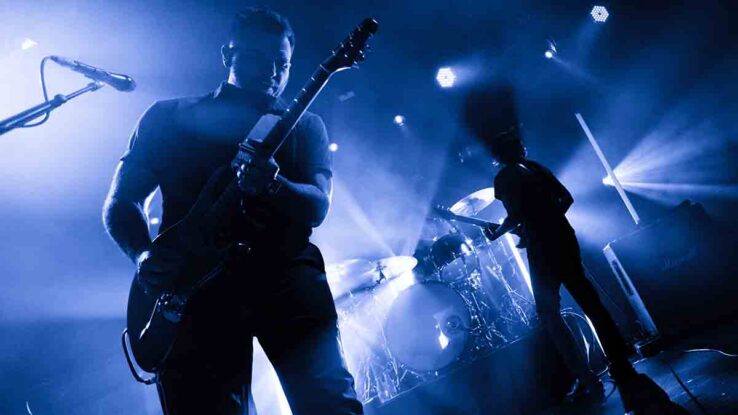


Thrice: “Songs don’t feel fully finished until you’re able to play them live”
Thrice frontman Dustin Kensrue talks new Horizons ahead of the band's upcoming UK live dates
A band who have spent their entire career refusing to stand still, Thrice are embracing a fresh form of reinvention with latest album Horizons/West.
Serving as a direct companion to 2021’s Horizons/East, it marks the four-piece’s most thematically focused era yet, transforming the image of a setting sun into a lens for mortality, fear, and the strange pressure of simply existing in the modern world. Capturing the growing confusion of our existence within bold, expansive rock songs laden with anger, frustration, and grief, it’s a record shaped by time as much as intention, driven by the commitment to evolution that has long fuelled the Californian post-hardcore icons.
With Thrice set to make their return to the UK for a run of headline shows in March, we caught up with frontman Dustin Kensrue to talk about the creation of album twelve, the band’s longevity, and why playing in front of a crowd night after night still deeply excites him.

Your latest full-length is a continuation from 2021’s Horizons/East. Was the plan always for there to be a West album, or did the idea reveal itself over time?
It’s kind of a weird setup. In 2021, we were making a record that was originally just called Horizons. We had a lot of ideas, so we thought that maybe we’d do two records – ‘East’ and ‘West’ – and separate their release by a couple of months. We thought it’d be fun, but we were so drained once we got done tracking the first record. We love the studio, but it’s so mentally taxing. We felt pretty spent, and we didn’t know if we had another album in us.
We decided to wait to record the second part of the album. There were ideas that ended up shifting over from that previous session, but 75% of the album is stuff that came from that time between. I liked knowing what was coming, lyrically and thematically, during those years. I was able to sit with it for longer, and that’s why I think Horizons/West ended up being one of the most thematically dense and consistent records we’ve ever done.
There are a few themes that run through lot of these songs, frequently coming back to the ideas of fear, mortality, and how we process reality. What sparked that lens for you?
It’s easiest for me to talk about the theme of the album through the image of a setting sun. That’s the central metaphor, and I end up playing with it in different ways on almost every song. A lot of it is about things progressing, and things ending. Mortality, death, and the unknown… Those things are naturally scary for us. The record plays with the idea of not looking away from those things and trying to integrate our feelings about them. It’s about trying not to run from them. I think that our fears are subconscious, and they end up driving us to do a lot of things. If we can see them, and sit with them, sometimes they can transform into something healthier and more hopeful.

You’re grappling with some of life’s biggest questions here, which as a songwriter must have its challenges. How do you fit those huge themes into a three-minute song without watering down their meaning?
It’s an interesting question, but I think part of it is just how I’m wired. These are the things I like talking about and thinking about, and I’ve kind of always been that way. It’s fun to be able to do it in a song, because people aren’t always ready for that in a conversation. I like the challenge of it too, and songwriting is a bit like building a puzzle. There’s something there even when you first start out, but it’s hard to see it take shape. You have to be patient and play with it. Artists will talk about how they’re discovering what they’re creating rather than actually creating, and I think there’s a lot of truth to that. As an artist, you have your own unique window that you’re able to see through. It takes time and effort, but eventually you’re able to see the thing that you’re supposed to see.
Sonically, the record has a real push-pull quality to it between volatility and space. When it came to the dynamics of these songs and how you wanted Horizons/West to sound as a whole, where were your heads at coming into this process?
To begin with, we came in and started wrestling with the ideas that we had in a live setting. It was just the four of us jamming. We had been working on gathering parts over time, but the process of us being together in a room and putting the songs together happened in a condensed period of about 20 days. We tried to use that compression to hold on to the spontaneity of the songs. There’s something visceral that happens when you start to play a song. You don’t know what you’re doing, and those instinctual qualities take over. Sometimes, as you work on a song over a long period of time, you lose bits of that. We were trying to jam on it, record it, listen back, and find those things that were exciting and interesting. We looked for those things that we wouldn’t have thought to play, but that our bodies somehow knew to play. I think that had a big impact on the energy of the record. Even the slower songs still have a different energy than the songs on East, and I think that’s why.
Were there any particular tracks that helped frame the album early on in the writing process?
We did know fairly early on that the record would start with ‘Blackout’, that ‘Gnash’ would be track two, and that it would end with ‘Unitive/West’. That gave us a good framing for everything else around the album. Knowing how the record is going to be ordered is always the hardest part for me, but creating in such a condensed time period helped somewhat. The songs were living together very presently with us, floating in the air around us.

You produced the album largely in-house, with the four of you taking the lead. What does doing things in that way offer you that working an outside producer might not?
I think there is a fluidity in getting to certain ideas, a shared language that we all have. When you bring someone else in, it can give you something to learn from, but there’s an efficiency that comes with just the four of us handling it. There’s a lot of trust that we have built up over time, and we know how to capture the energy we’re trying to find. A lot of it has to do with not trying to get everything perfect, too. We learned early on that doing that only builds this weird wall of perfection, and it just doesn’t sound or feel real. When you go for a good vibe, rather than the perfect take, those good vibes come together and create something that feels exciting, real and human. Everyone’s on the same page in seeing that as the goal.
Over the last few years, you’ve spent a good amount of time revisiting older material. You celebrated the 20th anniversary of The Artist In The Ambulance with a rerecorded version of the album, and you also played some shows to mark 20 years of The Illusion Of Safety. Did that affect your headspace going into this record?
Yeah, I’m sure it had an impact. It’s hard to nail down the specifics, but I think we all felt that there was something special about revisiting those albums and playing those songs again. There was a natural reintegration of these ways of thinking and playing that we hadn’t approached in a long time. I have a buddy who listened to the new record, and he said it sounds like Thrice ‘reintegrating its shadow’. I thought that was pretty accurate. We were able to reapproach some of those things in our own way. It didn’t feel forced, and it didn’t feel like a gimmick. We weren’t just doing what somebody else wanted us to do. Because of that, we didn’t feel all the weird little things you often do about art you created a long time ago. There wasn’t any shame or embarrassment, we were just able to see all the goodness there. Some of that naturally came back into this album, and I’m sure it will continue to have an impact on us going forward.
You’re returning to the UK this spring for a run of headline shows. After releasing twelve albums, how do you even begin building a setlist for a tour like this?
We try to find a balance. We play what people are hoping to hear, we try to represent the whole catalogue, and we try to satisfy our desire to play new songs. At the same time, we also have to think about the flow of the set and all of our tuning changes. I would not be able to do it at this point without an app called BandHelper. I’ve got the times, the songs, and the tunings all colour-coded on there, and it’s a huge help. It’s still a daunting task though. This current set we’re doing has a lot of new stuff in it. It doesn’t have any nostalgia to it yet, but it has just felt great. I’m looking forward to bringing it over to the UK.
You’re bringing Lysistrata out on this run too, who are a fantastic French band. What made you want them on the bill?
I don’t know how he ended up hearing about them, but that was thanks to Teppei [Teranishi, guitarist]. He found them, and brought them up in conversation, not in relation to the tour but just to tell us to check them out. We all listened and thought they were cool, so when this tour came up, we asked if we could take them out. It ended up working out. We’re really excited to have them on the shows.
We’re swiftly approaching three decades of Thrice, which is a monumental achievement. After all these years, what still keeps playing shows exciting for you?
For me, it’s about active creation. Songs don’t feel fully finished until you’re able to play them live for people. That’s when the creative process feels complete. When we’re writing, we’re often thinking about how it’s going to feel in a room full of people. Often, that will spur you to try something you might not have thought of otherwise. Touring can be a total drag in a lot of ways, but playing shows is always something that we love and cherish. That part never gets old.
Thrice play Manchester, Glasgow, Nottingham, Birmingham and London this March. Find tickets here

Photo credit: Aldara Zarraoa/Getty Images