Interview


Interview
Chalk: “We wanted to be bold and push stuff to the extreme”
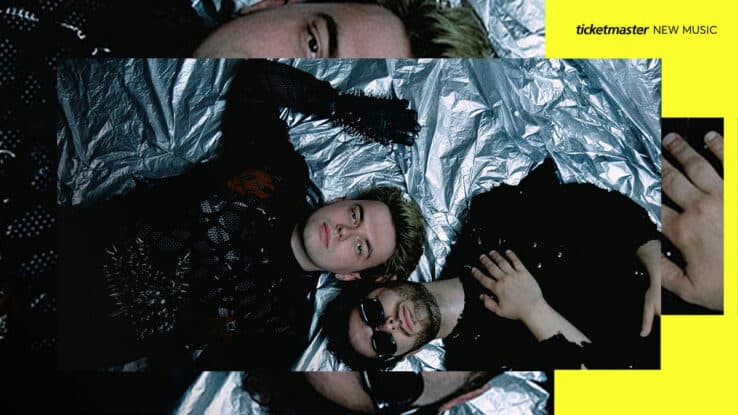
Ahead of their UK tour in April, the Belfast dance-punks discuss brave decisions, national identity and the visual world of their debut album
Belfast is the beating heart of Chalk. The city where Ross Cullen (vocals) and Ben Goddard (guitar) met as film students is recognised by name – in the Irish language – on their debut album Crystalpunk through penultimate track ‘Béal Feirste’, an eight-minute trance marathon that offers their answer to Underworld’s ‘Born Slippy’.
“It felt like that song was the song that all the other songs actually fell under,” explains Cullen, who is enjoying talking about the album to process things out loud. “A lot of the songs are quite autobiographical and with the context of being and living here, that is a song about what that can feel like today, or for people across different time periods in the country.”
Since forming in 2019, Chalk’s story so far has propelled them out of the post-punk box into an enthralling crossover act who bridge that gap with the electronic world. Across a trilogy of EPs titled Conditions, they found their feet with guitar music before nosediving into a universe influenced by Bicep, Death Grips and The Prodigy that they treasure so dearly.
Having recently supported Fontaines D.C. and as they gear up to join IDLES this summer, the timing of Crystalpunk’s arrival is impeccable, especially considering they have a fully-fledged UK tour earmarked for the spring. Chalk told us about the inspiration behind the album, the origin of its artwork and why the band is such an important vehicle for expression.

How are you feeling in the build-up to your debut album?
Ben Goddard: This is truly one of the flagship moments in your life, your debut album – there is no understating it. I remember being in an indie-pop band as a kid, talking about what it would be like to release a debut album, and this is 10 years later, which is actually mad to say. Because it’s getting closer, maybe I’m starting to feel a bit protective over it. I still haven’t quite figured it out yet!
What’s the story behind the spiky hand on the artwork? You’ve worn that glove on stage, Ross, and we’ve seen a similarly spiky head on the single artwork for ‘Pain’.
Ross Cullen: I wish we could say it was this planned symbol, but it actually revealed itself beautifully, because when we were doing costume designs with Lucinda Graham for the ‘Pain’ video, she had designed these gloves. We were looking at these Siberian bear suit spikes. The crystalpunk, the character, had these spikes, and then I would have these gloves. There was a shot of a glove, and I flipped it, put it in Photoshop and messaged our photographer.
She shot the actual hand that you see in the artwork, on the day we supported Fontaines, in the dressing room. The idea of a hand, something bold, appealed to us. It beautifully revealed itself, because we had no idea what was going to be, and then all of a sudden, it’s the symbol and aesthetic of the video.
Ben Goddard: There was a responsibility on the [‘Pain’] video to help establish a new aesthetic that we’ve been working on. There’s something about the simplicity of it, a means of encapsulating the [world of Crystalpunk]. A crystal is very beautiful, but it’s also very sharp. The spiky glove and shiny spikes, it’s almost crystal-like, it’s an emblem of the album as a whole.

Do you see Crystalpunk as a genre in itself? Do you think we’re going to see a whole wave of crystalpunk bands off the back of this album?
Ross Cullen: We’re trying to start the wave! It’ll be one of those Spotify Wrapped genres…
Ben Goddard: People found us quite hard to describe, and we found ourselves a little bit difficult to describe. When we first started out, we were very much ‘post-punk’, it was a lot more traditional, but then [came] the dance elements, industrial, techno, all these different things. Early on in the process, there was a fear that maybe the album wasn’t traditionally cohesive. But whenever we started calling it Crystalpunk, [it removed] a lot of doubts or second guesses. It has actually been quite a powerful word for us throughout the process, and really was the anchor for everything.
Despite that shift in sound you mention, ‘Longer’ might be the most traditional rock song you’ve ever written. How and why did that come about at this point in your career?
Ben Goddard: It came from a riff that Ross had for a while, but it never really fit, because it’s our most out-and-out rock song, so it was hard to make something of it. We really had to allow ourselves to lean into the rock elements that we drifted away from, but then from leaning into them, finding a way to push through and go somewhere we’d never gone before, maybe that’s what it took to resolve it. Like a lot of stuff for the album, we want to be bold and push stuff to the extreme.
‘Béal Feirste’ lasts for eight minutes, centred around lyrics like “Keep on going” and “Standing shoulder to shoulder”. What was it about the song that warranted the breathing space you’ve given it?
Ben Goddard: Before ‘Béal Feirste’, I feel like we’ve tried to achieve something like that before and failed. The idea of a more epic track has been around for a while, and it took the album to be the home for that. That’s the beauty of an album, [unlike] EPs, it could maybe allow for a bigger piece. For some people, it’ll definitely be the heart of the album. It is one of the times we most expressly state what we want to say with the album. Even though it’s the second-last song, it feels like a crescendo of what we’ve been leading up to.
Ross, you speak about communicating what it feels like to live in Belfast today, and also for past generations. Is it challenging to convey such a complex timespan of meaning throughout one song?
Ross Cullen: I’ve learned to be aware of the history of somewhere, keeping one eye on the past, but also one eye on the future. That probably goes the same for our influences. We’re proud to say who our influences are, but we also want to push boundaries and not sort of play the same [game as other artists]. I want Chalk, to be playing a whole different kind of game, and that was the point of the album: to challenge ourselves, take a few risks, maybe exist within this lineage of Irish acts to come out, but it would be nice to be known for doing something that was a little bit more unique.
Ben Goddard: The album is about identity, and ‘Béal Feirste’ especially is an ode to Belfast and where we’re from. There is a spoken word line in it: “The Irish don’t want us / the British don’t want us”, and it’s the north of Ireland identity, feeling unwanted by both sides, and how that perception shapes your own national identity. And then words like“shoulder to shoulder”, that song is about forging your own identity. Coming together and breaking the mould, or going against what was done before, is resistance in its own way. Choosing love is a radical thing to do.

Where are you both at with your own sense of national identity, if the takeaway is to try and forge your own?
Ross Cullen: We’ve been talking about it more than ever in the last few weeks… your heritage, not really knowing where to exist. For us, it’s a religious thing, coming from a family where my mum was raised Catholic and my dad was raised Protestant. I had a Protestant education, and none of them were ever trying to force any religion or ideology on me. I came to it myself. At the moment, I don’t necessarily think I need to be either, but I can maybe create my own identity and just be Irish. That’s something I’d be cool with calling myself.
Ben Goddard: I was born in London, moved to Monaghan at three years old, went to school in Armagh, but then we met in university in Belfast. I’ve been this complete mixed bag of identity, even my accent is a bit weird, and people have always found it very hard to place where I’m from. I’m in a similar boat with Ross, where I just feel Irish. I do feel Irish when I leave the country, and I take a lot of pride in being Irish. But it’s a mixed bag for anyone. It’s not a very straightforward thing, and there can be a lot of baggage with that. The album has been us figuring out what that is, and that’s not necessarily the easiest thing to talk about. But I certainly feel a [safety] and pride in calling myself Irish.
After writing the album, is there a comfort that you don’t need to have anything fully figured out, but instead, it’s purely about expressing it through the songs?
Ben Goddard: Chris [Ryan], our producer, his partner has a good line about this. If you can’t figure out exactly what you want to say [in a song], that’s what music and art is for – expressing it. Even if you find the words difficult, if you don’t have the concrete message, that completely validates your art. It’s the actual art of expression. Even though we come at it from a personal aspect, it is a shared experience. It’s personal when you listen to it by yourself, but when you play it live, you are putting it out there for people to take in.
Chalk will tour the UK from 22 April to 16 May. Find tickets here
Crystalpunk is out 13 March on Alter Music. Preorder and buy here