Interview


Interview
Bria Salmena: “I like to make a crowd feel uncomfortable. It’s funny to me”
Before joining Wolf Alice on tour, Salmena reflects on her steely stage presence, finding her voice as a solo artist & her friendship with the Mercury Prize winners
It’s been a journey for Bria Salmena to become, well, Bria Salmena. At least in terms of the way she wanted to express herself on debut album, Big Dog.
Having previously fronted post-punk outfit FRIGS before finding a day job playing with hunky country music enigma Orville Peck, Big Dog signposted the end of a difficult era for Salmena. Conceived with longtime collaborator and compadré Duncan Hay-Jennings, the album pulsates with a simmering rage, heart and grit akin to Sharon Van Etten’s finest efforts. Anchored by her peerless voice, Bria’s cavernous vocal proved to be a rich asset to plunder, ensuring Big Dog broods with something altogether more gothic – and more evocative than anything she’s ever recorded.
Having brought it to UK stages with a series of sample shows at The Great Escape back in May, the Canadian artist is preparing to tour with Wolf Alice on their forthcoming UK arena throughout November and December.
We caught up with Bria to reflect on Big Dog, her steely stage presence, carving out her identity as a solo artist, and her friendship with the Mercury Prize Award-winning band she’s hitting the road with.

Why did Big Dog feel like an appropriate title for the album?
Truthfully, I didn’t want to call it Big Dog. At the time we were completing the recording, I was going through a lot of personal crap. My band mates said this album was me taking back autonomy and doing things for myself. They said “you should call it Big Dog” as that was the original title for the song ‘Hammer’. I guess they convinced me to do it. They helped me take my power back, in terms of being proud of what I was doing. It felt like the final step for me to go and deal with what I was dealing with, to jump out of it.
There’s a real sense of momentum and intention throughout Big Dog, but the album feels to me like a document of you pulling away or leaving something behind.
A lot of artists have to do that as a coping mechanism. In that way, for me, there’s a barrier of protection from the situation via the songs.
You’ve previously spoken about Toronto’s DIY scene being overlooked, and it’s evidently intrinsic to your identity as a musician. That said, was it tough pulling yourself away from your city when you relocated to LA?
Yeah, for sure. I’m actually in Toronto now. I flew here on Tuesday. I think about this a lot when I come home. Ultimately, I do live in Los Angeles now, but for how long is undetermined. I feel more of a sense of home there, but when I do come back to Toronto I feel relaxed. I can’t tell if that’s just leaving the US and there’s a built-in tension that we carry in our bodies. Everything I work on creatively happens more naturally here, it feels more organic. I was with Duncan yesterday working through songs, and I was playing guitar in a way that I haven’t for a while. It felt very free form. Things just aren’t as dire here. I do feel very connected. It’s nice to come back and remember that.
Did living in LA help you move away from the period in your life you were writing about?
I don’t think it helped me move away from it. I wrote a lot of the record in LA. I needed to leave Toronto at the time that I did, as I’m curious about experiencing new things and putting myself in uncomfortable situations.

After FRIGS came to an end, what was the process of finding your voice as a solo artist like?
It was really interesting. FRIGS, we do have a lot of unreleased material we’re thinking about releasing next year, so I’m not sure it’s entirely over. Having worked Orville Peck between FRIGS and my solo project – as much as I was the lead singer of FRIGS and there was a lot of my expression in there, and my voice – it was nice to take a step back and participate in a group where I was singing and had input creatively. But it wasn’t my show. It allowed me time to reflect on FRIGS and think about what I wanted to do, and be, as a solo artist. I still haven’t figured it out. It’s an evolving thing. But I wanted to dive into my singing more, and lean away from the screaming sh*t I did in FRIGS. I didn’t want to sing twangy sh*t like I did with Orville either.
Speaking quite literally about your voice, what kind of impact did your sessions with Meg [Remy of U.S. Girls] have in revealing something deeper or richer in the way you deliver your vocals?
I’ve known her for a long time, but working with her made me think about my vocal performance in a way that I hadn’t before. I feel silly and a little stupid not really conceptualising that recording is a permanent performance. She really encouraged me to go into my feelings. Which is something I didn’t want to do, because of what I was dealing with. Like I said, those songs created a barrier for me, but she was like ‘no, you have to dig in there’. It was nice to have a vocal producer focusing on those elements of the recording. I wanted to think about myself as a different kind of singer, and that was the overarching goal with this record.
Going from FRIGS to playing with Orville Peck is a real sonic shift. They’re two very different beasts to contend with. Did you have much of a connection to country music before that?
I used to play in folk bands when I was in my early twenties. When I was younger, I’d listen to everything and absorb everything. The first records I ever bought were a Billie Holliday record, [Bob Dylan’s] Nashville Skyline, and a Ramones record. I played them all on one of those sh*tty Crosby suitcase record players.
It was exciting to work with Orville, though. When Orville Peck started it was just a bunch of punks cosplaying as country musicians. That was part of the fun. We could bring a lot of that energy to country music. It was just funny to us, to think people thought we were pulling it off.

How important was the Cuntry Covers project in leading towards Big Dog?
Really important. That gave Duncan and I an opportunity to explore what we wanted to do that was sonically different to FRIGS. But whilst we were in this country world, because of our day job with Orville Peck. We could do this on the side, during Covid, which was fun without putting the pressure on us to create original music straight away while we were experimenting sonically. Cuntry Covers Vol.1 I didn’t even think I’d release. I thought I’d just throw it up on Bandcamp, make a zine. The whole project came from creative boredom. Duncan and I, and his partner Jamie, just living together on this farm was a real marker of a very special time. When we started working on Cuntry Covers Vol.2, Duncan and I thought we’d break away from the acoustic sonics we had access to. We wanted to experiment more, to step back into the FRIGS world and pool our resources.
How did Lee Ranaldo get involved on the record? Have you always been a fan of Sonic Youth?
Big fan of Sonic Youth. That was kind of crazy. We still haven’t met in person – I guess we all live remotely now. My manager actually had the idea to ask Lee Ranaldo to play on ‘See’er’. He was down. He just cold call emailed him and asked to play on the track, and he was like ‘hell yeah’. That was a big deal for us, we were super excited. He sent so many stems, he sent so much stuff. We were going through it like ‘oh my God, this is so good’. It added a chaos to the track that we wanted. Sonic Youth was hugely influential in my early twenties when FRIGS started, so it was full circle.

What artists were important to you becoming a musician yourself?
If I’m being completely honest…. The real reason I even started playing guitar was because of Brody Dalle, from The Distillers. It’s not something to be embarrassed by. But that was the beginning. I’d been singing for a long time, but when you’re growing up in the 90s you’re either pop or soul. Or like 50s crooner classics. If you’re a girl you’re a pop singer. When I was seven that’s what I thought I was going to be. When I was about twelve a friend gave me a Distillers record and it blew my mind. I hadn’t heard a woman express themselves like that before. It was eye opening. It opened so many doors to Hole, Patti Smith. Then it unravelled and I just wanted to play guitar. Brody was the reason I started playing guitar. I’m interested in anybody that’s really expressive as a singer, women especially. I’m more drawn towards female voices. I’m very fucking picky when it comes to male singers. She was it for me.
I remember seeing the ‘City Of Angels’ video where she’s got thick black make-up that looked like bruised eyes, and her aggressively spiky hair. She looked like she’d kick the sh*t out of you.
Yeah.
I saw you perform at The Great Escape earlier this year and you were electric. Did you always know what your stage persona was going to be like, or is it a byproduct of your commanding voice?
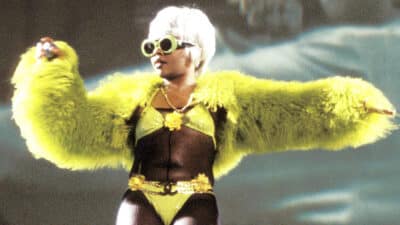
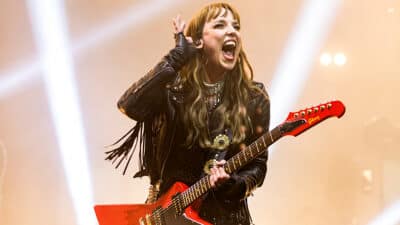
I learned a lot by playing with FRIGS. Being in my twenties and playing guitar music like that, then focusing on singing, I figured it out. It definitely was scary. There’s this feeling like you have to move a lot more. It’s like people who can’t handle silence between tracks. There was a lot of experimenting to see what I was comfortable with. Now I feel like in some ways I’ve been re-learning what this project is in a live setting and how to express myself, as I don’t necessarily want to fall into the FRIGS space. I have another project called God’s Mom which is just electronic music and vocals, and I don’t want to rip from that. It’s been a journey figuring out how I want to express myself, but ultimately I’ll just feel it out. It depends on the show. For that show [at The Great Escape] in particular, we were playing on the floor and there was someone *this* close to my face. Which I love. I love those types of shows because you have this power over people which feels really exciting. I love to take advantage of that. I like to make a crowd feel uncomfortable. It’s funny to me. At that show I went into the crowd at points just like ‘f*ck this’. You had to be in and out so quickly, so you just move into the chaos.
You do have this intense stare which definitely rattled people.
It’s f*cking fun to be able to do that to people. It’s the only time in my life when I can do that, so I take full advantage.

You’re about to tour with Wolf Alice. But you’d befriended Ellie long before you were announced as their tour support. What’s the story there?
I first met Wolf Alice – well Ellie and Theo first – through a really good friend of theirs Cal McRae, who was the band’s first manager. He introduced us. It was purely because we were in London so much [with FRIGS]. I forget why they asked us to tour. We toured with them in the States, when Cuntry Covers Vol.1 came out. I think Joff actually had a hand in that. Obviously we were friends, but I was like ‘why do you want me to open?’ That’s the fun of being in bands, you get to pick who you want to be on tour with.
Ellie’s a dear friend. They were in LA a lot last year recording The Clearing. I knew a lot of the lore but hadn’t heard any of the tracks until they released it. I feel like this record, the songwriting is crazy. Every record they get so much better.
They always pull out some surprises. ‘Bloom Baby Bloom’ is wild.
When ‘White Horses’ came out I was like ‘wow’, plus having Joel sing. It feels like they went into this recording with a clear idea of what they wanted out of it, and it shows.