Feature


Interview
Zach Zucker: “My greatest dream is to be regarded as a modern day court jester”
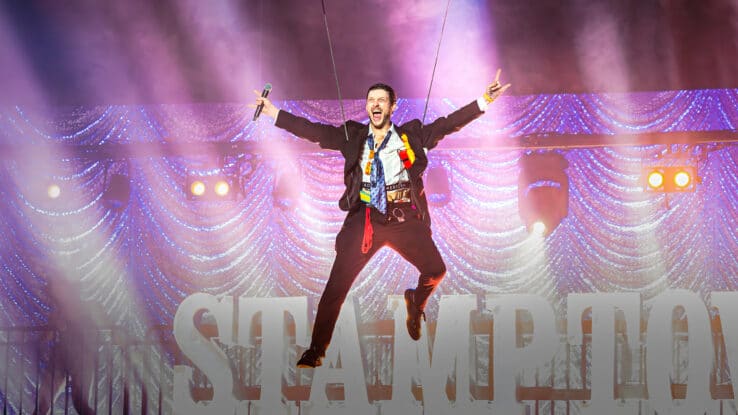
As the “sexy, skilled and stupid” variety show Stamptown hits London for three nights only, we speak to its ringleader about clowning, embracing failure and the joy of never knowing what might happen next
In 2014, two young performers crossed the Atlantic to attend a clown school in the small town of Étampes, near Paris. Jonny Woolley was an aspiring theatre-maker from Ontario; Zach Zucker a Chicago kid with big sports prospects but other ideas about performing. They hated each other.
“I would be like, ‘Who is this annoying Canadian guy?'” recalls Zucker, “and he’d be like, ‘Who is this annoying American guy?'” But they would begrudgingly connect over a shared love for hip hop and comedy, and under the tutelage of Philippe Gaulier – the revered, red-bespectacled master clown and pedagogue who died in February this year – they would become inseparable, forming a creative partnership that would take them across the world. “I think maybe now it’s evened out,” Zucker says, “but there was a time where he and I shared the same bed more than either of us were in bed alone or with our loved ones. We’re in each other’s brains.”
Alongside peers such as director Dylan Woodley and Norwegian clown Viggo Venn – the latter would go on to win Britain’s Got Talent in 2023 – the duo’s collaboration eventually became Stamptown, its name a nod to the place where they met and learnt their trade. First starting out in small Los Angeles venues before earning a residency at the Edinburgh Festival Fringe and performing in over 15 countries, Stamptown is a raucous variety show with a surrealist, punk energy running through it. Despite its international reach, its following is often described as cult-like, but with their first Netflix special released in August, perhaps that’s set to change.

I meet with Zucker a couple of days after the special’s premiere at the Edinburgh Fringe, where they have a handful of shows left. He looks exhausted and his voice sounds like it will go at any time, and if you’ve seen Stamptown you’ll understand why. Hosting the show as his sleazy alter-ego Jack Tucker, the clown spews bawdy jokes, rug pulls and all sorts of tics and stims in sync with Woolley’s board of sound effect interruptions. Their years of performing together make this chaos feel weirdly slick, but often they’re actually messing with each other. “He always says he gets a perverse pleasure for putting me in the shit, putting me really up against the wall,” laughs Zucker. “You have two idiots playing jazz music with each other, thinking they’re both in control, and we can both trigger the other person to do it. So it’s absolutely a double act. It is the special sauce to all my performances.”
That willingness to throw each other off balance is, perhaps, the essence of the clowning Zucker learned at Gaulier’s school. Outside the context of the Fringe, it feels like the concept of the clown is perhaps misunderstood or reduced to the image of a kids’ party entertainer making balloon animals. I’m curious of the status of the art form in 2026, or at least Stamptown’s take on it. For Zucker, it is less about a particular style of comedy than a willingness to embrace and upturn fear and failure, a desire to be bold and uninhibited. “All choices are made in the pursuit of creating the greatest live experience unique to this one moment, this one night, and you do it through a place of love and playfulness. I love the unknown, and I dare to always remain in a place of never knowing, so you can keep always being, you can keep always surprising yourself and keep always learning. With that approach, it’s not about how we feel, it’s about how the crowd feels. It’s what the crowd wants. It’s an active service.”
In a show drowning in bathos and delighting in drawn-out fever dreams and interruptions, the very concept of failure is stretched and remoulded in realtime. “Everyone can be good at being good, but if you can be good at being bad, then you’re at least entertaining and watchable,” he argues. “That is the core DNA for me of all this, that at any moment, things can change. You have to be a fatal optimist where any moment, no matter how bad it’s going, just around the corner is the joke that’s going to save the show. If you approach things with that lightness, that stupidity, that beaming idiot smile, it’s not guaranteed, but maybe, just maybe, it just might work.”

Of course, playing with the concept of failure is made easier when you have a cast of world class performers. The goofs and the antics might push and prod you, but this is ultimately a vaudeville variety show with seriously impressive acts. During one night of the Fringe run I see a woman swallow three swords, while later a juggler spinning four bamboo umbrellas with her feet leaves me spellbound. When looking for potential Stamptown acts, Zucker and the team follow a catchy mantra: “We say the holy trinity for what we’re looking for is like sexy, skilled, stupid.”
Beyond the neat catchphrase, Zucker wants Stamptown to be a space where performers can try something they can’t fit anywhere else, a dream they’re not telling us. Where Gaulier would say “put your guts on the table,” his student offers an updated take: “I want you to put your whole pussy behind it and I want to see your balls. I want to see everything you got. It doesn’t mean literally – it’s the fake spiritual pussy and balls that you have as a performer where if you don’t do this, you will die from the inability to express yourself this way.” One such performance that embodies this spirt is by English comedian Jordan Gray, whose closing song on the Netflix special lays everything bare about the trans experience. It’s a radical and liberating performance, one that should be experienced, not described. Zucker knew at once it had to be the finale. “How don’t you f*cking give this person this opportunity in this space? Tell me who else it should be? Because I’ve seen everything around the world for the last 10 years and that is the best piece ever.”
Gray’s performance is joyous but also dynamic and tender, and doesn’t necessarily always call for the clapping and whooping that Zucker demands as the ringleader of this circus. At times, I find myself caught in that gap: dumbfounded silence giving way to the realisation that I am supposed to cheer. It is a small dissonance, but one Zucker recognises too. “My dream is to have the same level of noise that we have, but built in with more musical rests that are intentional silences,” he admits, “because you don’t want it to just ga ga ga ga over and over. You’re watching people push the boundaries of what are our limitations, or what we think is societally possible that humans can do. You see something that you’ve not only never seen before, but you’ve never conceived of being possible, and so you might not always know how to react.”
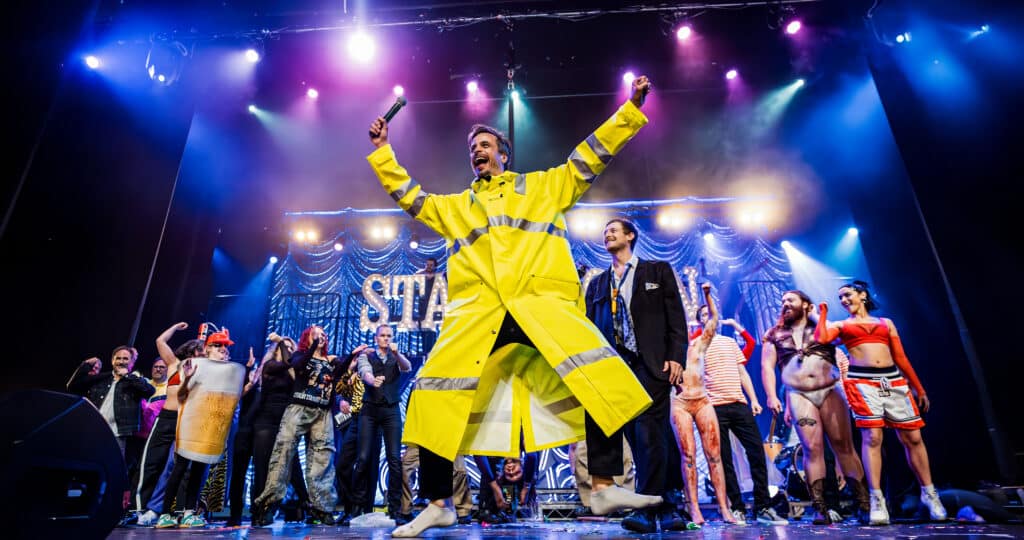
But perhaps dissonance is also entirely the point. Chaos is Stamptown’s stock in trade, and in the carnivalesque upturning of worlds that Zucker and his crew seek, isn’t it natural to for our expectations to be jarred and jolted? “My greatest honour, my greatest dream in life, would be to be regarded as like a modern day court jester who has the jester’s privilege to say whatever the fuck they want to whoever they want, and not just to cause problems, but to speak power to moments as they present themselves. Whether that’s doing the stupidest thing or throwing in a little bit of vulnerability, your job is there to relieve tension and make people feel better. At our best, that’s what we do. We show folks you can live this way, and hopefully some of these principles are transferrable to your life.”
Stamptown comes to the Soho Theatre Walthamstow, London, 3-5 September – find tickets here